


WTSD
WTSD (Went To Showdown) is the percentage of hands a player takes to showdown after they have seen the flop. It signals how often someone folds turns and rivers versus how often they keep paying off to see cards. WTSD is most useful read against VPIP, PFR, and an aggression stat, not on its own.
WTSD (Went To Showdown)
What WTSD measures
WTSD is the percentage of hands where a player reaches showdown after they have seen the flop. It uses postflop hands as the denominator, not all dealt hands. Forced folds before the flop do not count, and hands that end on the turn or earlier knock the count down. If a player sees 100 flops over a session and reaches showdown on 28 of them, their WTSD for that sample is 28.
WTSD is not a decision rule. It is a frequency that tells you how often an opponent stays in pots long enough to turn cards over, which is a proxy for how willing they are to pay off marginal hands and how easily they fold turns and rivers. The same number can describe a careful caller who only continues with real equity and a loose station who refuses to fold once they have seen a flop. Reading WTSD well means reading it against the rest of the HUD panel.
Related terms
- VPIP: the loose-or-tight read; pairs with WTSD to separate folders from stations.
- PFR: preflop initiative; tells you what kind of postflop range is showing up at showdown.
- HUD: the overlay that displays WTSD next to the seat.
- Showdown: the event WTSD measures arrival at.
- Showdown value: the hand-class concept that explains why some players fold WTSD-eligible hands and others call them down.
- Calling station: the high-WTSD archetype.
- Nit: the low-WTSD archetype.
- Aggressive regular: often a moderate WTSD with a strong AF.
WTSD vs W$SD (Won Money at Showdown)
WTSD is half of a two-stat pair. The other half is W$SD (Won Money at Showdown), the percentage of showdowns the player wins. They share the same hands as the underlying universe, but they answer different questions.
| Stat | What it counts | What it tells you |
|---|---|---|
| WTSD | Of the flops you saw, how many reached showdown | How often the player fights all the way to the river |
| W$SD | Of the showdowns you reached, how many you won | How strong the player’s range is when they do show down |
| WTSD/W$SD pair | The two read together | Whether they are getting there often with strong hands or often with weak ones |
A high WTSD with a low W$SD points at calling too wide. A low WTSD with a high W$SD points at folding too tight, getting to showdown only with the top of range. A moderate-of-both player is closer to the balanced postflop profile most regs aim for. The mistake worth avoiding is reading WTSD without W$SD next to it; the percentage on its own can describe two opposite players.
Poker Skill keeps no opponent stats, but its Give Up on Purpose lesson trains your side of this balance, folding queen-high that missed everything to a turn bet while a pair of jacks calls.
Reference ranges in 6-max cash
These bands are common reference points for 6-max NLHE cash at about 100 big blinds. They are guidelines, not laws; every game is different.
| WTSD band | Profile | Notes |
|---|---|---|
| 0-22 | Tight folder | Gives up turns and rivers fast; rarely shows down without near-nutted holdings. |
| 22-28 | Standard reg | Balanced postflop; folds the river when the line says fold. |
| 28-32 | Sticky reg | Calls down with bluff catchers more often; harder to bluff thin. |
| 32+ | Station / call-down | Calls down too often; thin bluffs get looked up fast. |
Two caveats sit on top of those bands.
Format and stake matter. Live full-ring runs higher across the board because more multiway flops mean more cheap showdowns. Online 6-max compresses the bands. Tournament WTSD drifts with stack depth, especially as antes pull players into more multiway pots in the middle stages. Anchor the read to the format you are looking at.
WTSD is a long-converging stat. It fires only on the hands a player saw the flop on, which is roughly half the rate VPIP fires. A clean read needs more hands than VPIP/PFR does. The bands above assume a sample large enough to trust; small-sample WTSD is closer to noise than signal.
When WTSD matters most
A few situations put real weight on WTSD over other reads.
- River bluffing decisions. A 22 WTSD opponent folds rivers more readily than a 32 WTSD opponent. The same line can work against one profile and get called quickly by the other.
- Thin river value bets. Against a high-WTSD station, you can value-bet thinner because they call wider; against a low-WTSD folder, you have to size up or check back to keep their fold range narrow.
- Bluff-catching decisions. A high-WTSD player fires fewer credible bluffs because they are not the kind of opponent who turns showdown-value hands into bluffs. Their river bets are more often value; bluff-catching gets harder.
- Profiling new opponents. Once VPIP and PFR have settled, WTSD is the next stat to read. It separates the loose-aggressive openers who give up postflop from the loose-passive openers who do not.
WTSD tells you less in a few specific spots.
- Tiny samples. A 50-hand WTSD is noise; the player has only seen a handful of flops, and the stat is whatever the cards dealt happened to do.
- Short sessions on a multi-tabling opponent. WTSD averages across all your data on the player; a recent shift in their game (tilt, a new study session, a different sleep state) is invisible.
- Multiway pots versus heads-up pots. WTSD does not separate them in most HUD configurations. A player who plays multiway pots loose and heads-up pots tight will look moderate overall.
Example: same VPIP, different WTSD
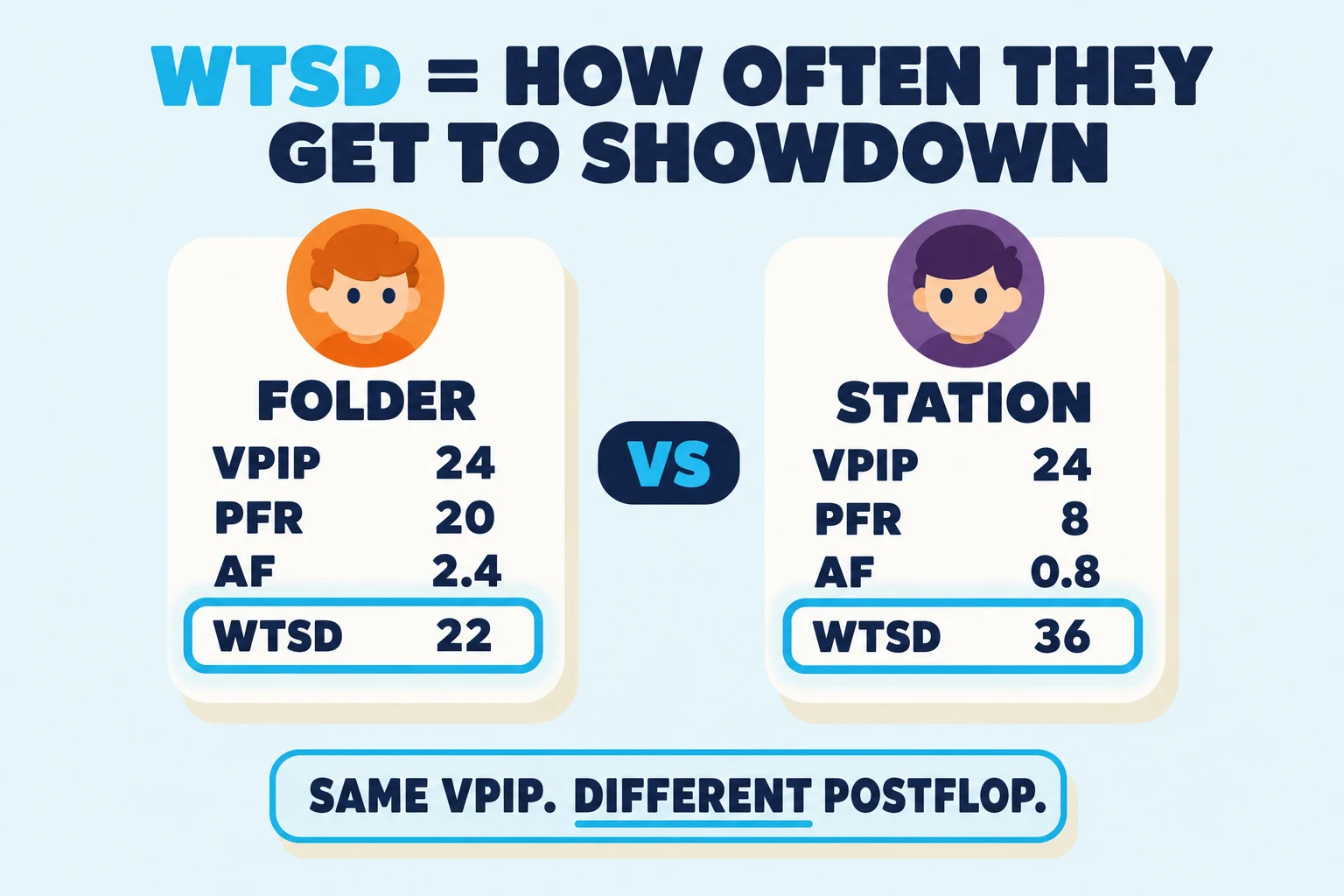
You sit down at a 6-max $1/$2 cash table with a real sample on two opponents. Both show a VPIP of 24 over a few thousand hands. The other panel numbers split them.
- Player A: 24/20, AF 2.4, WTSD 23, W$SD 53.
- Player B: 24/8, AF 0.8, WTSD 36, W$SD 42.
Player A is a balanced active regular. They open most of their range, three-bet healthily, and fold turns and rivers when their hand does not earn the call. WTSD 23 with W$SD 53 says they get to showdown rarely and win when they do — a tight postflop profile with selective calls. Bluffing Player A on a third barrel is a real tool; their fold-to-river-bet is implied by the WTSD on its own.
Player B is a passive limp-caller. Their VPIP and PFR look similar to Player A’s at first glance, but the gap and AF tell a different story, and WTSD confirms it. WTSD 36 means they are reaching showdown on more than a third of postflop hands. W$SD 42 says they are getting there with weak hands often enough that they lose more than they win at showdown. Against Player B, thin value rules and bluffing thin loses; the WTSD pair is the cleanest single read on that adjustment.
Two players, same VPIP, opposite postflop game. WTSD pulls them apart in one glance.
Common mistakes when reading WTSD
1) Reading WTSD without W$SD next to it
A 30 WTSD with a 40 W$SD is a station who pays off; a 30 WTSD with a 56 W$SD is a sticky caller who arrives at showdown with reasonable hands. Same number, different player. Always read the pair together. If the HUD panel only displays WTSD, treat it as a soft prior and lean on AF and fold-to-river-bet for the rest of the read.
2) Trusting a small sample
WTSD fires once per flop seen, not once per hand dealt. That makes it slower to converge than VPIP or PFR. A 200-hand WTSD is essentially noise; meaningful reads need a few thousand hands. If the badge is built on a thin sample, treat the bands above as a wide error bar, not a fine measurement.
3) Confusing WTSD with overall passivity
A high WTSD does not automatically mean a passive player. A loose-aggressive opponent with high VPIP and high AF can also show a moderate-to-high WTSD because they are firing big rivers and getting called or calling raises with their own bluff catchers. The stat reads the same; the game is different. Always layer AF and the preflop pair on top before drawing the conclusion.
4) Ignoring multiway versus heads-up
Most HUDs display a single WTSD that pools heads-up and multiway flops together. Multiway pots reach showdown more often by their nature: more players, more eyes, more cheap calls. A player who shows a 30 WTSD in mostly multiway sessions is not the same as a player who shows a 30 WTSD in mostly heads-up pots. If your HUD breaks this out, prefer the heads-up version for postflop reads where you are the only opponent.
FAQ
What is a normal WTSD for 6-max cash at 100bb?
Most balanced 6-max regulars sit around 23 to 28. Below 22 reads as a tight folder who is giving up too easily on turns and rivers. Above 32 reads as a station who pays off too often. These bands are guidelines for cash; live full-ring runs higher because of cheaper multiway showdowns, and tournament WTSD drifts with stack depth. The number tells you how often the player gets there, not whether their style is winning at the stake they are playing.
How is WTSD different from W$SD?
WTSD is the percentage of postflop hands that reach showdown. W$SD is the percentage of those showdowns that the player wins. WTSD is a frequency stat about how often they get there; W$SD is a strength stat about what they have when they do. Read together, the pair separates a high-WTSD station from a sticky caller who shows up with bluff catchers, and a low-WTSD folder from a tight-aggressive reg who folds correctly.
How many hands do I need before WTSD is reliable?
WTSD only fires on hands where a player saw the flop, so it stabilizes more slowly than VPIP or PFR. A few hundred hands is rough cluster only. A few thousand hands sharpens the middle of the spectrum where most regulars live. Below a thousand, treat WTSD as a soft prior alongside AF and fold-to-river-bet, not a fine read for thin spots where being wrong by five points changes the right line.