


Wheel
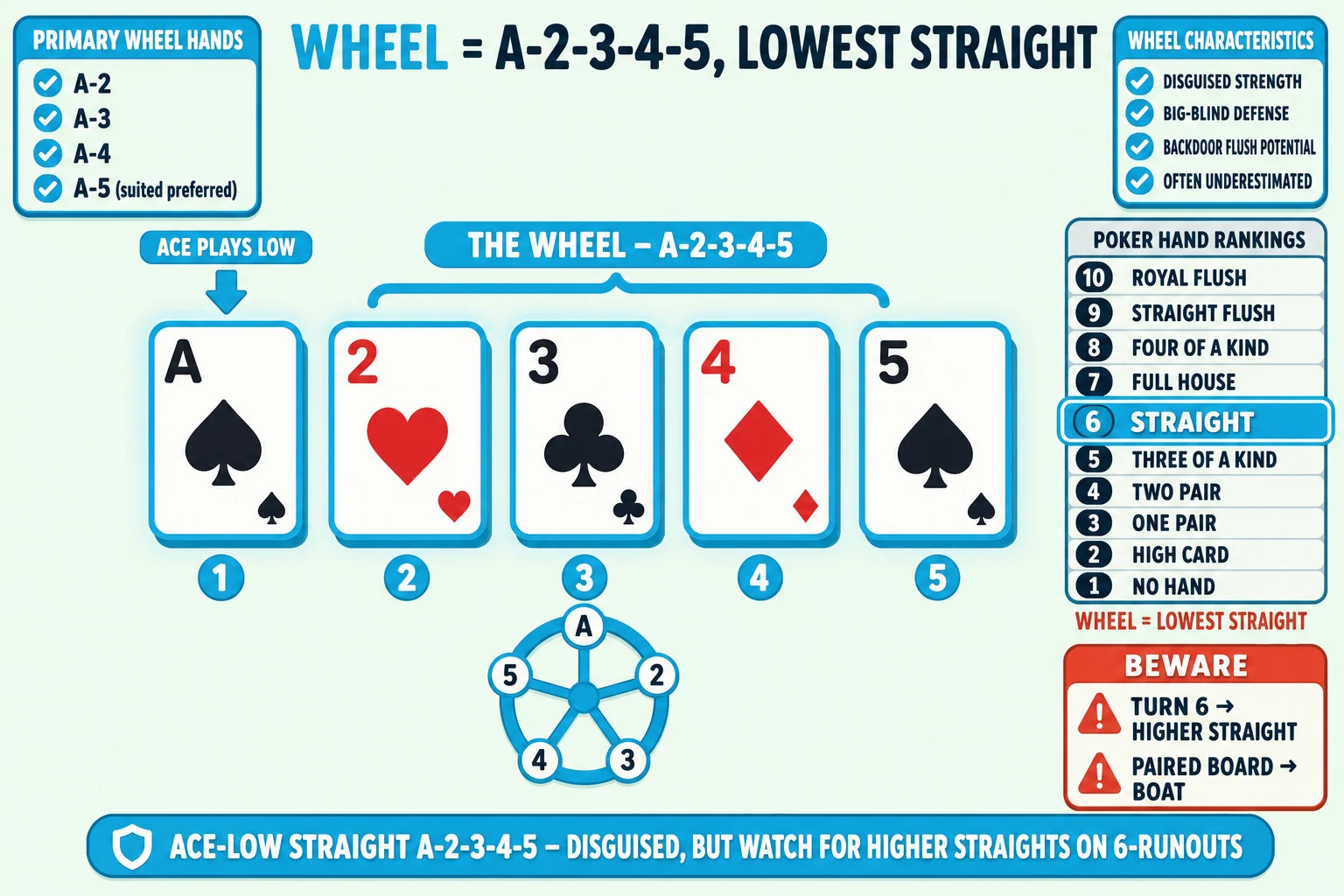
The wheel is the lowest straight: A-2-3-4-5, with the Ace acting low. It ranks as any straight, but opponents often overlook low straights while chasing highs or big pairs. The wheel often emerges from seemingly weak starters like A-2 through A-5, giving it surprise value. For example, holding A♠2♠ on a 3♣4♦5♥ flop gives you the wheel and many opponents will underestimate that hand. (Glossary: a straight is five consecutive ranks; an "out" is any card that improves your hand.)
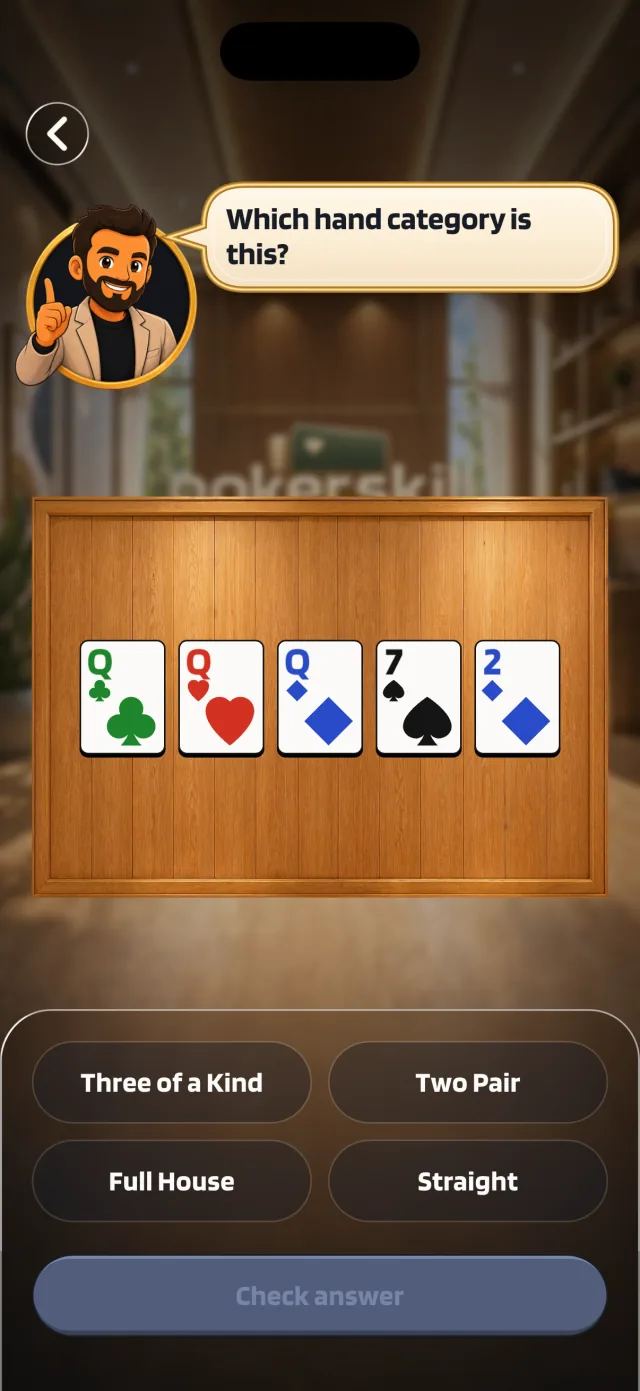
Practice this in Poker Skill. The Winners in Context capstone shows the wheel’s weak spot at showdown, where it loses to a hand holding the six that makes 2-3-4-5-6.
Get the free appThe Wheel (A-2-3-4-5) in No-Limit Texas Hold’em
What the wheel is and why it matters
The wheel is the lowest straight: A-2-3-4-5, with the Ace acting low. It ranks as any straight, but opponents often overlook low straights while chasing highs or big pairs. The wheel often emerges from seemingly weak starters like A-2 through A-5, giving it surprise value. For example, holding A♠2♠ on a 3♣4♦5♥ flop gives you the wheel and many opponents will underestimate that hand. (Glossary: a straight is five consecutive ranks; an “out” is any card that improves your hand.)
Which hole cards make wheel draws and why they’re playable
Primary wheel makers are A-2, A-3, A-4 and A-5; suited versions add flush potential. Suited A-2 through A-5 offer straight draws plus immediate or backdoor flush redraws. Backdoor flush means you need both the turn and the river to complete a flush.
Examples:
- A♠2♠ on a 3♣4♦5♥ flop gives you the wheel instantly.
- With A♦5♦ on a 2♣3♠K♠ flop you have four to the wheel and four outs. If suits align you also retain backdoor flush possibilities.
Use these hands for big blind defense and late-position opens; they disguise strength when they hit and retain drawing power when they miss.
Preflop strategy: when to include wheel hands in your range
Include suited A-2s-A-5s routinely in big blind defense and in balanced late-position open ranges.
Practical steps:
- Big blind versus a single raise: defend A2s-A5s more often than offsuit versions, since suited hands play better postflop.
- Late-position opens: include them to balance high-card ranges; they can win big pots when they make disguised straights.
- Facing aggression: prefer suited versions; offsuit A2-A5 depend on stack depth and opponent tendencies.
Deeper stacks and multiway pots increase implied odds, making speculative wheel hands more attractive.
Postflop play: extracting value and protecting the wheel
When you hit the wheel, don’t assume automatic value; always check the board for higher straights or heavy draws.
Guidelines:
- If you make the wheel on the flop, be cautious if the turn is a 6, since that card opens routes to higher straights.
- When drawing, leverage implied odds in multiway pots: calling with A5s on a 2-3-K flop can be correct with deep stacks and many callers.
- With suited wheel draws, size bets to create fold equity but avoid overcommitting on dangerous textures.
Extract value from one-pair and two-pair hands while protecting against coordinated boards that favor higher straights or sets.
Vulnerabilities and common mistakes with wheel hands
Common errors:
- Overvaluing a made wheel on coordinated boards; later 6s or 7s can produce higher straights.
- Calling down against heavy action without accounting for sets or two-pair that can dominate you.
- Ignoring opponent ranges; if a line represents top-end straights, fold more readily.
A made A-low straight is strong, but not invulnerable.
Applying math and reads: pot odds, implied odds, and opponent awareness
Use pot odds - your call size relative to the pot - to decide drawing calls. Use implied odds - expected future winnings - to justify speculative A-2-A-5 hands, especially deep-stacked and multiway.
Factor reads:
- Versus calling stations, implied odds increase because they’ll pay you off when you hit.
- Versus tight, linear raisers, tighten up; they often show sets or higher straights.
Always read the board for coordinated straight or set possibilities before committing chips.
Quick checklist
- Know that A-2 through A-5, suited preferred, are the primary wheel makers.
- Include suited wheel hands in big blind defense and in late-position opening ranges.
- Always assess pot odds and implied odds before committing to wheel draws.
- Check board texture for higher straight or set threats after making the wheel.
- Use bet sizing to protect made wheels and extract value from weaker holdings.
- Avoid overcalling when the board strongly favors higher straights or sets.