


Straight
A Straight is five cards in sequential rank, for example 6-7-8-9-10, suits ignored. Suits don't matter, so 6♠7♦8♣9♥10♠ counts as a Straight. It beats three of a kind, two pair, and single pairs, but loses to stronger made hands. Stronger hands include a Flush, Full House, Four of a Kind, Straight Flush, and Royal Flush. A Straight is a mid-strong hand; it wins many pots but remains vulnerable to stronger hands and draws.
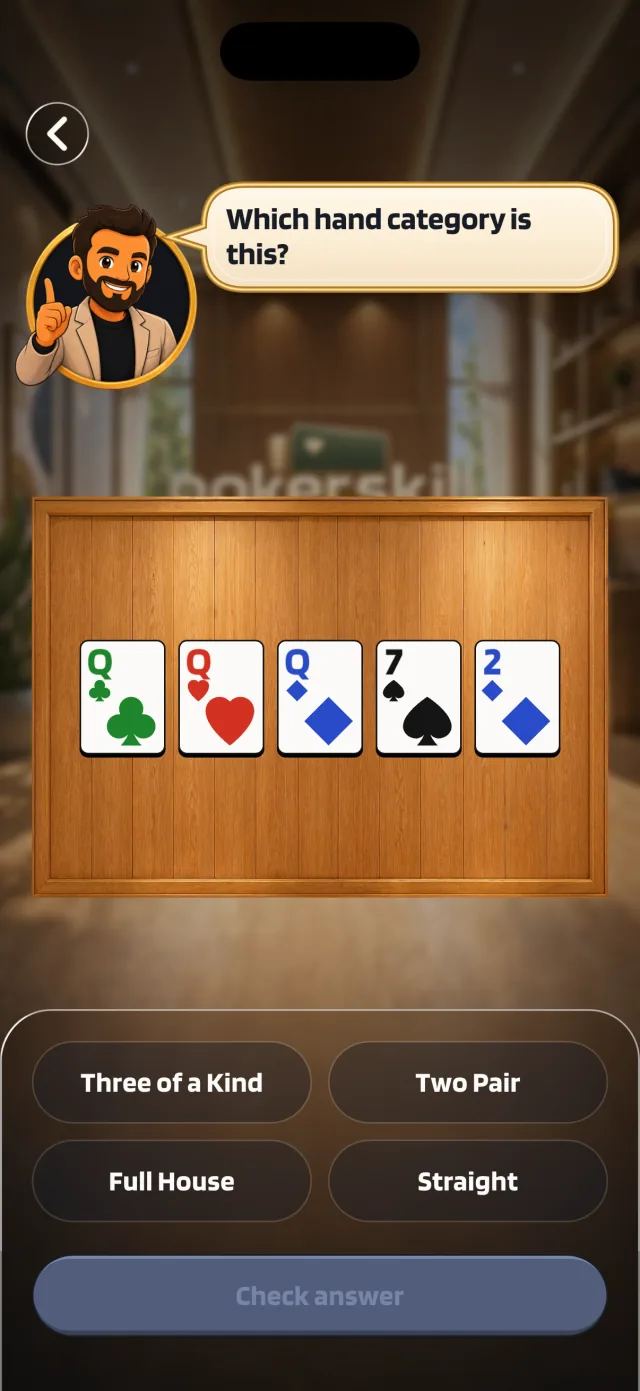
Practice this in Poker Skill. The straight is sixth of the ten hands on the hand rankings chart, directly above three of a kind and directly below the flush, and a Hand Ranking Drills question has you pick the flush over it.
Get the free appStraight (No-Limit Texas Hold’em)
What a Straight is
A Straight is five cards in sequential rank, for example 6-7-8-9-10, suits ignored. Suits don’t matter, so 6♠7♦8♣9♥10♠ counts as a Straight. It beats three of a kind, two pair, and single pairs, but loses to stronger made hands. Stronger hands include a Flush, Full House, Four of a Kind, Straight Flush, and Royal Flush. The next rung up is the flush in poker, which beats any straight. A Straight is a mid-strong hand; it wins many pots but remains vulnerable to stronger hands and draws.
For the full order of hands, odds, and tie-break examples, see the poker hand rankings chart.
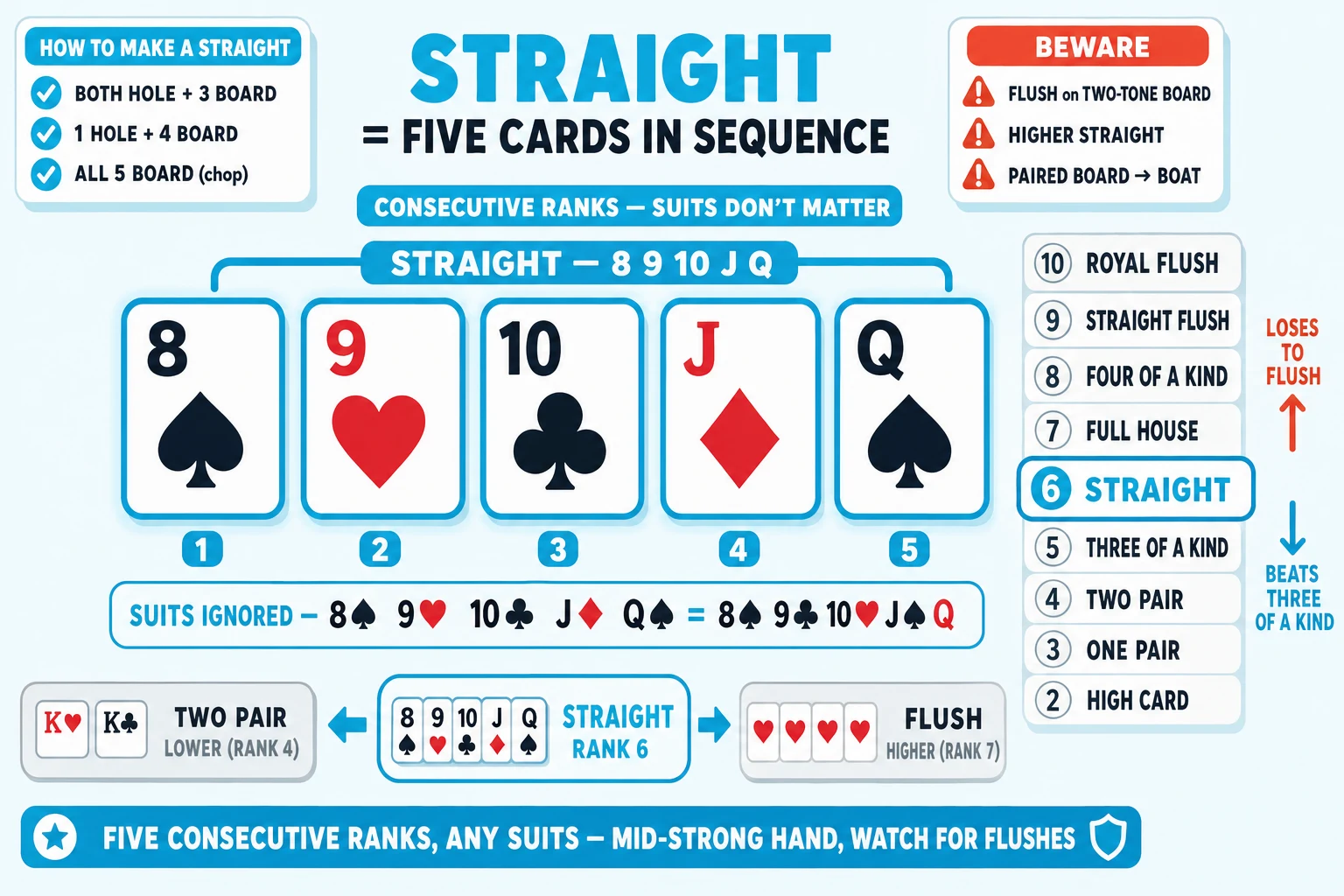
How a Straight is formed in Hold’em
You make a Straight from any mix of your two hole cards and the five community cards.
- You can use both hole cards plus three board cards. Example: with K♣9♣ and 10♦ J♥ Q♠ 2♣ 7♦ on the board, you make a K-high Straight (9-10-J-Q-K).
- You can use one hole card and four board cards. Example: with 8♠ and 5♦ 6♣ 7♥ 9♦ K♣ on the board, 5-6-7-8-9 makes a 9-high Straight.
- You can use zero hole cards if the five community cards form a Straight; then all players share it.
Straights can complete on the flop (first three community cards), the turn, or the river as the board develops. Multiple players often arrive at the same Straight, especially when the sequence appears largely on the board.
What beats a Straight
Hands that defeat a Straight include:
- Flushes (five cards of the same suit).
- Full Houses (three of a kind plus a pair).
- Four of a Kind.
- Straight Flushes and Royal Flushes (sequential cards of one suit).
If the board shows three suited cards, a Flush is possible; if the board pairs, a Full House may form on later streets. Always check for these possibilities before assuming your Straight is best.
Board texture and Straight vulnerability
Board texture describes how the community cards interact. Connected boards, for example 7-8-9-10-x, raise the chance multiple players share a Straight or someone makes a higher Straight. Boards with three cards of the same suit are dangerous because a Flush can outdraw your Straight.
Example: on 8♣ 9♦ 10♣ J♣ 2♠ the sequence 7-8-9-10-J makes a Straight, but three clubs allow a Flush to beat it. Evaluate whether your Straight is the best hand or only marginally ahead.
Strategic play with a Straight
- Extract value: bet to get called by weaker holdings like pairs and two pair. On a dry board, a medium-large bet often gets value.
- Protection: don’t slow-play while flush and full house draws are still live. A bet only makes a drawing hand pay a bad price when it is large enough for the pot, and once the turn or river completes an obvious flush or pairs the board, reassess your straight instead of betting to protect it.
- Read opponents: watch betting patterns, especially sudden aggression on the river. If a passive player suddenly bets big on a flush-completing river, assume they hit the flush.
Use concrete reads: if an opponent who was passive suddenly bets big on a flush-completing river, treat that as a strong sign they have the flush.
There is no straight without at least three board cards from a five-card sequence, so unless you hold the highest straight the board allows, the same run that made your hand can make a higher one for somebody else. Board-texture drills, the kind a poker training app runs, train you to price that risk before you count your own five cards.
Ties and split pots
When the five-card sequence appears entirely on the board, every player has at least that Straight, and the pot is split unless someone holds a card that makes a higher Straight or a better hand. Poker Skill teaches the exception on 7♠ 4♣ 8♦ 6♥ 5♦, a board that makes 4-5-6-7-8 for everyone, where only 10♥ 9♥ of the four hands offered makes a higher Straight, 6-7-8-9-10. Ties are common on heavily connected boards where hole cards don’t improve the sequence. At showdown, compare the best five-card hands - if identical, divide the pot.
Compare all ten poker hand rankings, best to worst to see where a straight sits.
For the pairwise answers, including what does and does not beat a straight, see what beats what in poker.
Checklist:
- Confirm your Straight uses the best five-card sequence available.
- Scan the board for flush and higher-straight possibilities before betting.
- Choose bet sizes that balance value extraction with protection.
- Watch opponent actions for signs of stronger hands or shared Straights.
FAQ
What beats a straight in poker?
A flush, a full house, four of a kind, a straight flush and a royal flush all beat a straight. A straight beats three of a kind, two pair, one pair and high card.
Does a flush beat a straight?
Yes. The flush sits one rung above the straight in the standard rankings, so any flush beats any straight.
Who wins if two players both have a straight?
The straight with the higher top card wins. If both players hold exactly the same five-card straight, the pot is split evenly between them.
Is A-2-3-4-5 a straight?
Yes. It is the lowest straight, called the wheel. The ace can play high or low, but a straight cannot wrap around the ace: Q-K-A-2-3 is not a straight.