


Flush
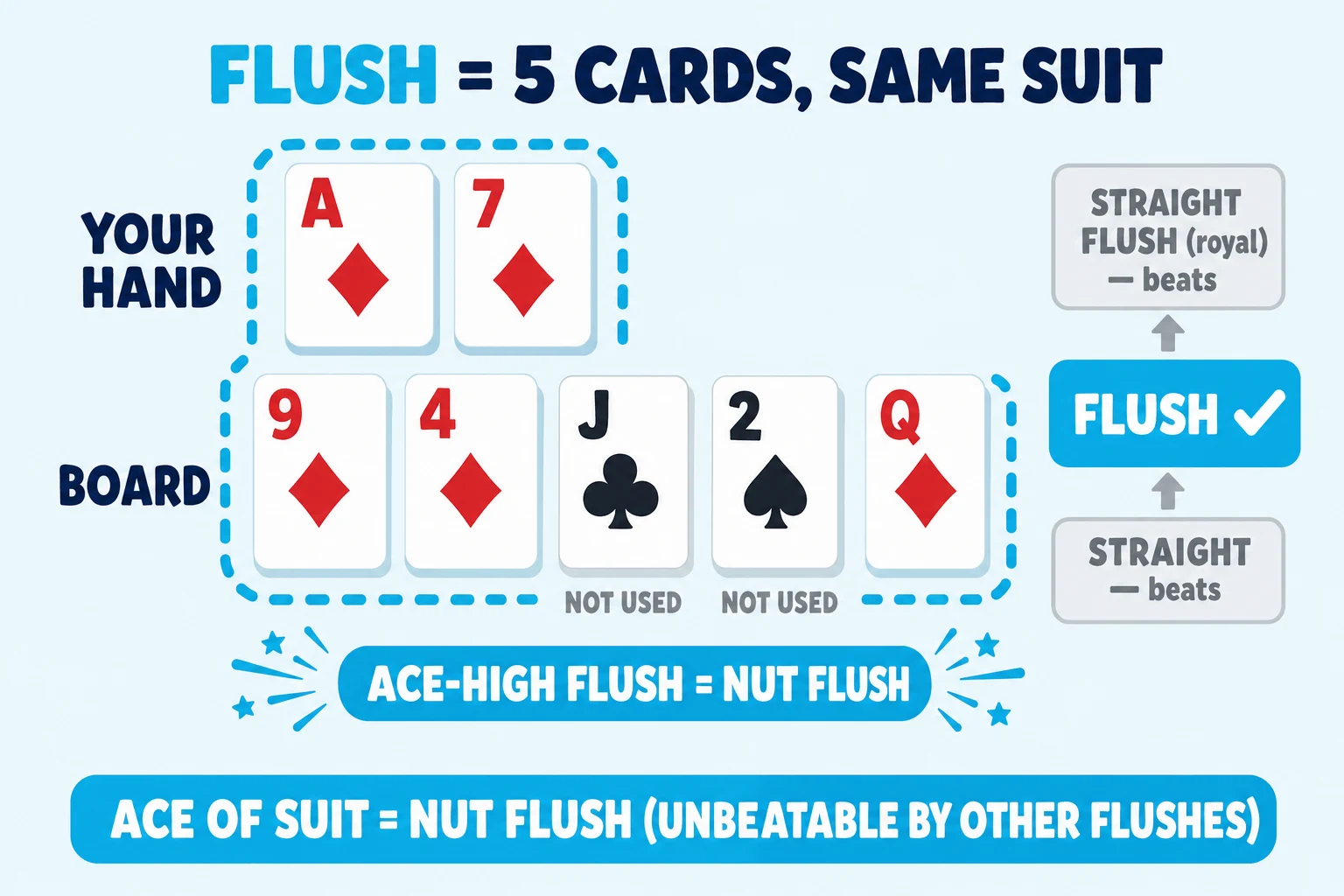
A Flush is five cards of the same suit that are not in sequence. In hand rankings, a Flush beats a Straight but loses to a Full House, Four of a Kind, and any Straight Flush. A Straight Flush is five consecutive same-suit cards; its Ace-high version is the Royal Flush, the top possible hand. Example: with hole cards A♦ 7♦ and a board of 9♦ 4♦ J♣ 2♠ Q♦, you have five diamonds and therefore a Flush.

Practice this in Poker Skill. The draw review capstone counts the clubs as dirty outs for A♣ Q♣ on 7♣ 7♦ 2♣, since the paired board lets a full house beat the flush they make.
Get the free appFlush - No-Limit Texas Hold’em
Definition and hand-rank context
A Flush is five cards of the same suit that are not in sequence. In hand rankings, a Flush beats a Straight but loses to a Full House, Four of a Kind, and any Straight Flush. A Straight Flush is five consecutive same-suit cards; its Ace-high version is the Royal Flush, the top possible hand. Example: with hole cards A♦ 7♦ and a board of 9♦ 4♦ J♣ 2♠ Q♦, you have five diamonds and therefore a Flush.
For the full order of hands, odds, and tie-break examples, see the poker hand rankings chart.
Flush vs straight: which wins
A flush beats a straight, every time. The two hands sit one rung apart in the rankings: the straight is five consecutive ranks in any mix of suits, while the flush is five cards of one suit in any order. The flush is also the rarer hand. A 52-card deck offers 10,200 five-card straight combinations against 5,108 flush combinations, roughly half as many ways to make one.
| Straight | Flush | |
|---|---|---|
| What it needs | Five consecutive ranks, any suits | Five cards of one suit, any ranks |
| Example | 6♠ 7♦ 8♣ 9♥ 10♠ | A♦ Q♦ 9♦ 4♦ 2♦ |
| Five-card combinations | 10,200 | 5,108 |
| Head to head | Loses | Wins |
Five cards that are both in sequence and in one suit make a straight flush, which beats both hands.
How rare a Flush is and why that matters
A Flush occurs about once in 509 five-card hands, so it remains relatively rare and valuable. That rarity gives two practical advantages: it usually improves your winning chances, and opponents often misjudge boards, creating extraction opportunities. Example: on K♣ 8♦ 3♣, a club on the turn gives A♣ x♣ the nut Flush with only three clubs showing. Opponents who see only high cards or a pair may call large bets, raising your expected value.
Assessing flush strength: top card and the “nut” flush
The Flush’s top suited card determines most of its relative strength. Holding the Ace of the suit gives you the nut flush - the highest possible Flush and safe from other flushes. If your best suited card is a King, an opponent with the Ace of that suit can beat you even with the same suit completed. Example: with K♥ J♥ on a Q♥ 9♥ 2♥ 5♦ board, an opponent holding the A♥ with another heart makes an Ace-high Flush and beats your King-high Flush. Always check your highest suited card against the board and likely opponent holdings.
Playing a made Flush: aggression, pots, and vulnerabilities
When you hold a strong Flush, extract value aggressively against players who call with weaker hands. Confirm your top-card strength - the nut flush lets you bet for value more freely. Size bets to keep draws and second-best hands in the pot; avoid tiny bets that allow cheap cards to change outcomes. Be cautious if the board pairs, since paired boards increase Full House risk; if the turn or river pairs, re-evaluate and consider pot control or folding to heavy action. Example: on Q♠ 7♠ 7♦ 4♠, your Spade Flush loses to any Full House, such as 7-Q, 7-4, Q-Q or 4-4.
Playing flush draws and preflop suited decisions
A flush draw means you have four suited cards after the flop, needing one more to complete a Flush. Flush draws justify calls and semi-bluffs because completing the Flush often wins a large pot. Preflop, suited hands - especially suited connectors like 9♣8♣ - gain value for their ability to make both Flushes and Straights. Before investing, weigh position, stack sizes, and opponent tendencies; chase draws only when the odds and implied odds (potential future winnings) justify it.
Reading board texture for flush-related risk
Quick checks to change your plan:
- Count suit cards on the board: three or more of one suit can hide made Flushes.
- Watch for paired ranks: a paired board creates Full House possibilities and should temper aggression with non-nut Flushes.
- Track aggression on suit-heavy boards: heavy betting can indicate either a made Flush or a strong draw applying pressure.
Compare all ten poker hand rankings, best to worst to see where a flush sits.
For flush matchups taken one at a time, starting with flush against a straight, see what beats what in poker.
Quick checklist
- Confirm five same-suit cards and whether they form a straight.
- Identify your top-suit card and whether you hold the nut flush.
- Check board pairing and higher-suit possibilities before committing chips.
- Factor implied odds when drawing and plan value extraction when made.