


Flop
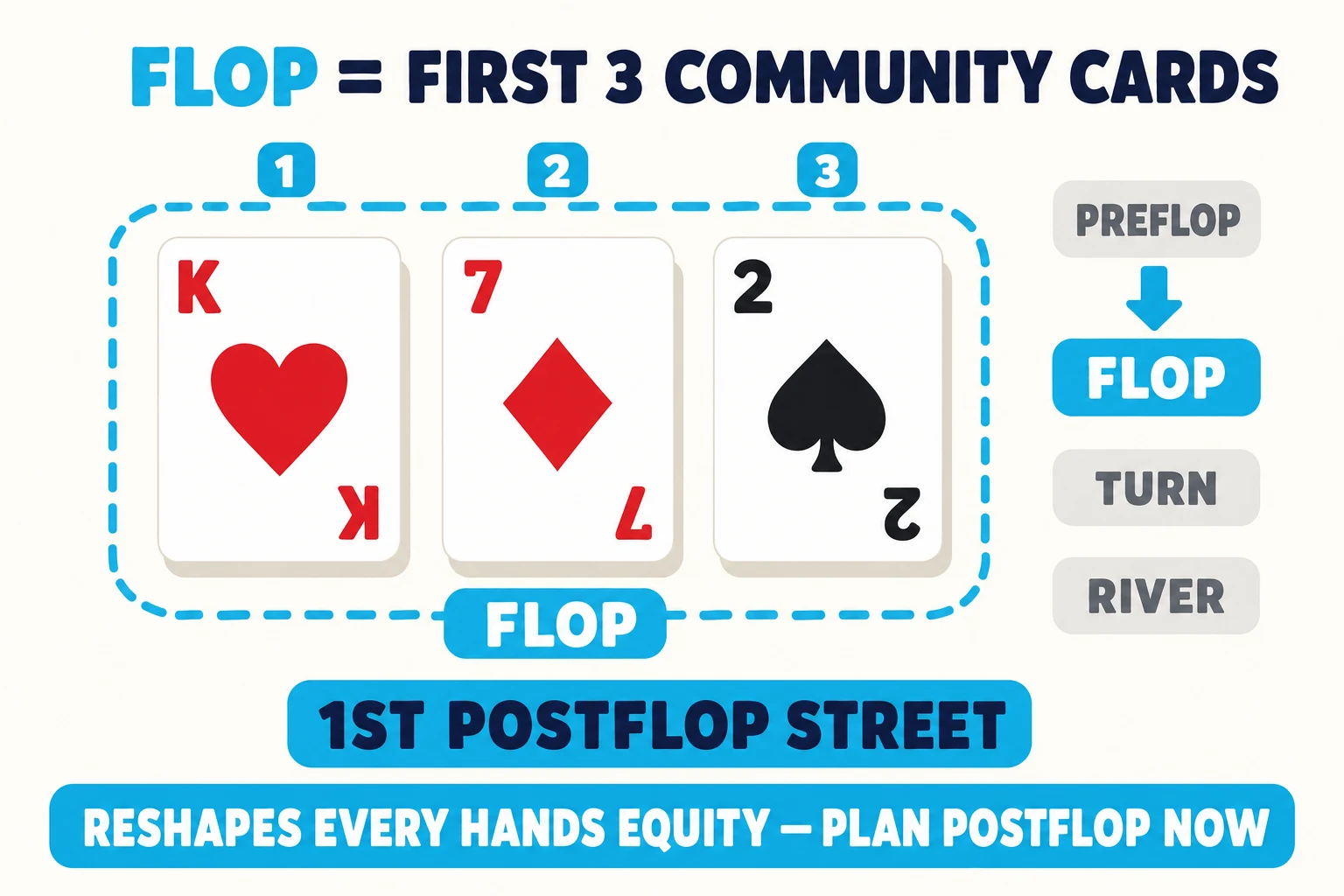
The flop is the dealer's first three community cards dealt face-up. These cards immediately reshape hand equities, the chances each hand will win, and often change pre-flop plans. Example: you raise pre-flop with A♥K♥ and the flop comes K♣7♦2♠. You now have top pair, a strong one-pair hand, and the board offers few draws. Contrast that with a J♠10♠9♦ flop after the same pre-flop action; many straights and flush draws exist, making your hand more vulnerable. Flop decisions largely set pot size and the hand's path. Betting or checking determines whether you commit more chips on the turn and river, or fold the pot.
Practice this in Poker Skill. A♠ Q♦ on Q♣ 8♦ 4♠ and Q♣ 8♣ on Q♦ J♦ 9♠ both flop top pair, and the lessons teach a bet with the first and a check with the second, where the flop hands the caller draws.
Get the free appThe Flop in No-Limit Texas Hold’em
What the flop is and why it matters
The flop comes after the first betting round: three cards turned face up at once, followed by a new round of betting.
Reading board texture: dry vs wet and coordinated vs uncoordinated
Board texture describes how flop cards interact with possible player holdings, and it comes down to a count of how many hands the flop helps. Dry flops, like K♣7♦2♠, give few straight or flush possibilities, so strong hands can bet value. Wet or coordinated flops, like J♠10♠9♦, create many straight and flush draws, weakening single-pair hands. Coordinated means cards connect or share suits, enabling draws; uncoordinated means the opposite. Recognizing texture guides whether to pressure draws aggressively or preserve chips against dangerous boards.
Continuation betting: when to lead and how much to size
A continuation bet (c-bet) is when the pre-flop aggressor leads again on the flop. It uses initiative and fold equity (the chance opponents fold) to win pots. Practical sizing:
- On dry flops bet about half the pot to gain value without heavy protection.
- On mixed or damp boards size around two-thirds pot because some draws threaten your hand.
- On very wet, draw-heavy boards, size up toward full pot when you bet a strong hand, to charge the draws; one pair is less secure there, and checking it can keep the pot smaller. Example: you raised pre-flop with A♦K♦. On K♣7♦2♠ a half-pot c-bet extracts value; on J♠10♠9♦ a larger bet pressures many draws. Keep sizing consistent so opponents cannot easily deduce whether you hit the flop.
Adjusting to opponents: ranges, numbers and tendencies
Count opponents: multiway pots increase the chance someone holds a strong made hand or a draw. Against tight opponents you can bluff more, since they rarely call marginal flop bets. Against calling stations, cut back on bluffs and increase value-bet sizes to extract chips from calls. Versus aggressive opponents who often raise c-bets, consider checking or using larger sizing to discourage raises. Use reads to decide whether to fire a second barrel on the turn, slow-play to keep opponents in or fold.
Betting objectives on the flop: value, protection and bluffing
- Value: extract chips from worse hands, for example top pair on a dry board.
- Protection: deny equity to draws; for example bet larger on two-suited boards with two pair or a set, while top pair on a very wet board sometimes checks to keep the pot smaller.
- Bluffing: force folds when opponents miss; success depends on fold equity and opponent tendencies.
Quick checklist for flop decisions
- Identify flop texture and note if it’s dry or wet, coordinated or uncoordinated.
- Count opponents in the pot and estimate their likely hand ranges.
- Decide whether to c-bet or check based on your initiative and opponent types.
- Choose a sizing consistent with board texture to achieve value, protection or fold equity.
- Use reads to plan turn action: fire a second barrel, slow-play or fold.