


Float
A float is calling a flop bet with a weak or marginal hand intending to bluff or take the pot later. You float when you expect the bettor to show weakness on the turn, for example by checking. Floats connect tightly to continuation-bet (C-bet) dynamics; a C-bet is the preflop aggressor's flop bet. Defenders, especially out-of-position players like the Big Blind, use floats to exploit aggressive but passive opponents.
Practice this in Poker Skill. A flop call needs something behind it in the Check-Call lesson: 6♣ 5♣ calls on K♣ 7♣ 5♠ with bottom pair and a flush draw, while 9♠ 4♠ on A♥ 7♦ 2♣ has nothing in common with the board and folds.
Get the free appFloat in No-Limit Texas Hold’em
What is a float?
A float is calling a flop bet with a weak or marginal hand intending to bluff or take the pot later. You float when you expect the bettor to show weakness on the turn, for example by checking. Floats connect tightly to continuation-bet (C-bet) dynamics; a C-bet is the preflop aggressor’s flop bet. Defenders, especially out-of-position players like the Big Blind, use floats to exploit aggressive but passive opponents.
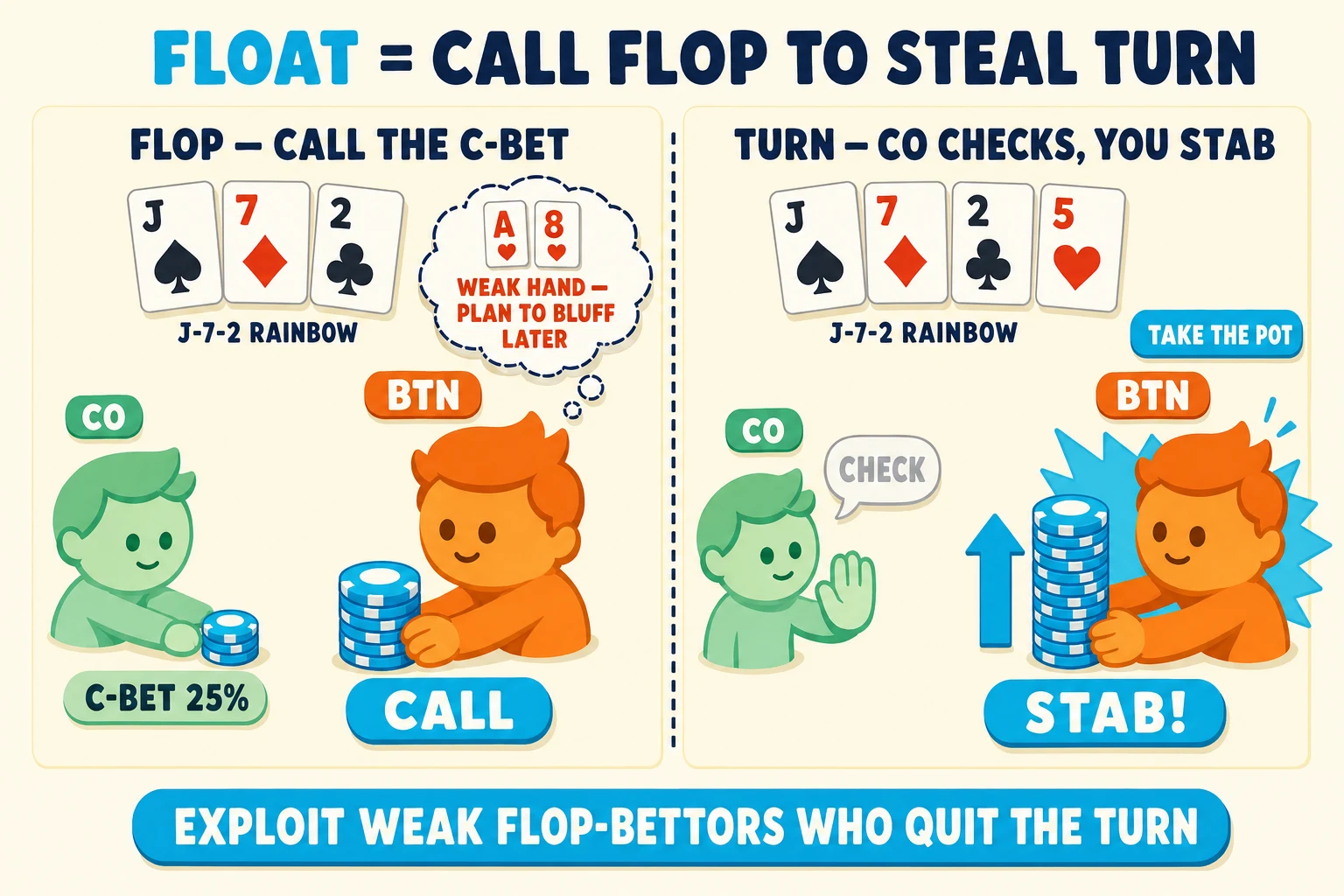
Example: CO opens, BTN calls, CO C-bets a small amount on J-7-2 rainbow. As the BTN in position, you call with A8, planning to represent strength on the turn if CO checks.
When to consider attempting a float
Float when the situation gives you a realistic chance to take the pot later.
- Opponent tendency: Float more against players who often give up on later streets.
- Bet-sizing: Small flop C-bets create wider floating opportunities by offering easier calls and more turn pressure.
- Board texture and position: Choose boards that likely miss the aggressor’s range and produce credible turn cards for your story. Being in position makes floating far easier; out-of-position floats require tighter selection.
Example: You’re BTN versus an SB open who C-bets 25% pot on 9-6-3 rainbow. That small sizing and a board unlikely to hit their raising range makes floating attractive.
How to construct a float plan on the flop and turn
Treat a float as a planned action, not a reflexive call. On the flop: call with a clear follow-up plan, deciding whether to bet the turn if the aggressor checks. Don’t call merely because the price is cheap; have a turn line.
Handling ranges:
- Strong hands (nuts, two-pair): raise or call for value depending on action and stacks.
- Good hands (top pair, good kicker): mostly call for value and protection; raise when appropriate.
- Weak hands (gutshots, backdoors, medium overcards): call to float and use selective check-raise bluffs on turns that favor your story.
- Trash hands (no equity): generally fold; only use as aggressive check-raise bluffs versus frequent folders.
Profitability constraint: Fold hands that are clearly negative-EV to continue. Still, calling to float can be profitable against unbalanced or passive opponents.
Reading bet-sizing, board texture, and opponent tendencies
- Small C-bets: Float more widely versus small flop C-bets, especially against players who seldom barrel.
- Board textures: Favor dry boards that likely missed the aggressor’s range or that produce believable turn cards.
- Opponent profiling: Only float when you expect turn passivity or an unbalanced opponent range. Avoid floating versus players who reliably follow with second barrels.
Common mistakes and maintaining discipline
Don’t float too often. If opponents frequently fire second barrels or balance ranges, floating becomes costly. Always have a turn plan and be ready to fold to continued aggression without clear weakness. Use floating selectively-base it on sizing, texture, and tendencies, not as an automatic defense.
Quick checklist
- Target opponents who give up on later streets.
- Prefer small C-bets and boards that likely miss the aggressor’s range.
- Classify your hand (strong/good/weak/trash) and choose raise/call/fold accordingly.
- Enter every float with a specific turn line and willingness to fold to aggression.
- Avoid floating versus players who frequently barrel or maintain balanced ranges.