


Board Texture
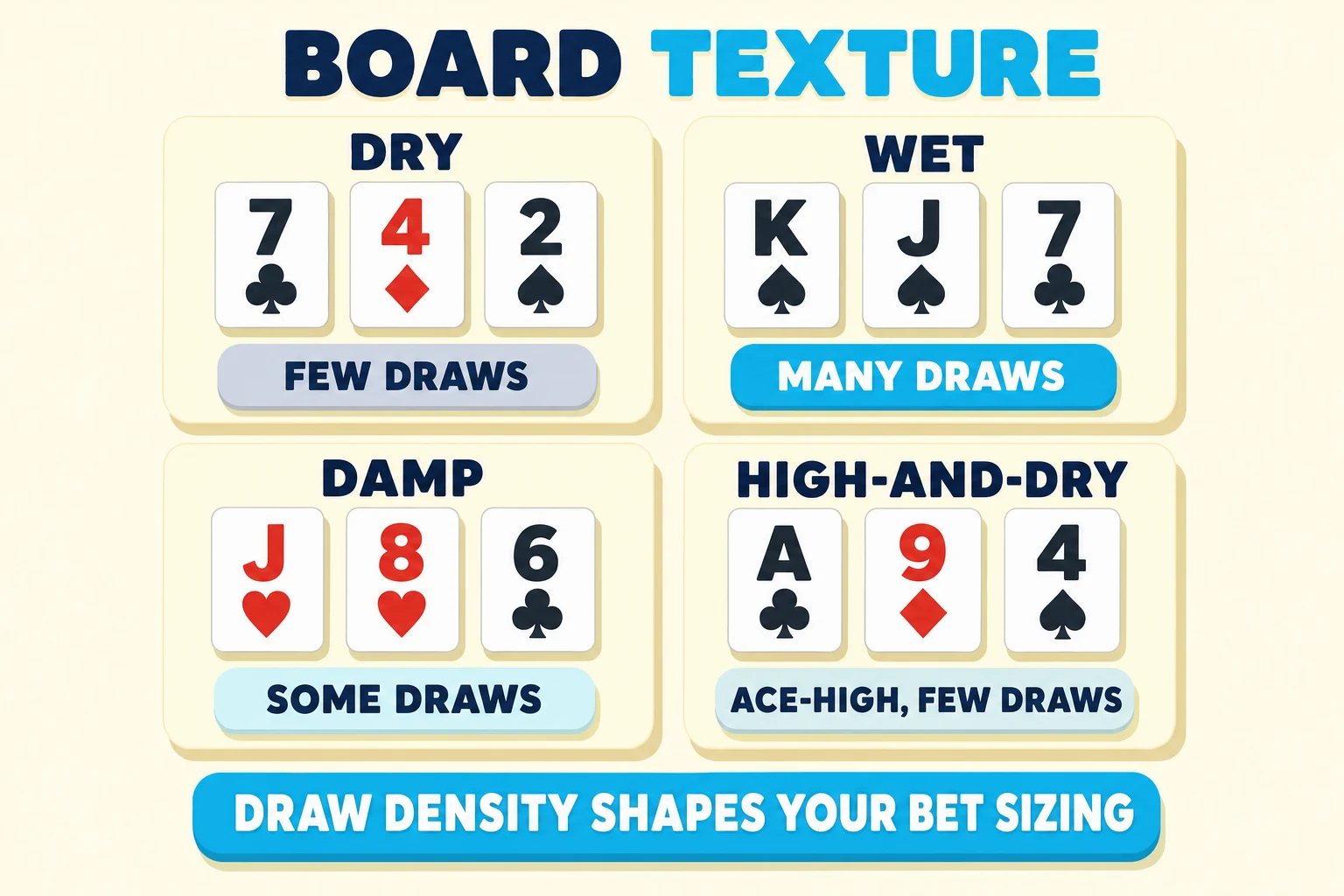
How the community cards connect and how many draws live on them. Texture drives bet sizing, c-bet frequency, and pot control. Dry, damp, wet, and high-and-dry are the four shapes you'll re-read every flop.
Practice this in Poker Skill. Dry and wet boards both show up in the flop lessons: A♣ 10♠ bets for value on 9♦ A♠ 4♠, a disconnected board, while K♣ Q♦ checks top pair on Q♠ J♣ 10♦, which hits the caller’s hands too hard.
Get the free appBoard texture
What board texture is and why it matters
Board texture describes how the community cards connect and how many draws are live on them. In No-Limit Hold’em it sets bet sizing, hand-strength reads, and most postflop choices. A “draw” is a hand that can improve to a stronger holding, like a straight or flush. Read texture on every flop. It tells you how big to c-bet, how often to bluff, and which streets you can fire credibly.
Dry boards (low draw potential)
Dry flops have little connectivity and few straight or flush possibilities. 7-4-2 rainbow (three different suits) gives opponents almost no clean way to improve. C-bet sizing runs smaller, around half pot, because there’s little draw equity to charge. Small bets extract value from worse pairs and price bluffs cheaply. Bluffing works more often on dry textures since opponents have fewer outs and fold more flops. Keep your bet sizes similar across value and bluff combos so you don’t telegraph strength. With A♠K♦ on 7-4-2 rainbow, a half-pot c-bet folds out medium pairs and costs almost nothing when it doesn’t.
Wet boards (many draws)
Wet boards present multiple straight and flush draws and wider range equity. K♠J♠7♣ (two spades and connected ranks) or a monotone flop like J♠8♠4♠ are both wet for different reasons. C-bet sizing runs larger here, up to three-quarters or a full pot, to charge draws and protect made hands. Pots get bigger and play more polarized: large bets come from strong made hands and strong semi-bluffs. With KQ on K♠J♠7♣, size up to deny spade and straight draws their correct odds.
Damp and high-and-dry boards (middle cases)
Damp boards sit between dry and wet: some draws, not many. J-8-6 two-tone is the textbook shape. C-bet sizing usually lands around two-thirds pot, bigger than dry but smaller than fully wet. High-and-dry boards have a high card but little connectivity, like A♣9♦4♠. The preflop raiser’s range usually has the high-card edge, so betting often makes sense. Bluff frequency should sit a bit below dry-board defaults, but controlled pressure still earns folds.
The shorthand: shift aggression and barrel frequency along the dry-to-wet axis based on draw density. Lean on selective semi-bluffs on damp boards. Bet for value on high-and-dry boards.
Strategic implications: c-bets, bluffing, and value extraction
C-bet sizing follows draw density: bigger when you need to charge draws, smaller when you don’t. Keep sizing consistent across strong and weak hands so the size doesn’t give your range away. Bluff-versus-value balance: dry boards support a higher bluff frequency. Wet boards want polarization: value bets and semi-bluffs with real equity, not air. Mix enough to stay unreadable, but let texture set your defaults.
Adjusting to opponents and pot development
Against calling-heavy players, lean larger for protection on wet boards and cut bluffs back. Against fold-prone players, lean into bluffs on dry and high-and-dry textures. Reread the board on every street. A dry flop can turn wet, and the right sizing changes with it.
Quick checklist
- Quickly classify the flop: dry, damp, wet, or high-and-dry before sizing.
- Set c-bet size to match draw density (≈½ pot dry, ≈⅔ damp, up to full pot wet).
- Choose bluff frequency based on texture and opponent tendencies.
- Re-evaluate strategy on each subsequent street as the board changes.