


Board Coverage
Board coverage describes how well a preflop range can connect with many different flops, turns, and rivers, not the strength of any single hand. A range with good coverage holds enough hand types to credibly show up with strong holdings on low, middle, high, paired, and flushy boards alike.
Practice this in Poker Skill. From the button, the preflop lessons open 9♥ 8♥ and 5♠ 5♥ beside the broadway hands, a suited connector and a small pair that cover the low boards broadways miss.
Get the free appBoard coverage in poker
Definition: a range that connects with many boards
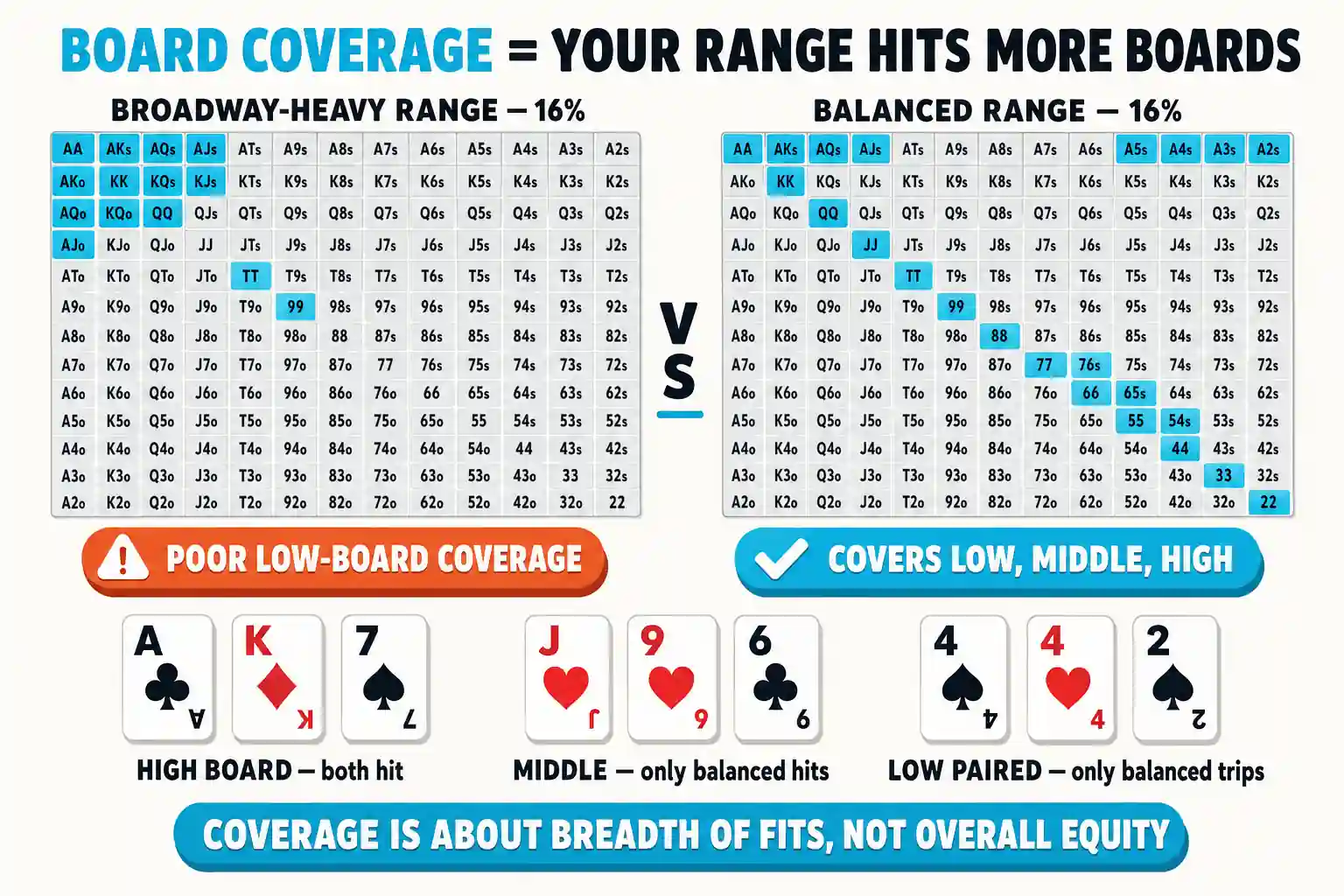
Board coverage is how well a preflop range can connect with many different flops, turns, and rivers. It is a property of your whole range, not of any single hand. A range with good coverage holds enough hand types to credibly show up with strong holdings on low, middle, high, paired, and flushy boards alike. A range with poor coverage looks fine on paper but has whole textures where it cannot make a strong hand at all, and skilled opponents will attack those textures.
A useful mental shortcut:
- Range advantage = your range has more total equity on this board.
- Nut advantage = your range holds more of the very best combos on this board.
- Board coverage = your range can show up with credible strong hands across many boards, not just this one.
The three concepts overlap, but they answer different questions. Coverage is about breadth across textures; the other two are about depth on a single texture.
Related terms
Board coverage vs range advantage vs nut advantage
These three sit close together in the GTO literature and players mix them up constantly. The cleanest way to keep them straight is to ask which question each one answers.
| Concept | Question it answers | Tied to |
|---|---|---|
| Range advantage | Whose range has more equity on this flop? | One specific board |
| Nut advantage | Whose range holds more of the absolute strongest combos on this flop? | One specific board |
| Board coverage | How many different boards can my range credibly connect with? | The range itself, before any board appears |
Coverage is a preflop property. You decide it when you build your opening or 3-betting range. Range advantage and nut advantage are postflop measurements; they shift each street as cards come out.
A range can have great coverage and still be at a range disadvantage on a given flop. A range can also have a big range advantage on one specific flop but terrible coverage overall. The two are independent.
When board coverage matters most
Coverage is load-bearing in spots where your range has to act on a wide variety of textures:
- Single-raised pots in position. You will see a thousand different flops as the preflop raiser. A range that hits only one fifth of them will get exploited on the rest.
- 3-bet pots out of position. A 3-betting range that ignores low boards lets opponents float and barrel any low or paired flop against you.
- Spots where you continuation-bet a high frequency. A high c-bet rate only works if your range can credibly back it on most boards.
Coverage matters less in spots where the action collapses to one or two outcomes:
- Short-stacked or jam/fold ranges. When the next decision is all-in, coverage of postflop boards is irrelevant.
- Multiway pots where folds are rare. Your range strength matters more than its breadth.
- Spots where you’ve already taken a polarized line. A pure river overbet is about combos, not coverage.
The rule of thumb: the more postflop streets your line will reach, the more coverage matters.
Example: under-the-gun on a low paired flop
Two opening ranges, both about 16% of starting hands, opened from under-the-gun for 2.5 big blinds. The big blind defends. The flop comes 4♠ 4♥ 2♠.
Range A: broadway-heavy. AA–77, AK, AQ, AJ, KQ, KJ, KQs, KJs, QJs. Looks tight and solid. Roughly 60% raw equity against the big blind’s defending range.
Range B: balanced for coverage. AA–77, AK, AQ, AJ, KQs, KJs, A5s–A2s, 76s, 65s, 54s, plus 66–22. Same hand count, slightly different shape.
On 4♠ 4♥ 2♠, range A has more raw equity than range B. But it has zero trips (no hand contains a 4), no straight draws, no real low-board interaction. The strongest hand it makes is an overpair. Range B has 44 in it for trips, has 22 for the underboat, and has A5s–A2s for low-card interaction.
If you bet range A, the big blind cannot fold. They have all the small pairs, all the suited fours, all the wheel hands you don’t have. They can check-raise you off your overpair and you cannot credibly continue. The clean play with range A is to check the whole flop and hope to bluff-catch later.
Range B can bet a portion of its hands (the trips, the overpairs that connect to backdoors) and back the bet up across the turn and river without getting trapped. Same equity advantage on the flop, very different paths through the rest of the hand.
That’s coverage. The same overall strength, the same hand count, two completely different postflop experiences.
Common mistakes
1) Treating coverage as an equity argument
Coverage is not “my range has more equity.” A range can be ahead on equity and still be uncoverable on the board in front of it. The 4♠ 4♥ 2♠ example above is the textbook case. If you find yourself defending a betting line with “but I had 60% equity,” check whether you also had any nutted combos.
2) Stuffing a range with offsuit broadways
KJo, QTo, and the rest of the offsuit broadway crowd look strong and do nothing for coverage. They miss low boards entirely, they make weak top pairs on high boards, and they block out the suited variants that would have helped. Trim them where you can to make room for suited aces, suited connectors, and small pairs.
3) Assuming position fixes coverage
Position helps you act with information, but it does not fix a poorly built range. The button can have terrible coverage if its opening range is too tight. The big blind can have great coverage if its defending range is wide and connected. Build the range first; let position shape how you play it.
4) Forgetting coverage on later streets
Flop coverage is the loudest version of the concept, but turn and river coverage matter too. A range that hits the flop fine but can never make the second nuts on a turn flush card has a coverage hole. When you plan a multi-street line, ask which turn and river cards your range can survive, not just which flops.
FAQ
Is board coverage the same as range advantage?
No. Range advantage is whose range has more equity on the current board. Board coverage is how well your range can show up across many different boards. Two ranges can be tied in coverage and have very different range advantages on a specific flop.
Which preflop hands give the most board coverage?
Suited aces (A2s–A5s) cover wheel and flushy boards, suited connectors (54s through 87s) cover middle and connected boards, and small pocket pairs (22–66) cover paired and set-mining boards. Premium hands and broadways cover high boards on their own. A range with all four buckets has the widest coverage.
Can I have too much coverage?
Not really, but you can pay for coverage by including hands that play badly out of position. If a coverage-friendly hand like 65s is hard to play from the small blind, the right call is sometimes to drop it from that specific position rather than force-fit it. Coverage is a goal, not a checklist; fit it to the spot.
Does coverage matter in cash and tournaments?
It matters more in deeper-stacked spots, which is most of cash. In short-stacked tournament play, decisions collapse toward all-in or fold and coverage thins as a concept. The deeper the effective stacks and the more streets remain, the more coverage drives expected value.