


Range Advantage
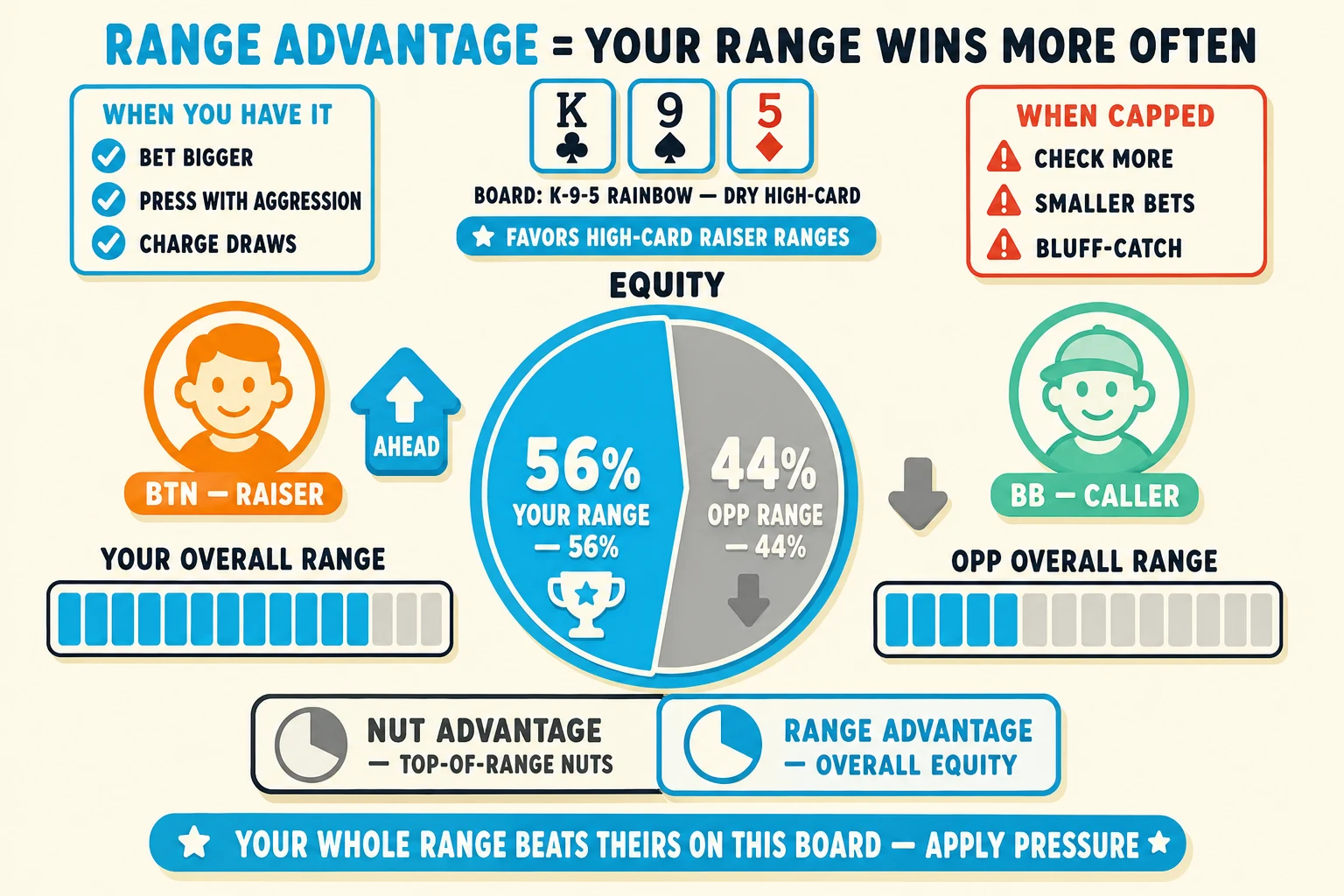
Range advantage compares the overall strength distribution of one player's possible hands to an opponent's, not your single holding. A range is every hand a player could reasonably have given betting and position. A player with range advantage simply holds a higher proportion of strong made hands and powerful draws. When your range is stronger, you can bet more aggressively to extract value and force folds. If your range is weaker or capped-meaning your prior actions make the strongest hands unlikely-lean toward defensive lines like smaller bets, check-calling, or bluff-catching.
Practice this in Poker Skill. The Check-Raise lesson reads range advantage from the caller’s side, raising a strong draw on a ragged four-three-deuce flop that missed the raiser but only calling with one on an ace-high board that fits the raiser.
Get the free appRange Advantage in No-Limit Texas Hold’em
Definition: What range advantage is and why it matters
Range advantage compares the overall strength distribution of one player’s possible hands to an opponent’s, not your single holding. A range is every hand a player could reasonably have given betting and position. A player with range advantage simply holds a higher proportion of strong made hands and powerful draws. When your range is stronger, you can bet more aggressively to extract value and force folds. If your range is weaker or capped-meaning your prior actions make the strongest hands unlikely-lean toward defensive lines like smaller bets, check-calling, or bluff-catching.
Concrete example: Raising from the button versus a big blind caller usually gives the button a preflop range advantage. The button’s range typically contains more high cards and broadways than the big blind’s calling range.
Spotting range advantage at the table
Use simple cues to estimate who holds the advantage:
- Preflop actions and position. Treat the raiser’s opening range versus the caller’s defending range as your baseline. Raisers, especially from late positions, often show stronger or more polarized ranges than callers.
- Betting patterns that cap or uncapped ranges. A player who checks after earlier aggression is often capped and unlikely to hold the absolute nuts. A player who calls down repeatedly keeps their range uncapped because calling preserves the possibility of strong made hands.
- Reassess after each street. Every call, raise, or check narrows an opponent’s plausible holdings and shifts range advantage.
Practical spot: Button raises, big blind calls. A flop of 9♥8♥7♣ favors ranges with suited connectors and straight/flush combos, so the button usually holds the advantage.
How board texture shifts range advantage
Different runouts help different preflop ranges. Connected, coordinated, or flushy boards favor ranges heavy in suited connectors and straight or flush combos. Dry boards-like K♦7♣2♠ rainbow-tend to favor high-card-heavy opening ranges. When an out-of-position caller checks and then calls later streets, their range often tightens toward stronger made hands and draws, shifting the advantage to them. Conversely, if the board removes many of the raiser’s speculative hands, the preflop aggressor can lose their initial advantage.
Bet sizing and aggression with range advantage
When you have a clear range advantage, use aggression to capitalize:
- Larger bets extract value. If your range contains more strong hands, bigger bets win larger pots and deny equity to draws.
- Mix value with selective bluffs. Balanced aggression, including bluffs on boards that favor your perceived range, increases overall profitability.
- When capped, be defensive. If your range is capped relative to the opponent’s, prefer smaller bets, check-calls, or folding to heavy pressure; large bluffs become riskier.
Example: On a flushy turn that favors your opening range, a large bet polarizes your line-strong made hands get value and middling hands can credibly represent the nuts.
Adjustments across streets: maintaining or conceding advantage
Range advantage is dynamic and changes each street.
- Re-evaluate who benefits from the board and how betting has pruned ranges.
- If your range becomes capped, switch to bluff-catching and pot control rather than barreling.
- If advantage remains with you, continue applying pressure and increase bet sizes selectively against opponents who fold too often.
Keep these rules practical: estimate ranges from preflop action and position, reassess after each street, use larger bets with a clear advantage, and prefer playing in position to maximize informational edges.
Checklist:
- Estimate ranges using preflop action and position.
- Reassess range advantage after each street and adjust your lines.
- Use larger bets to exploit a clear range advantage; choose smaller bets or defensive play when capped.
- Prefer in-position play to capitalize on range advantage.