


Nut Advantage
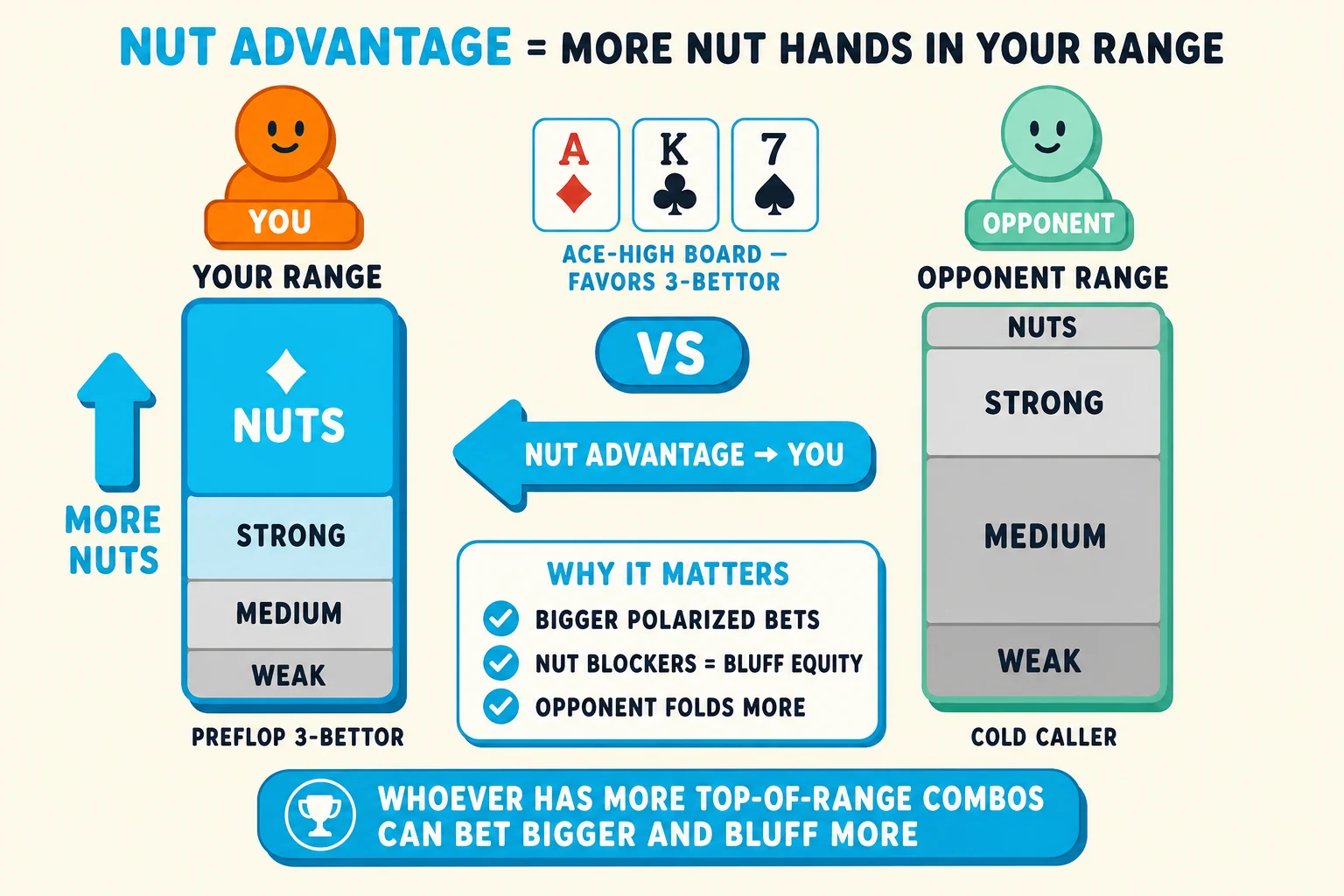
"The nuts" is the best possible hand on a given street, the absolute best flush, straight, or full house on the current board. "Nut advantage" describes which player's range is more likely to contain those best hands. Range means the set of hands a player could plausibly hold given actions. Holding the nuts, or cards that block opponents from them (nut blockers), lets you credibly represent maximum strength and forces difficult calls.

Practice this in Poker Skill. Knowing which flush is the nut comes first, and the Nut Flushes & Monotone Boards lesson practices it, asking whether a flush draw is the nut one or can lose to a higher flush.
Get the free appNut Advantage
Definition: The Nuts and Nut Advantage
“The nuts” is the best possible hand on a given street, the absolute best flush, straight, or full house on the current board. “Nut advantage” describes which player’s range is more likely to contain those best hands. Range means the set of hands a player could plausibly hold given actions. Holding the nuts, or cards that block opponents from them (nut blockers), lets you credibly represent maximum strength and forces difficult calls.
Nut advantage matters because it changes decisions: bet sizes, bluff profitability, and opponents’ fold-or-call choices. If the board pairs and one player’s range contains most full-house combos, that player can bet bigger more often. Opponents without blockers face a tougher fold-or-call decision.
How Position and Preflop Range Create Nut Advantage
Acting after your opponent (in position) often creates a range advantage: you can include more hand combinations that connect with many boards. That range advantage frequently converts into nut advantage on a variety of textures.
Preflop actions shape range composition. A 3-bettor typically has a tighter, stronger range with more premium hands and more nutted combos on ace-high or paired boards. A caller’s range tends to contain more suited connectors and fewer top-pair/top-kicker combos. On a board like A♦ K♣ 7♠, a 3-bettor’s range may include more ace-two and AK combos than a cold caller’s range.
To evaluate nut advantage, compare overlap: which side can realistically make the best hands on each street given preflop actions and position. If most nutted combos sit on one side, that side has nut advantage and can apply more pressure.
Identifying Nut Blockers and Their Practical Value
Nut blockers are cards in your hand that reduce opponent combinations for the absolute best hands. For example, holding the A♠ on a three-spade board removes many of the opponent’s nut-flush combos.
A quick process to count blockers:
- Identify the specific nut (e.g., nut flush, nut straight, nut full house).
- List the opponent’s likely holding combos that make that nut given preflop actions.
- Subtract combos containing the card(s) you hold.
Blockers become most valuable on later streets. On the river, key nut blockers boost the credibility and EV of large bluffs because opponents are less likely to hold the single combo that beats your line. Secondary blockers - cards that reduce lower flush or straight combos - help too, but they generally carry less EV than true nut blockers.
Using Nut Advantage to Size Bets and Execute Bluffs
When you have nut advantage, you can use larger, polarized bet sizes. Polarized bets represent either very strong hands or pure bluffs, so they pressure marginal callers. On a three-spade board where your range contains many nut-flush combos and you hold a nut blocker, a large river shove credibly pressures opponents off hands that would otherwise call.
Use nut blockers to pick bluff spots. If your hand removes the single combo that makes the nut, a shove forces opponents to fold many medium-strength hands. Pair such bluffs with a high value frequency so your betting distribution looks balanced.
Adjustments When You Lack Nut Advantage
If your range is nut-disadvantaged, be more cautious with large bluffs and reduce polarized frequencies. Favor smaller sizes and thinner value bets to avoid overcommitting when you can’t credibly represent the nuts.
Shift into multi-street pressure or induce folds instead of forcing single big shoves. Target spots where you can manufacture blocker equity - plan a river stab if turn action creates additional blocking cards. Exploit opponents’ tendencies rather than pushing marginal all-ins.
Checklist:
- Identify the nuts for the current board before acting.
- Count nut-blocker combos in your hand and estimate opponent combos.
- Prefer larger, polarized bets when you have nut advantage; shrink bluff sizes when you don’t.
- Use position and preflop range construction to build future nut advantage opportunities.