


No-Limit
No-limit is the betting structure where the maximum bet or raise is your entire remaining stack, subject only to the table's minimum-bet and minimum-raise rules. It is the structure that makes bet sizing and stack depth into real strategic choices, and it is the format almost every modern hold'em book and lesson assumes by default.

Practice this in Poker Skill. Keeping the all-in far away is a choice you make, and with second pair, Q♥ J♦ on K♣ Q♠ 4♥, you call the flop bet in the Intro to Pot Control lesson to keep the pot small.
Get the free appNo-Limit (NLHE)
What “no-limit” means
No-limit is a betting structure where the largest bet or raise you can make is your entire remaining stack at the table. There is no upper cap on the size of any single wager. The lower side still has rules: a bet has to clear the minimum bet, a raise has to add at least the size of the previous bet on top of it, and you can only ever wager chips that are already in front of you. Inside that floor, every sizing decision is yours.
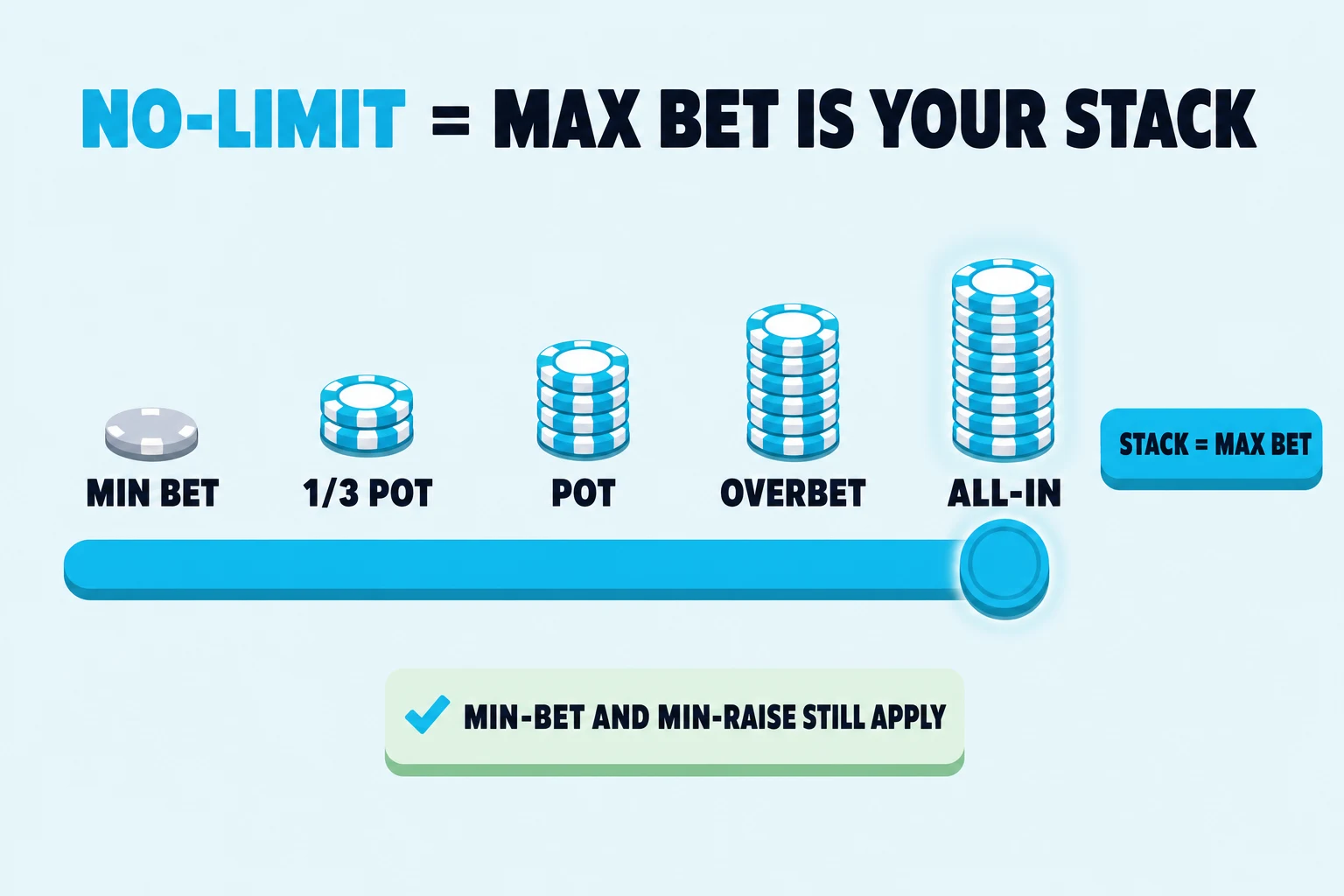
A short way to hold the rule in your head:
- The ceiling is your stack. If you have 100bb in front of you, your maximum bet on this street is 100bb.
- The floor is the min-raise rule. A raise has to add at least the size of the last bet on top of it.
- Chips you cannot reach do not exist. You play “table stakes” — only what is in front of you can be wagered or won this hand.
Related terms
- Bet: the act of putting chips into the pot during a betting round; no-limit is what removes the cap on its size.
- Raise: increasing the current bet; no-limit gives you sizing freedom on it.
- Bet sizing: the choice that exists only because no-limit lets you pick any number from the floor up to your stack.
- Stack depth: the chip count in big blinds that determines how much room your no-limit decisions have.
- SPR: the postflop number that drops out of stack depth, the lever no-limit makes you read.
- Cash game: the format Poker Skill’s lessons default to, played as no-limit hold’em at around 100bb.
- Shove: the all-in move that no-limit’s no-cap rule makes available on every street.
- Min-raise: the floor that sits underneath the no-limit ceiling.
No-limit, pot-limit, and fixed-limit at a glance
The three classical betting structures answer the same question, “how big can this bet be?”, in three different ways. Hold’em runs on all three, but the modern strategy library has consolidated around no-limit.
| Structure | Maximum bet or raise | Minimum on the same street | Where it shows up |
|---|---|---|---|
| Fixed-limit | A predetermined amount fixed by the table (typically the small stake preflop and on the flop, the larger stake on turn and river). | The same predetermined amount. There is no sizing choice. | A small slice of live cardrooms. Mostly older limit hold’em games. |
| Pot-limit | The current size of the pot after the calling action. | At least the size of the previous bet or raise, added on top. | Pot-limit Omaha is its main home; pot-limit hold’em is rare. |
| No-limit | Your entire remaining stack. | At least the size of the previous bet or raise, added on top. | Almost every modern hold’em cash game and tournament. |
The single sentence that captures the strategic difference: in fixed-limit, sizing is decided for you. In pot-limit, the pot decides for you. In no-limit, you decide. That last column is why bet sizing is its own glossary entry, why stack depth has bands, and why postflop strategy in no-limit hold’em is taught around the SPR number rather than around fixed sizing menus.
When the no-limit ceiling matters most
The no-limit rule is always “true,” but it only changes a decision when the ceiling is actually within reach.
- Deep cash, multi-street pots. With a 100bb effective stack and a small preflop pot, the all-in is three streets away. That distance is what creates room for the multi-street value plan, the layered semi-bluff, and the river overbet.
- Short-stacked spots. With 15bb and a raise in front of you, the all-in is one decision away. The no-limit rule is what makes the shove the standard answer at that depth — it would not be available in fixed-limit at all.
- River overbets. When the stack behind is large compared with the pot, the only way to threaten all of it in one bet is to bet more than the pot. Pot-limit cannot do that. Fixed-limit cannot do that. No-limit can, and that single move shapes which hand classes actually want to bluff or value-bet the river.
- Deep-stack postflop pressure. When the SPR is low, a small bet can already commit stacks. When the SPR is high, larger sizes are needed to threaten the same commitment. Either way, the lever you are pulling is the same one, the no-limit ceiling, at a different distance.
When stacks are very short, when the pot is tiny, or when neither side has any intention of committing, the no-limit rule is dormant. The player who notices that and the player who keeps shoving regardless are not playing the same game.
Example: the river decision the no-cap rule creates
You are in a $1/$2 6-max no-limit cash game with $400 effective. You hold A♠A♣ on the button. The cutoff opens to $6, you 3-bet to $20, the cutoff calls. Pot $43.
Flop K♣7♦4♠. The cutoff checks. You bet $25 for value and to charge the straight draws that might be lurking. Cutoff calls. Pot $93.
Turn 2♠. Cutoff checks. You bet $55. Cutoff calls. Pot $203.
River 9♣. The cutoff checks again. You have $300 left in your stack. The pot is $203.
In a fixed-limit $10/$20 game this whole hand would have looked different — the pot on the river would be smaller, your bet would be capped at $20, and the cutoff’s call would cost a fixed $20 regardless of what you held. In a pot-limit game you could bet at most $203, the pot. In no-limit, your maximum is $300 and the pot is $203, so a shove here is an overbet of about one and a half times the pot, a bet pot-limit cannot make, and it puts the cutoff’s whole remaining $300 on the line against a hand like K-Q. You shove. The cutoff thinks for a long beat and calls with K♥Q♥. Your aces hold, and you scoop an $803 pot, because no-limit let the last bet be bigger than the pot.
The hand was not unusual. The structure was. Three streets of “you decide” sizing produced a river spot where one more no-limit decision moved the rest of the stack. Fixed-limit cannot make that hand. Pot-limit can make a similar one but caps the river. Only no-limit lets the whole stack be at stake on a single street whenever both players consent to put it there.
Common mistakes when playing no-limit
Most no-limit leaks come from carrying the wrong mental model into the format.
1) Treating no-limit like fixed-limit
The fixed-limit reflex is “bet the prescribed amount and decide later.” It does not survive contact with no-limit. If you default to one tiny size every street, opponents capping your range as marginal pairs can run you over with raises priced for fold equity. Pick a size for each street with intent. The intent is the answer to “value, protection, or bluff” from the bet entry, not a habit.
2) Ignoring stack depth before sizing
A 25% pot bet at 20bb effective and a 25% pot bet at 100bb effective look identical on the felt and lead to opposite hands. At 20bb the same percentage-of-pot bet often pot-commits the bettor; at 100bb it leaves three more sizing decisions ahead. Read the stack depth, then size. Not the other way around.
3) Defaulting to pot-sized bets
Pot-limit muscle memory leaks into no-limit when players choose pot-sized bets reflexively, even when the spot calls for a third-pot block bet or a 1.5× pot overbet. The default is not “pot.” The default is “the size that fits this hand’s plan against this opponent’s range.”
4) Forgetting min-raise and table-stakes rules still apply
No-cap on the upside does not mean no rules anywhere. A raise still has to add at least the size of the previous bet on top of itself; raising from $100 to $150 is not legal because the increment ($50) is less than the bet you are raising over ($100). The rule applies before the flop too, because the big blind counts as a bet, a point Poker Skill makes early in its Bet vs Raise lesson. So the smallest legal preflop raise goes to two big blinds. And table stakes still cap you at what is in front of you on the felt — you cannot pull more out of your wallet mid-hand. The all-in exception is the only soft spot in the min-raise rule, and it only applies when a player is going all-in for less than a full raise.
FAQ
What is the difference between no-limit and pot-limit?
In pot-limit, your maximum bet or raise is the size of the pot at the moment you act. In no-limit, your maximum bet or raise is your entire remaining stack. The minimum-raise rule is the same in both formats: a raise has to add at least the size of the previous bet on top of it. The practical effect is that no-limit allows the overbet — a bet larger than the current pot — and pot-limit does not. Pot-limit hold’em is rare today; pot-limit Omaha is the format where the cap actually shapes day-to-day strategy.
Is there really no minimum bet in no-limit?
There is. A bet on a new street has to be at least the size of the big blind (the table’s minimum bet), and a raise has to add at least the size of the previous bet on top of itself. The “no-limit” name describes the absence of a maximum, not the absence of a floor. The all-in is the only structural exception: a player who shoves for less than a full raise can still go all-in, but the short shove may not reopen the betting for players who have already acted.
Why do most modern lessons assume no-limit?
Because almost every casino, online room, and televised event runs hold’em as no-limit. Pot-limit hold’em is uncommon, fixed-limit hold’em is largely confined to a small slice of live games and a few online sites, and the strategy literature has followed the population.