


Bet
Putting chips into the pot during a betting round. In No-Limit Hold'em the size is your choice from the table minimum up to your full stack, and the choice is most of the strategy.
Practice this in Poker Skill. The basic betting capstone asks the value, protection or bluff question hand by hand, and A♣ J♥ on 5♥ Q♥ 2♦ answers none of them, so it checks and keeps its showdown value.
Get the free appBet (No-Limit Texas Hold’em)
What a bet means in No-Limit Hold’em
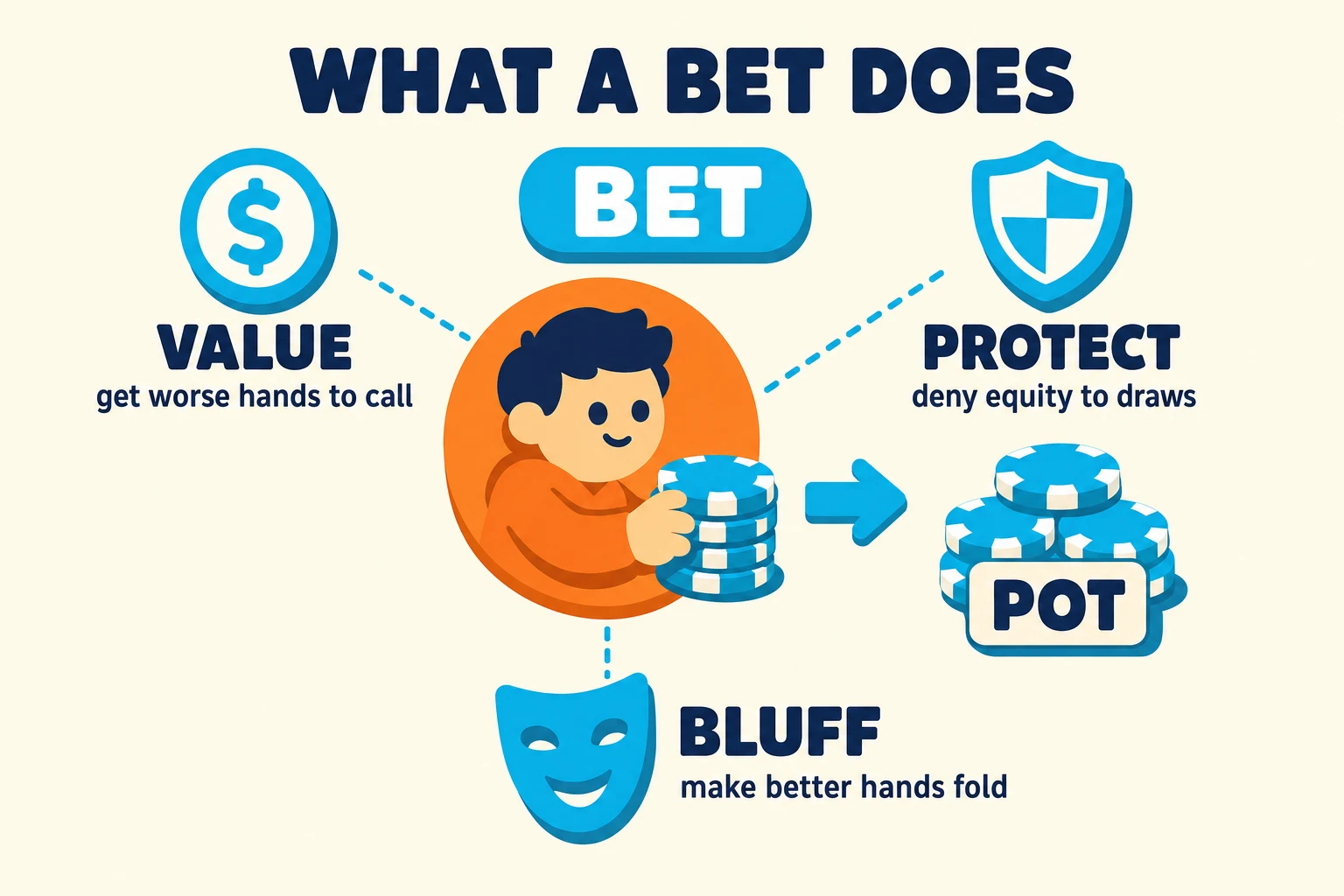
In No-Limit Hold’em (NLH), a bet is putting chips into the pot during a betting round. With no upper cap on the size, you can wager any portion of your stack from the table minimum up to all of it. That freedom is what turns sizing into a real decision instead of a fill-in-the-blank. Every bet does one of three jobs:
- Extract value: get worse hands to call.
- Protect: deny equity to drawing hands.
- Bluff: make better hands fold.
Knowing which of the three you’re doing is what makes a bet well-sized. On a $100 pot with top pair, betting 2/3 pot (~$67) charges draws and pulls value from worse pairs in the same motion.
Common bet sizes and what they’re for
Typical sizes you’ll see or use:
- Small (~1/3 pot): pot control, or coaxing calls from weaker hands. On a dry board, a small bet keeps worse hands in while limiting losses if raised.
- Medium (~2/3 pot): the workhorse for protection and value. Pressures draws and still gets called by medium-strength hands.
- Full pot: best for big value or big fold equity, usually on the turn or river with strong made hands.
- Overbet (more than the pot): heavy pressure, polarized ranges of very strong hands and bluffs.
- All-in: commits the stack outright when SPR or tournament pressure means smaller sizes don’t add information.
How bet size affects pot odds and opponent decisions
Bet size sets the pot odds your opponent gets, which is the call cost divided by the total pot after their call. Pot odds set the equity they need to call profitably. With $100 in the pot and a $50 bet, the call costs $50 to win $150: 3:1, or about 25% equity needed. Bet $100 instead and the call needs about 33% equity. Bigger bets buy fold equity and price out draws; smaller bets keep more hands in and hide your strong combos. Polarized ranges (nuts and bluffs) want the bigger sizes; merged ranges (lots of medium hands) want smaller bets or checks.
All-ins, overbets, and stack-to-pot
All-ins make the choice clean for the opponent: call or fold. That clarity earns its keep when the stack-to-pot ratio (SPR), the effective remaining stack divided by the pot, makes committing the obvious answer. With $100 in the pot and $100 behind, SPR is 1 and most made hands are committing or folding, so the shove just confirms the math.
Overbets work against opponents who mis-evaluate single-street commitments and against ranges that don’t have a clean answer to a bet bigger than the pot. Reserve those sizes for spots where SPR, range shape, and reads agree.
A simple sizing approach you can actually use
Solvers run many sizes per spot. Most players do better with a small repeatable menu.
- Pick 1–2 default sizes (for example, 1/3 pot for control and 2/3 pot for value/protection).
- Before betting, ask: value, protection, or bluff? Size to that purpose.
- Adjust for opponent and SPR: tighten sizes against calling stations, lean larger against frequent folders, and watch the SPR before any commitment-class bet.
Consistent sizes reduce mistakes and information leakage. Vary only when stack depth or a clear dynamic asks for it.
Quick checklist
- Pick 1–2 default bet sizes (for example, 1/3 and 2/3 pot) and use them consistently.
- Before betting, ask: value, protection, or bluff. Size to that purpose.
- Check pot odds and SPR before calling or committing chips.
- Reserve all-ins and overbets for spots where pressure and stack structure agree.