


Bet Size Family
Bet sizes are the amounts you can wager up to your chip stack in No-Limit Hold'em. With no fixed limit, choosing how much to bet becomes a core strategic decision. Size affects hand dynamics, opponent responses, and fold equity - the chance an opponent folds to your bet. Sizing ties directly to your range (the set of hands you might have), position, and pot size. Treat sizing like a language used to show strength, control the pot, or force decisions.
Practice this in Poker Skill. Big sizes are saved for wet boards in the flop lessons, where top set on Q♦ 9♦ 7♣ bets big to make the draws pay and a strong draw bets big to win now or hit its outs.
Get the free appBet Size Family - No-Limit Texas Hold’em
What the bet size family is
Bet sizes are the amounts you can wager up to your chip stack in No-Limit Hold’em. With no fixed limit, choosing how much to bet becomes a core strategic decision. Size affects hand dynamics, opponent responses, and fold equity - the chance an opponent folds to your bet. Sizing ties directly to your range (the set of hands you might have), position, and pot size. Treat sizing like a language used to show strength, control the pot, or force decisions.
Common bet size types
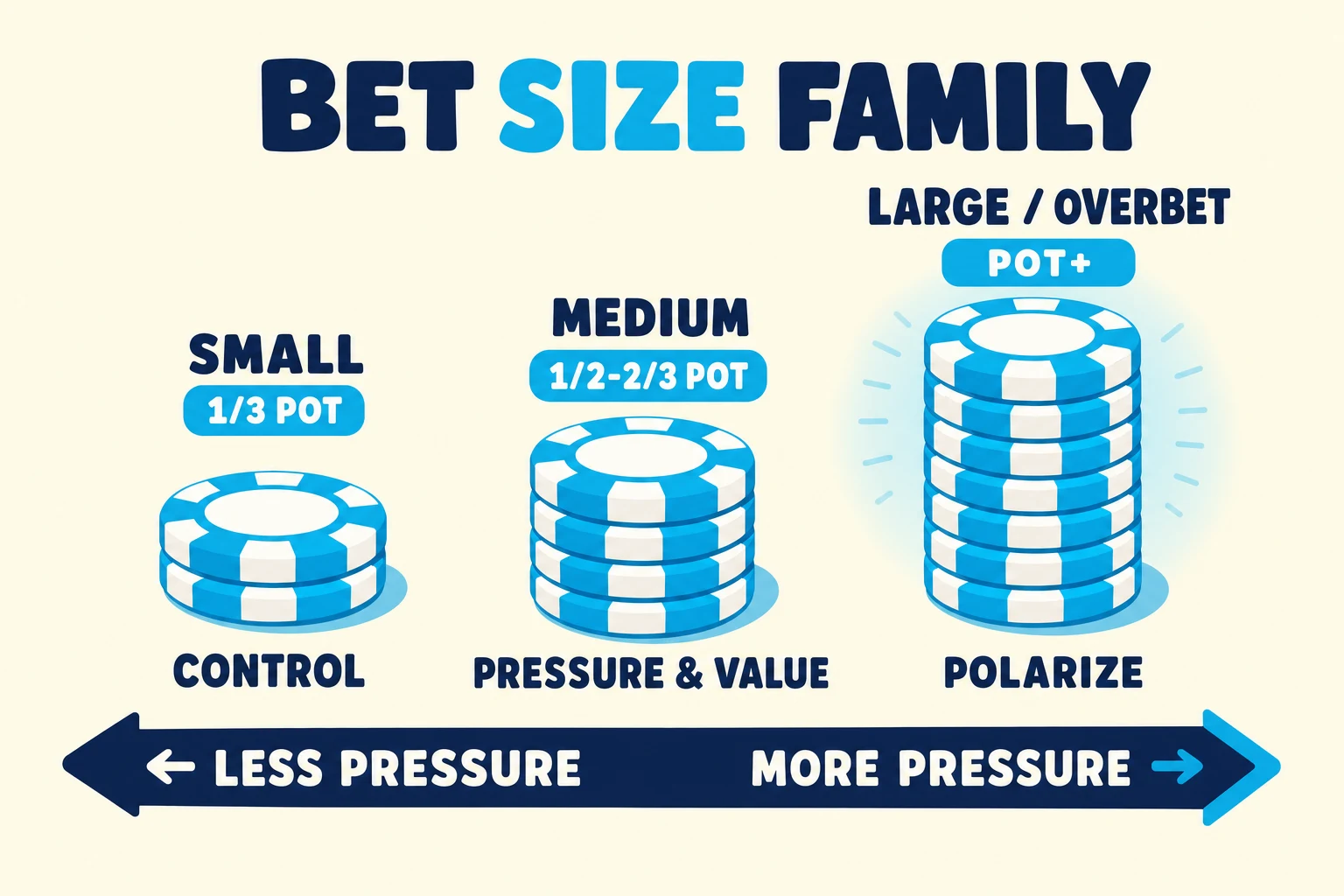
- Small bets: about one-third of the pot. Example: $100 pot, bet $30-$35. Use small bets to risk little, keep the pot manageable, retain initiative, or bluff modestly while letting weaker hands continue.
- Medium bets: roughly one-half to two-thirds of the pot. Example: $100 pot, bet $50-$67. Use medium bets to apply pressure, extract value from medium-strength hands, and balance value hands with bluffs.
- Large bets / overbets: pot-sized or larger, including overbets above 100% of the pot. Example: $100 pot, bet $120 or shove. Use large bets in polarized spots to represent either very strong hands or bluffs and to force folds or get maximum value when called.
How bet sizes shape strategy
- Polarization: A polarized range contains mostly very strong hands and bluffs. Larger sizes favor polarization because they force opponents to fold marginal hands. A merged range, with many medium-strength hands, uses smaller bets or checks to keep opponents’ weaker hands in.
- Stack depth and SPR: SPR (stack-to-pot ratio) equals your stack divided by the pot. Low SPRs push play toward big bets or all-ins because stacks commit sooner and decisions simplify. Example: $200 stacks with a $100 pot gives SPR 2, often leading to larger commits on later streets.
- GTO vs exploitative play: Solvers mix sizes by texture and position for Game Theory Optimal strategies. In live or recreational games, adjust exploitatively to opponent tendencies - for example, use bigger value bets versus calling stations and smaller bluffs versus players who fold frequently.
Practical sizing choices for real play
Humans tend to use one or two dominant sizes per situation to avoid complexity and being exploited. A simple approach:
- Predefine default street sizes (for example, flop one-third, turn two-thirds when barreling).
- Choose a size based on objective: control (small), extract/value or pressure (medium), or maximize fold equity/polarize (large).
- Factor opponent type: use bigger bets against sticky callers for value and smaller bets to induce calls from worse hands. Example: On a dry A-7-2 flop with a $100 pot, bet $33 on the button to keep worse hands in. Against a nit, bet $67 to extract value mainly from strong holdings.
Quick takeaway and application
Treat bet sizes as a deliberate language: small to control, medium to value or pressure, large to polarize and maximize fold equity. Adjust sizes by SPR, board texture, and opponent skill rather than following rigid rules. In many cash and live settings, one or two reliable sizes per spot beat complex, marginal solver mixes.
Quick checklist
- Choose one or two primary sizes for each situation and stick to them.
- Match size to objective: control, value/extract, or maximize fold equity.
- Factor SPR and board texture before polarizing with a large bet.
- Adjust sizing exploitatively against predictable opponents.