


Pot
The pot is the total chips or money collected from all bets during one hand. It includes contributions from every betting round: preflop (after hole cards), flop (three community cards), turn (fourth community card) and river (fifth community card). The chips left in the pot at showdown become the prize contested by remaining players. The pot grows when players bet, raise or call.

Practice this in Poker Skill. Checking adds nothing to the pot, the first rule in the Check vs Call lesson, where a check with no bet in front of you costs nothing and your stack stays the same.
Get the free appThe Pot in No-Limit Texas Hold’em
What the pot is
The pot is the total chips or money collected from all bets during one hand. It includes contributions from every betting round: preflop (after hole cards), flop (three community cards), turn (fourth community card) and river (fifth community card). The chips left in the pot at showdown become the prize contested by remaining players. The pot grows when players bet, raise or call. When a player is all-in for less, the extra chips go into a side pot that player cannot win.
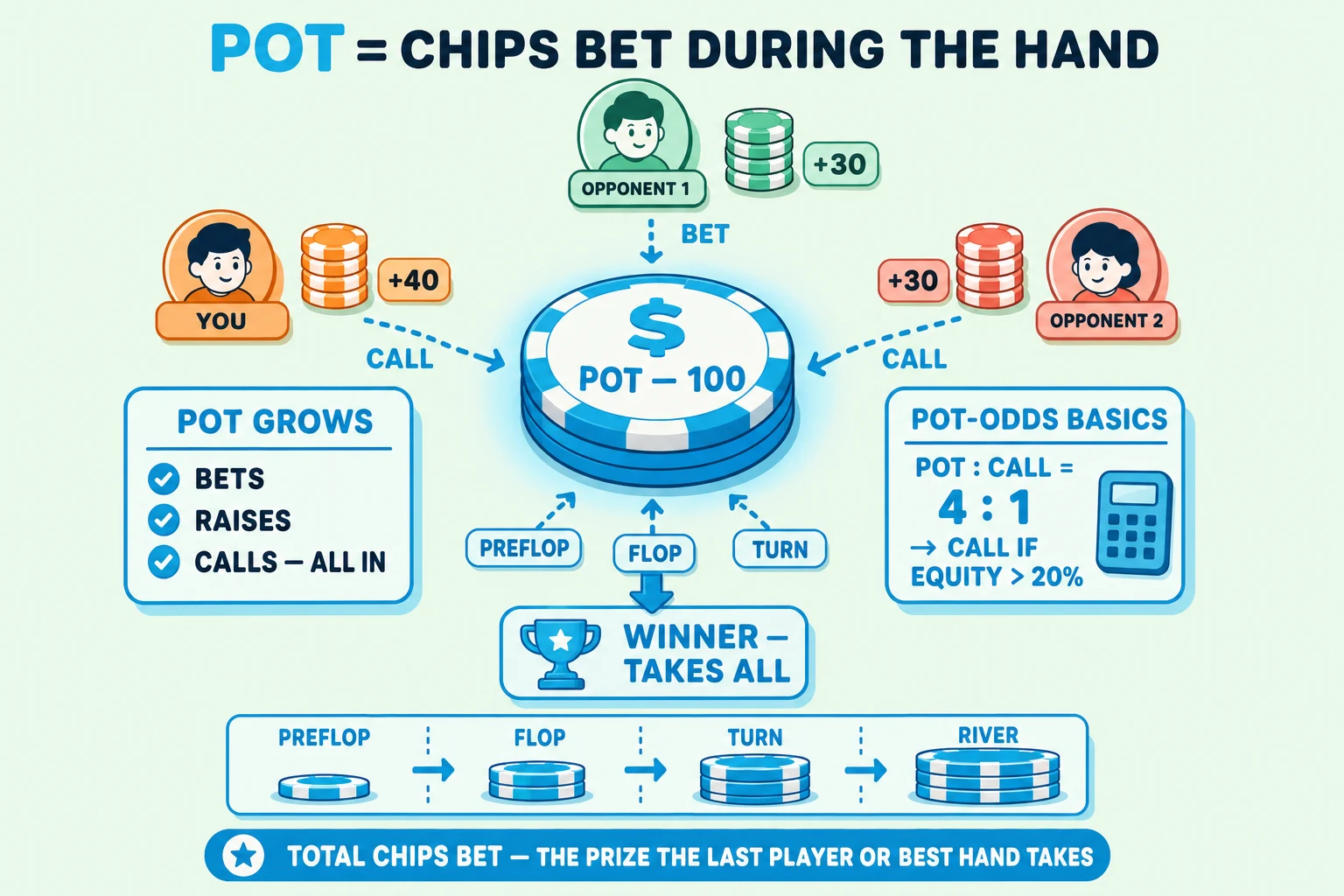
How the pot builds during a hand
Players add chips to the pot whenever they bet, raise or call. For example: the blinds put $7 in the pot preflop, a player opens for $20, another raises to $60 and the opener calls - the pot now contains the original $7 plus $120 in new action. No-limit rules let any player bet up to their entire stack, so pots can jump suddenly and dramatically. Tracking exact pot size matters: a $10 bet into a $40 pot has a different strategic and mathematical consequence than a $100 bet into the same pot. Watch pot size to choose bet amounts, decide calls, and avoid overcommitting with marginal hands.
Using pot odds to decide calls
Pot odds are the ratio of the current pot size to the cost of a contemplated call. They show how much you stand to win versus what it costs to continue.
Simple steps to use pot odds:
- Count the current pot size, including the bet just made.
- Note the exact cost to call that bet.
- Form the ratio: pot : call. Example: pot $200 and bet to you $50 gives pot odds of 200:50, or 4:1.
- Estimate your hand’s chance of winning (your equity).
- If your win probability exceeds the break-even point implied by the odds, the call is mathematically justified.
Example: the pot is $150, an opponent bets $50, making the current pot $200. Calling costs $50, so your pot odds are 200:50 (4:1). Compare that to your estimated equity - based on outs (cards that improve your hand) and win probability - to decide whether to call.
Accurate pot-odds decisions depend on correct pot counting and realistic equity estimates.
Bet sizing and controlling pot size
Bet sizing controls how fast the pot grows. Large bets quickly inflate the pot, useful for extracting value with strong hands or applying pressure to force folds. For example, betting $150 into a $100 pot builds size and increases fold equity. Smaller bets or checks keep the pot manageable, protecting marginal hands and reducing risk to your stack. When facing multiple opponents or uncertain holdings, smaller sizing preserves chips while keeping weaker hands in play. Align your sizing with your goal: build the pot when ahead, control it when drawing or unsure.
Psychological and risk-management roles of the pot
Pot size shapes opponent behavior. Big pots raise stakes and can push some players to fold more while prompting others to gamble and call down with weaker hands. You can grow the pot to pressure risk-averse opponents or keep it small to avoid high-variance confrontations. Constant pot awareness helps balance aggression and bankroll protection. Avoid inflated pots in poor spots and build them in favorable ones to maximize long-term value.
Quick checklist
- Track the pot size after every betting action.
- Convert pot size and call cost into pot odds before calling.
- Choose bet sizes deliberately to either grow or control the pot.
- Use pot awareness to guide pressure plays and risk management.