


Call
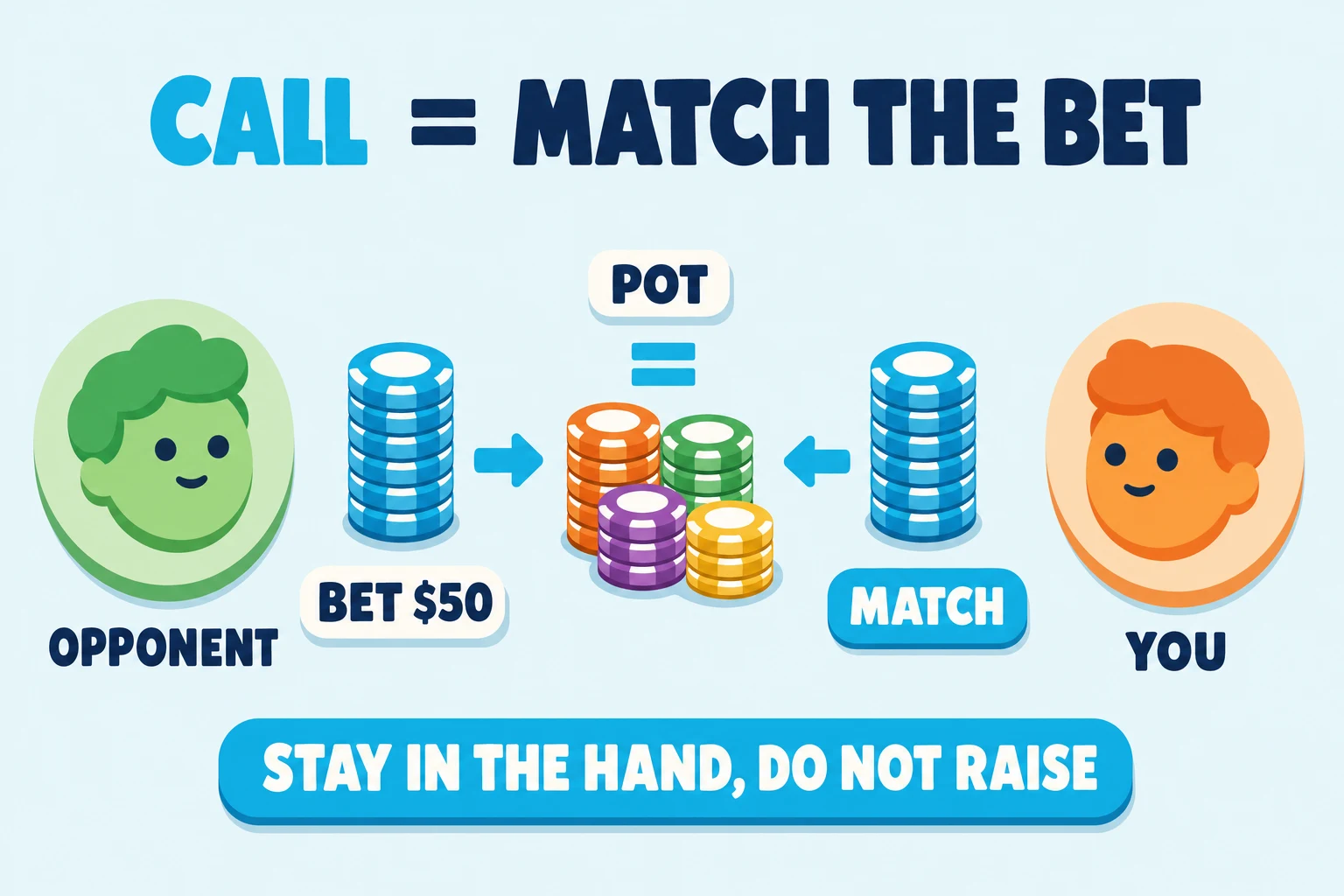
A "call" matches the current highest bet so you stay in the hand. You do not raise; you put in chips equal to the last bettor. In No-Limit, where players can wager any amount up to their stack, calls become more complex. An opponent can commit a very large amount on any street. Call when you want to realize equity-your chance to win at showdown-without expanding the pot. Calling also controls risk versus aggressive lines. Example: with A♠7♠ on a J♠9♦4♠ flop and one bet to you, calling preserves draw equity without inflating the pot like a raise would.
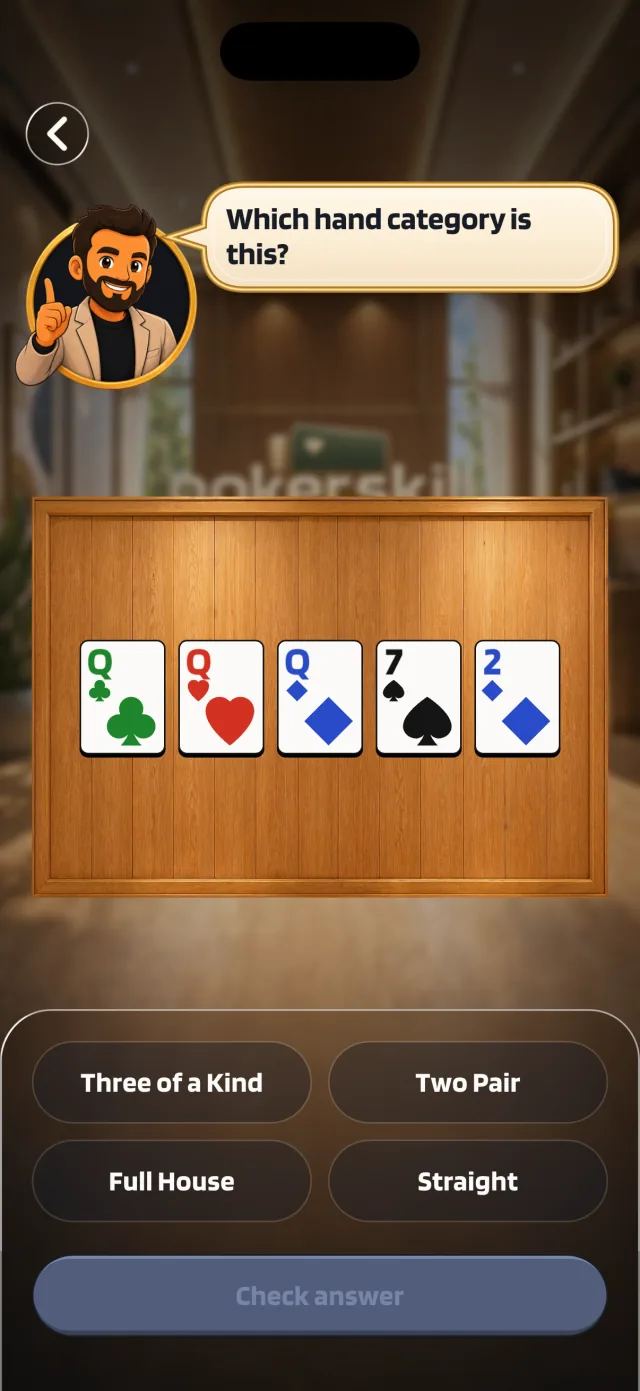
Practice this in Poker Skill. The Check-Call lesson sorts weak draws from real ones on the flop: A♥ 5♥ calls with a pair and the nut flush draw, while J♦ 6♦ folds on Q♠ 8♣ 3♥, where the backdoor needs two perfect cards.
Get the free appCall (No-Limit Texas Hold’em)
Definition: What a “call” means and when you use it
A “call” matches the current highest bet so you stay in the hand. You do not raise; you put in chips equal to the last bettor. In No-Limit, where players can wager any amount up to their stack, calls become more complex. An opponent can commit a very large amount on any street. Call when you want to realize equity-your chance to win at showdown-without expanding the pot. Calling also controls risk versus aggressive lines. Example: with A♠7♠ on a J♠9♦4♠ flop and one bet to you, calling preserves draw equity without inflating the pot like a raise would.
For the full pricing math, the three-question filter, and the calling-station fix, read calling in poker. Looking up more definitions? Browse the full poker terms list.
How to use pot odds and expected value (EV) to decide
Pot odds measure the ratio of the current pot size to the amount you must call. EV compares the long-term profitability of that call.
Steps:
- Count the pot, including chips already committed and any pending bets.
- Divide the current pot by the call amount to get pot odds as a ratio.
- Convert the ratio to the break-even win probability and compare it to your estimated chance of winning.
Example: the pot is $1,500 and an opponent shoves $375 all-in. Calculating using current pot ($1,500) versus call ($375) gives 4:1; including your call makes it effectively 5:1. You must win about 17% of the time (roughly 1 in 6) to make the call profitable. If your estimated chance to win exceeds that, the call is +EV.
Implied odds and reverse implied odds: thinking beyond the current pot
Implied odds estimate extra chips you expect to win on later streets if you hit your draw. They justify some calls that current pot odds do not, especially with deep stacks. Example: with one card to come and deep stacks, calling a small bet with four to a flush (one card away) can be correct because you expect to extract large bets when you hit.
Reverse implied odds consider the opposite: cases where hitting your apparent best hand still loses you more chips. For instance, you might make a lower flush while an opponent holds a higher one. Reverse implied odds argue against speculative calls when hitting often leaves you second-best.
Rely on implied odds more with deep stacks and players who pay off. Discount them when opponents rarely call large bets.
Reading opponents and avoiding common calling mistakes
Math alone won’t win hands. Avoid reflexive calling with weak draws or marginal hands versus hyper-aggressive players unless pot odds and reads justify it. Conversely, call more against opponents who bluff frequently or overvalue hands.
Track tendencies: bet sizes, aggression frequency, and shown hands at showdown. If a player regularly overbets with weak holdings, calling with medium strength becomes more attractive. If they shove only with monsters, fold more often.
Concrete mistake to avoid: calling small bets on dangerous boards-paired or coordinated suits-without a clear plan for later streets. You can still lose even when you hit.
Practical factors: position, stack depth, and tournament vs cash game play
Position matters: calling from late position gives you more information from opponents who act after you. Stack depth changes implied odds: deep stacks make speculative calls reasonable; short stacks reduce implied odds and push decisions toward folding or shoving.
Tournament play emphasizes survival and often reduces marginal calls. Cash games with deep stacks justify more speculative calling. Always use effective stack size-the smaller of you and your opponent’s stacks-when calculating pot and implied odds.
Checklist
- Calculate pot odds before deciding to call.
- Estimate your win probability and compare it to pot odds for EV judgment.
- Consider implied and reverse implied odds given stack depths.
- Observe opponent tendencies and recent showdown behavior.
- Adjust calling frequency for position and game format (cash vs tournament).