


Reverse Implied Odds
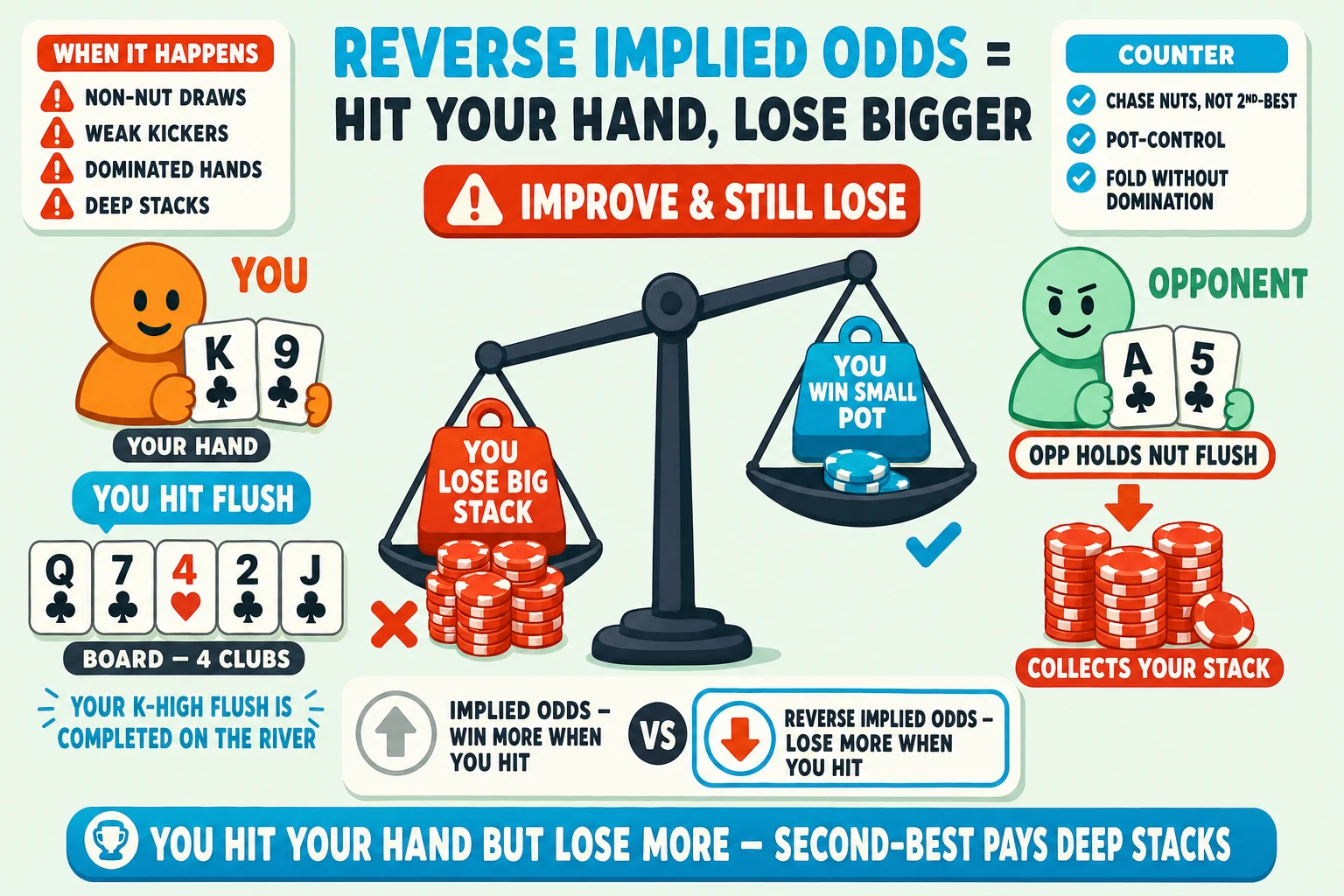
Reverse implied odds occur when you improve your hand but still lose more chips. The problem isn't failing to improve; it's improving to a hand that's actually second-best. This occurs often in No-Limit Hold'em, where deep stacks allow large payoffs. For example, you make a king-high flush (five cards of the same suit) on the river, but an opponent has an ace-high flush. They can jam and win the pot, leaving you with the better-looking but losing hand.

Practice this in Poker Skill. The CO vs One Caller lesson folds K9 offsuit behind a limper for a reverse-implied-odds reason: it makes a top pair that a better kicker beats, so it wins small and loses big.
Get the free appReverse Implied Odds
What Reverse Implied Odds Are
Reverse implied odds occur when you improve your hand but still lose more chips. The problem isn’t failing to improve; it’s improving to a hand that’s actually second-best. This occurs often in No-Limit Hold’em, where deep stacks allow large payoffs. For example, you make a king-high flush (five cards of the same suit) on the river, but an opponent has an ace-high flush. They can jam and win the pot, leaving you with the better-looking but losing hand.
Short definitions: “nuts” - the best possible hand given the board. “Kicker” - a side card used to break ties.
Typical Situations That Create Reverse Implied Odds
These concrete matchups often create reverse implied odds:
- Chasing non-nut draws. For example, with K♣9♣ and two clubs on board, the river can give you a king-high flush while an opponent holds A♣x♣. Your flush is second-best to their ace-high flush.
- Top pair with a weak kicker in multiway pots. “Multiway” means more than two players. Example: you hold K♠10♣ on K♦7♥3♠; you have top pair but a weak kicker. An opponent with K♣Q♣ beats you, and more players increase the chance someone has a better kicker or two pair.
- Made hands that can be outdrawn later. Example: you make a flush on the turn while another player has a set. If the river pairs the board, their set becomes a full house and your flush loses a large pot.
How Stack Size and SPR Amplify the Risk
Deeper stacks magnify reverse implied odds because opponents can pay you off for large amounts when you are second-best. The more chips behind, the bigger the potential loss.
SPR - stack-to-pot ratio - equals effective stack size divided by pot size. High SPR turns small advantages into big swings. Later street bets can commit both players even after you improve, raising the cost of being second-best.
Short stacks cap your absolute loss, so reverse implied odds matter less in those spots.
Evaluating a Call: Accounting for Reverse Implied Odds
Use a simple, practical framework:
- Estimate how often your draw or improvement will still be behind. Consider opponents’ ranges and whether they often hold stronger hands, for example A-x against a K-high flush draw.
- Estimate the likely loss when second-best, factoring stack sizes and opponents’ willingness to commit chips.
- Adjust your call EV: subtract the likely “second-best” loss from projected winnings when you hit.
- Factor opponent tendencies. Players who thin-value or pay off big increase reverse implied odds; tight, fold-to-river players reduce it.
- Use board texture to judge whether your draw can become the nut hand or can be easily dominated.
Practical Adjustments at the Table
- Tighten calling ranges for non-nut draws and dominated top-pair hands, especially on coordinated boards (connected or suited).
- Prefer betting or folding rather than calling where you might get paid off when behind. Avoid passive lines that invite multi-street calls.
- Size bets to avoid committing to multi-street confrontations when vulnerable. Avoid marginal multiway pots, where domination risk rises.
Quick checklist
- Be cautious with non-nut draws, especially on coordinated boards.
- Consider opponent tendencies and stack sizes before calling improvements.
- Tighten calling ranges and adjust bet sizing in deep-stacked situations.
- Subtract potential “second-best” losses from projected call value before committing chips.