


RFI
Raise First In (RFI) means opening the betting round with a raise when no one else has entered the pot. Don't limp or wait for other action; opening raise forces opponents to call, fold, or 3-bet. Good RFI choices maximize expected value and give you control of post-flop dynamics. You pick pot size and often gain positional advantage when opening from late seats.

Practice this in Poker Skill. The preflop capstone shows how the seat changes an RFI, hand by hand: you fold K♥ 8♥ under the gun, where the range is tightest, and raise A♠ 8♠ once the action folds to the small blind.
Get the free appRaise First In (RFI) - How to Open-Raise Smartly
What RFI Is and Why It Matters
Raise First In (RFI) means opening the betting round with a raise when no one else has entered the pot. Don’t limp or wait for other action; opening raise forces opponents to call, fold, or 3-bet. Good RFI choices maximize expected value and give you control of post-flop dynamics. You pick pot size and often gain positional advantage when opening from late seats.
Brief jargon: a 3-bet is a re-raise after the initial raise; post-flop refers to play after the flop is dealt.
How Position Changes Your RFI Range
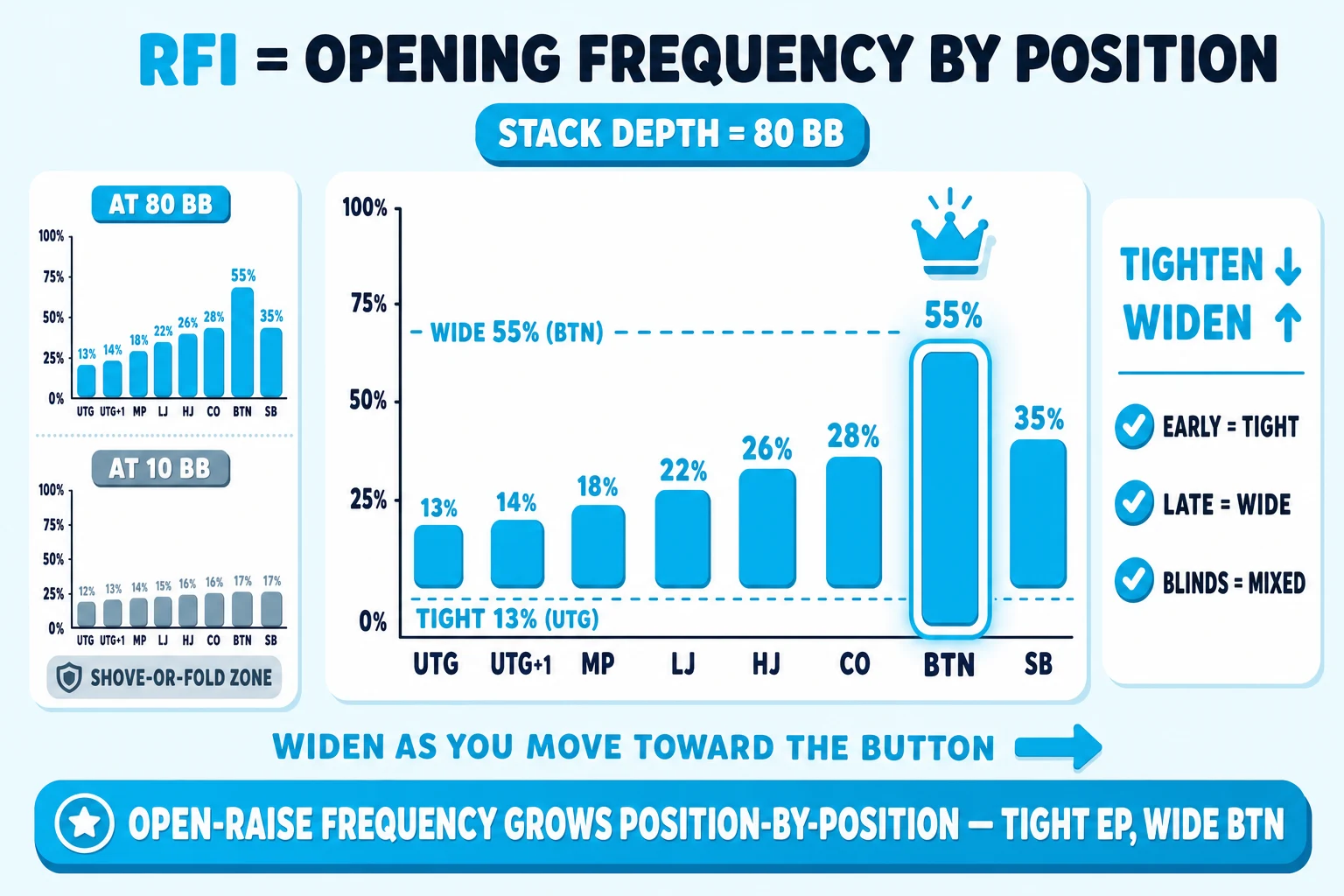
Your seat at the table determines how wide or tight your opening range should be. Early positions like Under The Gun (UTG) face more players and lack post-flop position, so open much tighter. Late seats such as Cutoff (CO) and Button (BN) face fewer opponents and can open many more hands.
Concrete example from common ranges: at about 80 big blinds (80bb) the Button can open roughly 55.5% of hands. When stacks shrink to around 10bb that Button opening range drops to about 38.9% because shove dynamics change. UTG stays markedly tighter in both cases.
From UTG, prefer hands with clear value or strong playability. From the Button, add speculative and steal-oriented hands because you’ll act last after the flop.
Adjusting RFI by Stack Depth
Effective stack depth shifts which hands profitably open. Shallow stacks favor hands with strong raw equity and often move decisions toward shove-or-fold solutions. Speculative hands lose value with short stacks because implied odds shrink.
Deeper stacks justify including small pocket pairs and suited connectors, since implied odds and post-flop maneuvering increase. In practice both how often you open and which hands you include depend on effective stack sizes.
RFI Differences: Tournaments vs Cash Games
Game format changes RFI strategy. Tournament antes add dead money and push you to widen ranges to steal blinds and antes. Tournament ICM pressure also tightens marginal opens in late stages where survival matters.
In cash games, rake reduces the profitability of marginal opens, so RFI ranges are often narrower. As tournament blinds grow and stack-to-blind ratios shift, adjust your opening ranges dynamically across stages.
Exploiting Opponents and Table Dynamics with RFI
Use GTO RFI charts as a baseline, then exploit opponent tendencies. Widen opens against blinds who fold too often, to win more steals. Tighten or fold more against frequent 3-bettors and aggressive defenders who punish opens.
RFI also helps control pot size: open to extract value from weaker hands that call, or fold hands that don’t play well multiway when you’re out of position.
Checklist
- Note your position (UTG, CO, Button) before choosing an RFI range.
- Check effective stack depth - favor raw equity with short stacks, add speculative hands with deep stacks.
- Account for antes, rake, and tournament stage when widening or narrowing opens.
- Start from a GTO baseline and adjust ranges based on opponent tendencies and table flow.
Apply these steps hand by hand: position first, stack second, then opponent reads - and your open-raise decisions will more consistently produce profitable, controllable pots.