


Ring Game
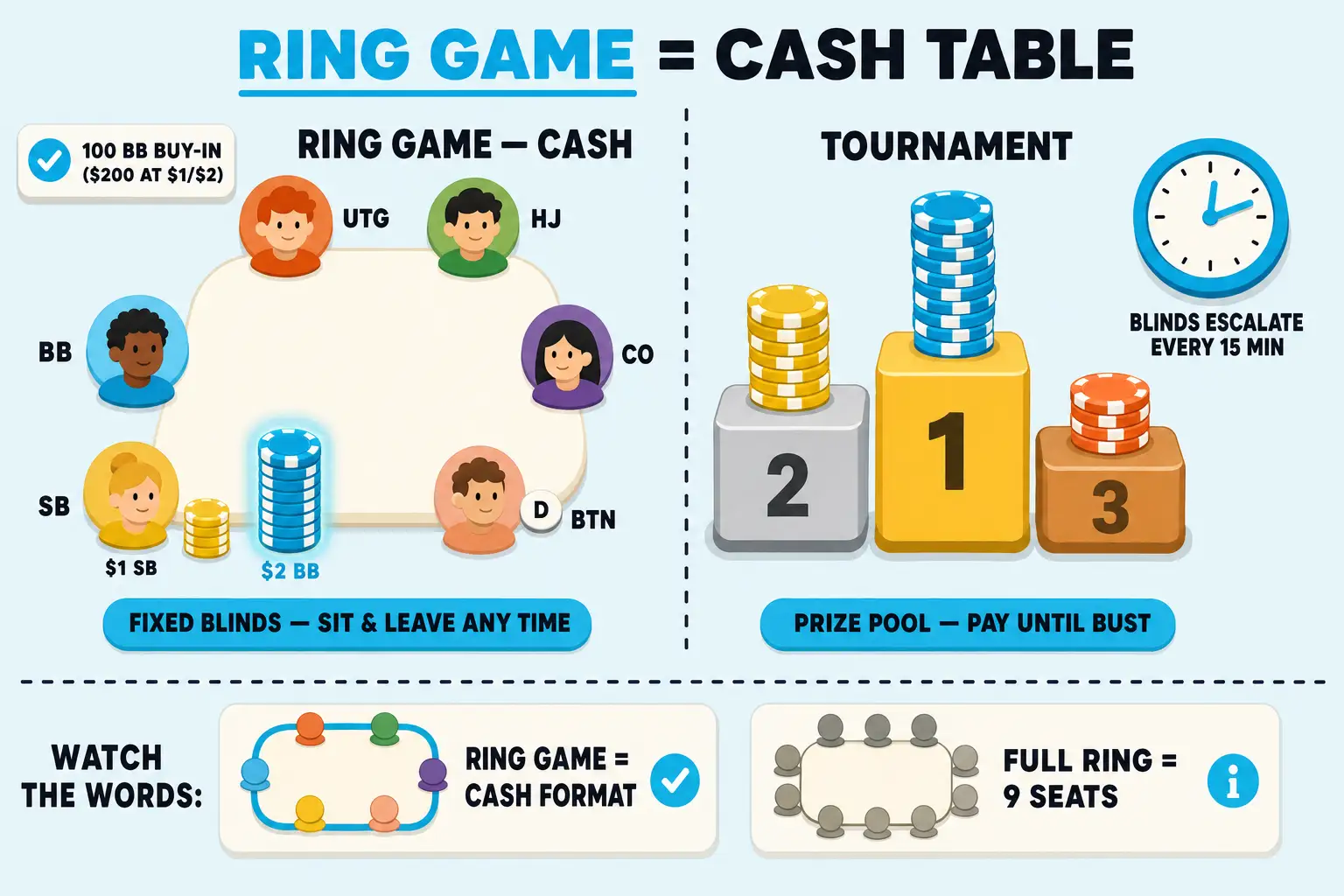
A ring game is an ongoing cash poker table with fixed blinds and chips that hold real money value. You buy in for a chosen amount, sit down whenever a seat opens, and leave whenever you want. The format is the everyday cousin of a tournament — no clock, no escalating blinds, no payout ladder, just one decision after another at the same stakes.
Ring Game in cash poker
What a ring game is
A ring game is an ongoing cash poker table where chips have real money value, the blinds stay fixed, and players can sit down or stand up whenever they like. You buy in for an amount you choose (commonly 100 big blinds in NLHE), play as many or as few hands as you want, and cash out the chips you have in front of you on the way out. There’s no clock, no payout ladder, and no point at which the table “ends” — the same seat keeps running as long as a few players want to play.
Related terms
- 6-max: the short-handed cash table size Poker Skill uses as its default training scope.
- Short-handed: any cash table with fewer than the full-ring complement, including the 6-max default.
- Rake: the house fee on cash pots; it shapes how aggressively a ring-game line has to win to clear net.
- Blinds: the forced bets that seed every ring-game pot. Fixed in cash, escalating in tournaments.
- Big blind: the unit a ring-game stack is measured in (a $200 stack at $1/$2 = 100 bb).
- Stack depth: the chip count in big blinds; ring games run at one steady stack depth, tournaments don’t.
- Preflop: the first betting round of every ring-game hand.
Ring game vs. full ring (the vocabulary trap)
These two phrases sound the same and don’t mean the same thing.
- Ring game is a format word. It tells you the chips are cash, the blinds are fixed, and the seat is sit-and-leave. It says nothing about how many seats are at the table.
- Full ring is a table-size word. It tells you the table is set up for nine or ten seats, in contrast to six-max or heads-up. It says nothing about whether the chips are cash or tournament.
A 6-max NLHE cash table is a ring game. A 9-handed cash table is a ring game and full ring. A 9-handed tournament is full ring but not a ring game. A few older books use “ring game” loosely to mean “full ring” — that usage exists, but the dominant modern usage is the cash-format one.
Ring game vs. tournament
The two formats split on five things every cash player should be able to name without thinking.
| Property | Ring game (cash) | Tournament |
|---|---|---|
| Chip value | Each chip equals real money | Chips are scoring units only |
| Blinds | Fixed at the posted level | Escalate at timed levels |
| Stack depth | Steady (you reload to your buy-in) | Drifts down as blinds rise |
| Sit and leave | Anytime, mid-orbit if you want | You play until you bust or finish |
| Payout | Whatever chips are in front of you | A prize-pool ladder that pays the top finishers |
The structural difference flows downstream into ranges, bet sizing, and risk. Cash ranges sit at one fixed stack depth and one fixed rake structure; tournament ranges shift with stack-to-blind ratio, ICM pressure near pay jumps, and ante-driven pot economics. Poker Skill’s lesson scope is 6-max NLHE cash at roughly 100 bb — that’s a ring game.
When the ring-game label matters
The label earns its keep in a few specific spots:
- Reading a cardroom schedule. A live cardroom posts “ring games” and “tournaments” as separate columns. If you walk past the right board and don’t know which is which, you can spend an hour at the wrong product.
- Picking a study lane. Cash strategy and tournament strategy diverge fast; a learner who treats the same opening chart as universal will misprice spots in both formats. The format you’re sitting in, ring game or tournament, decides which lessons apply.
- Bankroll math. A ring-game session ends when you stand up; a tournament session ends when you bust or cash. Cash bankroll guidelines are usually expressed in buy-ins (e.g. 25–50 buy-ins for the stake); tournament guidelines run higher because variance over a 1,000-entry field is larger than over the same number of cash hands.
- Vocabulary collisions. “Ring game” sometimes gets used to mean “full ring” in older material. Reading the surrounding paragraph for the format vs. table-size cue saves you from importing 9-handed assumptions into a 6-max ring game.
Example: a $1/$2 NLHE ring game session
You sit down at a $1/$2 6-max NLHE cash table at a local cardroom. The room runs ring games at $0.50/$1, $1/$2, $1/$3, and $2/$5; you pick $1/$2.
- Buy-in. You hand the chip-runner $200, which is 100 big blinds. The table caps the buy-in at $200; some rooms allow a $300 max instead. You stack your chips and post a blind to enter the next orbit.
- Blinds. Two players to the left of the dealer button post $1 (small blind) and $2 (big blind). The blinds rotate one seat clockwise after each hand. They don’t go up. You pay the same $2 big blind on hand 1 and hand 400.
- Sit-out. Your phone rings during hand 30. You tap “sit out,” your seat skips when the action reaches you, and the dealer doesn’t deal you in. You owe the missed blinds when you return; that’s all. No clock penalty, no chip decay.
- Cashing out. You play forty-five minutes, stand up with $263 in chips, and the room cashes them at face value. Your session result is +$63 minus rake and tip. You can come back tomorrow and sit at the same $1/$2 game with the same chip count if you want; you can also sit at a different $1/$2 table at a different room.
A tournament version of “the same $1/$2 stake” doesn’t exist. A tournament has buy-ins, a clock, escalating blinds, and a finish line. A ring game has none of that — which is exactly the structural feature that lets a cash grinder play hundreds of thousands of hands at one stake.
Common mistakes
1) Confusing “ring game” with “full ring”
Importing the 9-handed assumption into a 6-max table breaks ranges from the first decision. A 6-max cutoff opens roughly twice as wide as a full-ring cutoff because the cutoff is closer to the button when there are fewer seats behind. If you read “ring game” and picture a 9-handed table when you’re sitting at a 6-max table, every range you load is wrong.
2) Bringing tournament range assumptions to a ring game
Tournament solver work bakes in escalating blinds, ICM, and ante economics. A ring game has none of those. Pushing 8 bb open shoves from the small blind because “that’s the chart” is a real leak when you’re sitting deep in a $1/$2 cash game. Cash ranges are tighter from early position, more linear, and less reliant on fold-equity shoves than tournament ranges at comparable stack depths.
3) Ignoring that the rake structure is fixed across the session
In a ring game the room takes the same percentage on every raked pot, all night. The rake quietly compounds. Players who study tournament ranges and bring them to a cash table often lose to the rake before they lose to opponents — small-pot calls and limp-call lines that were marginal at gross pot odds become losers once the cap is removed. Read the rake entry before you treat a ring-game decision as if rake didn’t exist.
4) Treating “full ring” as a synonym for “tight”
Full-ring tables do play tighter than 6-max on average, but the slang collapse is misleading. A loose live $1/$2 full-ring table can be looser than a tight online 6-max table; the seat count is one input to range width, not the only one. Use short-handed and 6-max as your table-size vocabulary, and let “ring game” stay in its lane as the format word.
FAQ
Is a ring game the same as a cash game?
In modern usage, yes. A ring game is a cash poker table — chips with real money value, fixed blinds, sit-and-leave anytime. The phrase “ring game” survives from older cardroom language and is still standard on live schedule boards and in older training material. A few books use “ring game” specifically to mean a 9-handed cash table (full ring), but that secondary sense is rarer; if a paragraph contrasts a “ring game” with a tournament, it’s the cash-format meaning.
Why is a 9-handed cash table called full ring?
“Full ring” describes a table that runs at full seat capacity — typically nine or ten seats in NLHE. It’s a table-size word, not a format word. A 9-handed cash table is full ring; a 9-handed tournament event is also full ring at start. The phrase exists to distinguish full-capacity tables from short-handed formats like 6-max and heads-up. Poker Skill’s training scope sits in 6-max, which is short-handed by definition.
Do online sites still use the term ring game?
Some do, some don’t. Most major poker sites label the cash-game lobby with words like “Cash” or “Cash Games”; smaller and older sites still post a “Ring Games” tab. The lobby filter is usually the same regardless of which label the site uses — pick a stake, pick a table size, sit down, leave when you want. If you see “Ring Games” on the lobby chrome and “Cash” on the rules page of the same site, treat them as synonyms for the format.