


Rake
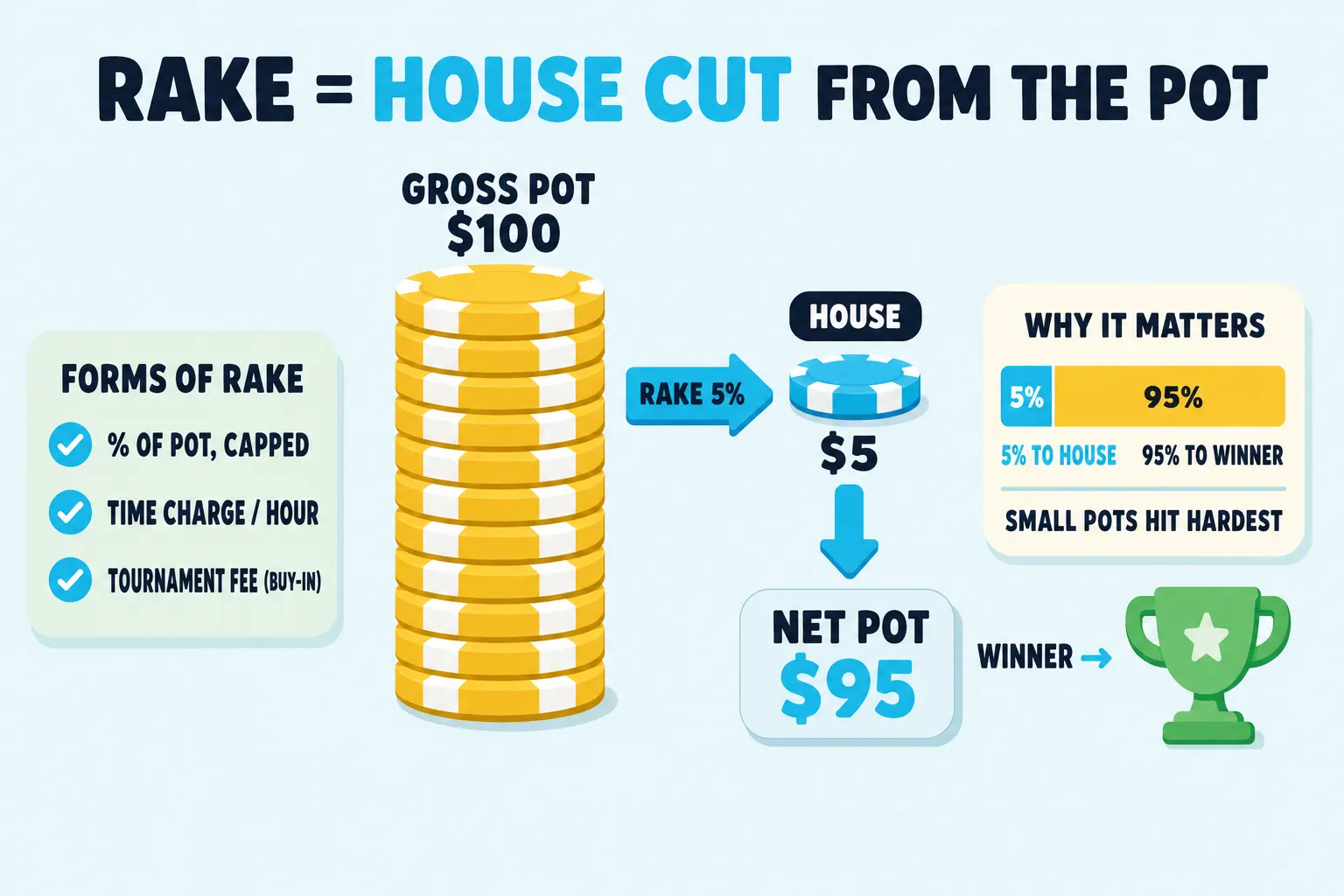
Rake is the fee the cardroom or online platform takes from a cash-game pot for running the game. It is usually charged as a small percentage of the pot with a cap, and sometimes as a flat hourly time charge instead. Rake quietly changes the math under every call, especially in small pots and at low stakes.
Rake in NLHE Cash
What rake is
Rake is the fee the cardroom, casino or online poker platform takes from a cash-game pot for running the game. The dealer (or the software) drops a small slice of each raked pot into a separate slot before the rest goes to the winner. In some rooms, rake is charged as a flat hourly fee per seat instead of being skimmed from pots. Either way, rake is the price of admission for a cash game, and it sits underneath every call, raise and check you make.
Related terms
- Pot: the gross figure on the table; rake is removed from this number before the winner is paid.
- Pot odds: the call-math that quietly shifts when the net pot shrinks below the gross.
- Expected value: the long-run scoreboard rake reduces line by line.
- Big blind: the standard unit rake is quoted in (e.g. capped at 3 bb).
- Blinds: the seeded chips that contribute to many low-rake preflop pots.
- Preflop: the street where no-flop-no-drop rooms charge no rake at all.
- Value bet: the line where the gross-vs-net gap matters most when sizing thinly.
How rake is charged
Cash-game rake comes in three common forms. The first two are what most live and online cash players see; the third is included for contrast because tournament fees work very differently.
| Form | What it means | Where you see it |
|---|---|---|
| Percentage of pot, capped | A percentage of the pot (around 5% online, often 10% in small live games), taken until a cap is reached. Small live games often cap at about 3 big blinds, and some rooms use one dollar cap, such as $4, at more than one stake. | Live cardrooms and online cash games. |
| Time charge | A flat hourly fee per player at the table. No money is taken from individual pots. | Some live high-stakes rooms; some short-handed games. |
| Tournament fee (for contrast) | Built into the buy-in and entry fee. Paid once before the event begins; no per-pot drop during play. | Multi-table tournaments and sit-and-gos; often listed as “$100 + $10”. |
Take a structure of “5% capped at $5”. That means the room takes 5% of every raked pot up to a maximum of $5. A $40 pot pays $2 in rake. A $100 pot pays $5. A $400 pot still pays $5, because the cap is hit. Once the cap is reached, the rake stops scaling with the pot.
Some rooms also follow a no-flop-no-drop rule: if the hand ends before a flop is dealt, no rake is taken. Taking those pots is one job of a first-in raise. No-flop-no-drop is why aggressive preflop play in raked games often pays for itself even when it does not get called; winning the pot before the flop wins 100% of the gross pot, while winning a postflop pot wins 100% of the net pot.
Why rake bites small pots hardest
Capped rake is harder on small pots than on big ones, because the same percentage takes a larger share of a smaller gross. A $20 pot at 5% pays $1, a fee that is 5% of what you win. A $400 pot at 5% capped at $5 pays $5, barely over 1% of what you win. That asymmetry is why small-pot calls and thin limp-call lines are the first to suffer in a heavily raked game.
Two practical consequences sit on top of that math.
- Marginal calls move from +EV to -EV. A line that is barely profitable at the gross-pot price stops being profitable once the rake is removed, and the weakest hands are the first to go.
- Low-stakes games get tougher. A $4 cap at $1/$2 is a much bigger share of an average pot than a $5 cap at $5/$10. Players who switch up in stakes often find that similar results in big blinds per hour produce more net dollars per hour, because the rake-to-pot ratio gets smaller.
The general rule the books support: the higher the rake, the tighter the preflop ranges should be and the more value there is in lines that take the pot down before a big rake hit.
Example: gross pot vs net pot
A $1/$2 6-max cash table runs 5% rake capped at $5. You open Q♠ J♠ on the button to $6. The big blind calls, and you take the flop heads-up. The pot at that point is $13 (your $6, the big blind’s $6, the small blind’s $1). On a T♠ 7♠ 2♣ flop the big blind checks, you bet $9 with your flush draw and the big blind calls. The pot is now $31. The 5♠ turn completes your flush: you bet $20, big blind calls. River is 4♣: the big blind checks, you bet for value and the big blind folds, so the pot you win is the $71 already in the middle.
- Gross pot: $13 + $18 + $40 = $71.
- Rake taken: 5% of $71 = $3.55, under the $5 cap.
- Net pot you scoop: $71 - $3.55 = $67.45.
The $3.55 is easy to miss because it never reaches your stack.
A second case shows the cap behavior. A $5/$10 game, same 5% cap at $5. You win a $300 pot. 5% of $300 is $15, but the cap kicks in at $5; you pay $5. The same percentage rule produces a much smaller share of a much bigger pot.
What rake actually costs you
You only pay rake on pots you win, so your personal bill is the number of pots you drag multiplied by the rake taken from each one.
Start with the room’s structure. At $1/$2 with 5% capped at $5, any pot of $100 or more costs you the full $5. Pots smaller than that cost you 5% of whatever the pot was.
Then estimate how many pots you actually win in an hour, which is a small fraction of the hands a live table deals.
Say you drag six pots an hour at that table, of the size in the example above:
- Rake per pot: $3.55
- Pots won per hour: 6
- Cost per hour: 6 × $3.55 = $21.30
At $1/$2, where the big blind is $2, $21.30 an hour is roughly 10.7 big blinds an hour going to the room. Win bigger pots and each one costs the full $5 cap instead, which puts the hourly figure at $30, or 15 big blinds an hour.
That is the number your edge has to clear before you have made a single dollar. It is also why the same player can be a winner in one room and a loser in another with identical play. Two things move it: how many pots you win, and what the cap is where you sit.
Nothing about this is hidden. The structure is posted at the desk or in the lobby, the arithmetic is one multiplication and almost nobody does it.
Common mistakes when ignoring rake
1) Paying for thin marginal calls without rake-adjusting
A flop or turn call that breaks even at gross pot odds is a small loser at net pot odds. The gap is small per hand and devastating across thousands of hands. The fix is straightforward: when a call is borderline, lean toward folding in a heavily raked spot and toward calling in a less-raked or tournament spot. The math does not care that the difference looks small.
2) Limping into multi-way raked pots with junk
Open-limping with weak hands is already a marginal habit; in a raked game it is worse, because the small pots you tend to win after limping are the ones the cap takes the biggest percentage of. Limp is on the menu for every hand of Poker Skill’s First In: Don’t Limp lesson, and it is never the right answer. Tight, position-aware preflop play earns a quiet bonus in raked games: it shifts you toward bigger pots when you do play, and bigger pots get a smaller share taken at the cap.
3) Using tournament strategy assumptions in cash games
Tournaments charge their fee up front and let you play freely from there; cash games charge per pot. That difference shows up in preflop ranges, which rake pushes tighter in cash games. Treating cash-game preflop ranges as if they were tournament ranges drifts you into too many small pots that get raked.
4) Ignoring time charge math when the room offers both
A time-charge game has no per-pot drop; you pay a fixed hourly fee and keep 100% of every pot you win. That structure rewards playing more hands and more pots. A percentage-rake game rewards playing fewer, bigger pots. If you sit in a time-charge game and play your normal raked-game strategy, you are paying for hours you did not use.
FAQ
Is rake taken on every hand?
Not always. Under a no-flop-no-drop rule, if every player folds before the flop, the winner takes the pot with zero rake removed; once the flop is dealt, the room takes the percentage up to the cap. Time-charge games are the exception, because the fee is per hour at the seat rather than per pot, so it does not depend on whether a flop comes.
How much rake is normal in a low-stakes cash game?
A common small-stakes live structure is 10% of the pot capped at about 3 big blinds, and online cash games often take around 5%. Some rooms keep one dollar cap across stakes, such as 10% capped at $4 in both $1/$2 and $2/$5 games. A fixed cap like that is 2 big blinds at $1/$2 but less than 1 at $2/$5, which is why rake takes a smaller share of your winnings as you move up in stakes.
How much does rake cost me per hour?
Multiply the number of pots you win in an hour by the rake taken from each. At $1/$2 with 5% capped at $5, a pot of $100 or more costs you the full $5, so winning six such pots an hour costs $30, which is 15 big blinds an hour. The pots-won figure is the part you have to estimate honestly for yourself. Whatever total you land on is what your edge has to beat before you show a profit.
Does rake change my preflop strategy?
Yes, in cash games. With rake, marginal hands that would be playable in a cheaper game stop being profitable, so you play fewer hands before the flop, and the size of the adjustment depends on how heavy the rake is. Tournament ranges do not need this adjustment because the fee is paid once before play begins.