
Expected Value in No-Limit Texas Hold’em
What Expected Value (EV) Means for Your Poker Decisions
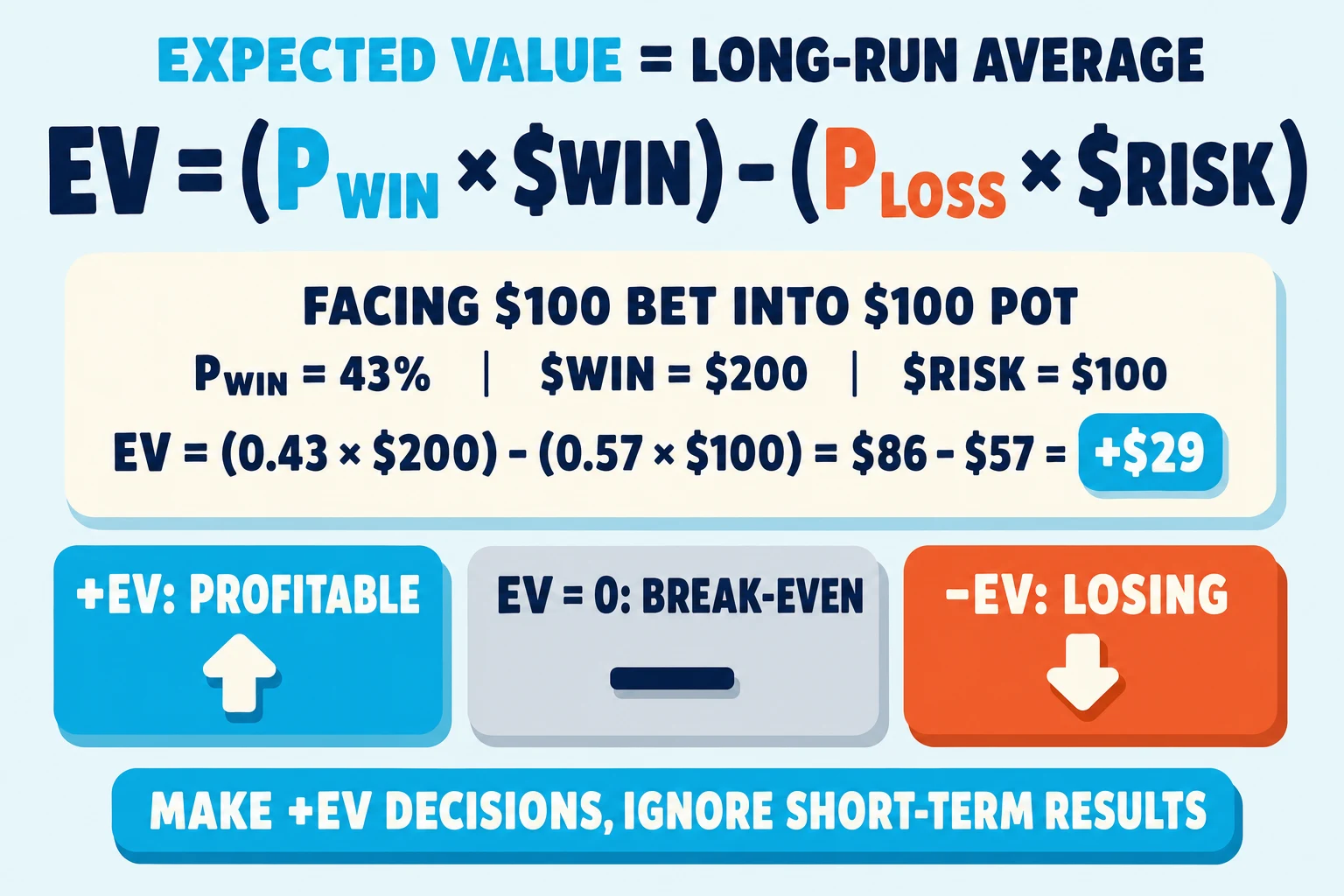
Expected Value (EV) measures the average outcome of a decision over many repetitions. In poker, EV shows whether calling, betting, raising, or folding earns chips long term. +EV decisions make money over time; -EV decisions lose money; EV = 0 is break-even. Use EV to compare options instead of relying on single-hand results.
How to Calculate EV (Simple, Practical Formula)
The basic equation is: EV = (Probability of Winning × Amount Won) - (Probability of Losing × Amount Risked).
Quick table check:
- Determine how much you can win if the action succeeds.
- Determine how much you must put in (the risk).
- Estimate your chance to win and plug values into the formula.
Example: you face a $100 bet into a $100 pot. If you call $100, the pot after your call is $300, so you can win $200 while risking $100. Let P be your chance to win: EV = P × $200 - (1 - P) × $100. Set EV = 0 to find the break-even P: P × $200 = (1 - P) × $100 -> P = 1/3 (≈33%). Call only if your win probability exceeds that break-even point.
Convert hand equity (your percentage to win) and pot sizes into the formula to decide whether a call or raise is +EV.
Preflop EV and Hand-Selection Principles
Preflop decisions should favor hands with higher expected equity and better playability. Playability means how often a hand can improve and how easily it realizes equity on later streets. Construct opening and 3-betting ranges around +EV opportunities given your position and stack sizes. In late position you can open wider because positional advantage increases EV for many hands. Avoid marginal hands that look okay preflop but become -EV postflop, and beware reverse implied odds-when you win small pots but lose big to stronger hands.
Post-Flop EV: Pot Odds, Implied Odds, and Reverse Implied Odds
Pot odds compare the call amount to the total pot after your call and give the break-even probability required to justify a call. Implied odds account for additional money you expect to win on future streets if your draw completes, turning marginal calls into +EV. Reverse implied odds describe situations where your made hand still loses to a stronger holding, which can make a call -EV. Recalculate EV on every street: as bet sizes and ranges change, a line that was +EV on the flop can become -EV on the turn or river.
EV When Facing or Making Bets: Sizing, Bluffs, and Balance
Bet sizing alters payoffs and therefore the EV of each line. Bigger bets increase rewards when successful but also raise the cost of bluffs and calls. Solvers mix sizes to maximize EV and reduce exploitability. Bluffing adds EV when opponents fold often enough; balance between bluffs and value bets protects long-term EV against observant players. In practice, using the dominant solver bet size often preserves most EV while keeping decisions simpler.
Measuring and Scaling EV: Tracking Results and Units
Measure performance in big blinds per 100 hands (bb/100) or as percentage-of-pot to compare sessions and actions. Small edges-a few percentage points of +EV-compound into significant profit over thousands of hands. Use post-session review to turn theoretical EV lines into concrete adjustments: identify recurring -EV spots and replace them with +EV alternatives.
Quick checklist
- Use the EV formula to test any call, bet, or raise before committing chips.
- Compare pot odds to hand equity and include implied and reverse implied odds when relevant.
- Choose bet sizes that preserve positive EV; favor dominant sizes when practical.
- Balance bluffs and value to protect long-term EV against observant opponents.
- Track results in bb/100 and review hands to convert theory into consistent +EV decisions.