


Equity Shift
Equity measures your percentage chance to win the pot at showdown. An equity shift is any change in those chances as cards are revealed or as opponents' ranges tighten. Shifts occur on every street - preflop, flop, turn, and river - and a single card can swing equity dramatically. Recognizing shifts matters: if your equity drops after the flop, betting as if nothing changed can turn value into a costly bluff. If your equity rises, extract more value or close action with a larger bet.
Practice this in Poker Skill. The turn lessons build the habit of rereading your equity one card at a time, as when the 7♥ on 6♥ 10♠ 2♥ completes the flush and J♦ 10♦ checks its top pair back.
Get the free appEquity Shift
What an equity shift means in No-Limit Hold’em
Equity measures your percentage chance to win the pot at showdown. An equity shift is any change in those chances as cards are revealed or as opponents’ ranges tighten. Shifts occur on every street - preflop, flop, turn, and river - and a single card can swing equity dramatically. Recognizing shifts matters: if your equity drops after the flop, betting as if nothing changed can turn value into a costly bluff. If your equity rises, extract more value or close action with a larger bet.
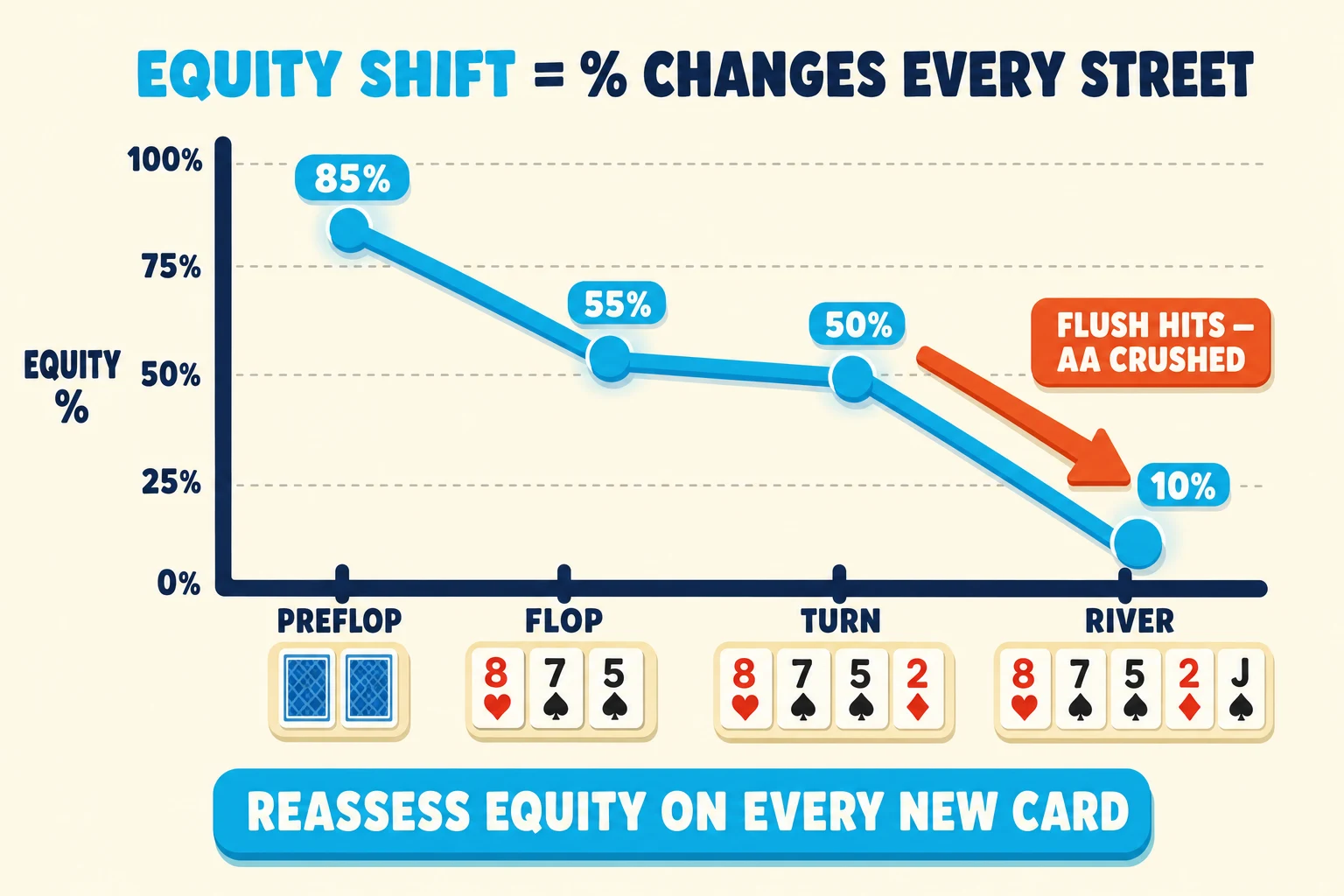
How equity changes from preflop to river
Preflop equities are calculated against opponents’ ranges (the set of hands they might hold). For example, A♦A♣ is a heavy preflop favorite versus a typical big blind calling range. The flop can change that picture quickly: draw-heavy or connected boards often shift equity toward the caller’s likely holdings. On the turn and river, a single card can reverse earlier advantages - straights or flushes complete, or missed draws restore your lead. Think of equity as fluid: preflop advantage does not guarantee final equity. Example pattern: AA favored preflop; flop 8♥7♠5♠ brings spade and straight draws, cutting AA’s equity versus a calling range; a blank turn (2♦) may change little; a river spade completes a flush and crushes AA, while a blank river restores AA’s edge. Each street demands reassessment.
Range considerations, actions, and information
Your hand’s raw equity can differ from your entire range’s equity. If you hold a strong hand that rarely fits your line - for example, a set you usually check - your hand can be strong while your represented range looks weak. Bet size and timing narrow perceived ranges. Large bets often polarize toward very strong hands or bluffs; small bets suggest a wider, middling range. Use opponents’ actions to update how often they hold hands that beat you or that you beat. Practical rule: don’t calculate equity in isolation - translate bet size and timing into range weights, then estimate equity versus that updated range.
Board texture and positional impact on equity realization
Board texture matters. Wet, draw-heavy boards with connected suits and ranks allow many hands to improve, so equities shift faster and more dramatically. Dry boards, disconnected and rainbow, favor preflop favorites and produce smaller shifts. Position - acting last - helps you realize equity more often. When equities are close, the player in position controls pot size and uses opponents’ actions to fold out equity or extract value. Out of position, marginal hands realize equity less often; be more cautious on coordinated boards.
Tools, practice, and a practical example
Use equity calculators and simulations to see how hands perform versus common ranges across many runouts. Running A♦A♣ against a big blind defending range across thousands of boards builds intuition faster than ad hoc guesses.
Quick practice steps:
- Pick a common preflop spot, such as cutoff open and big blind call.
- Load a typical defending range for the caller and run equities for your hand.
- Examine several flop textures and note how equities shift; repeat for turn and river.
Concrete example: open A♦A♣ from the cutoff and get called by the big blind. Preflop AA is a strong favorite. Flop 8♥7♠5♠ gives spade draws and connected holdings much improved equity. That flop narrows ranges and shifts equity away from AA, so slow aggression unless the action or a specific read justifies continuing strongly.
Quick checklist
- Update equity estimates after every new card or significant bet.
- Think in terms of ranges, not just your hole cards.
- Adjust aggression based on board texture and positional advantage.
- Practice common matchups with an equity tool to build reliable intuition.