


Equity Realization
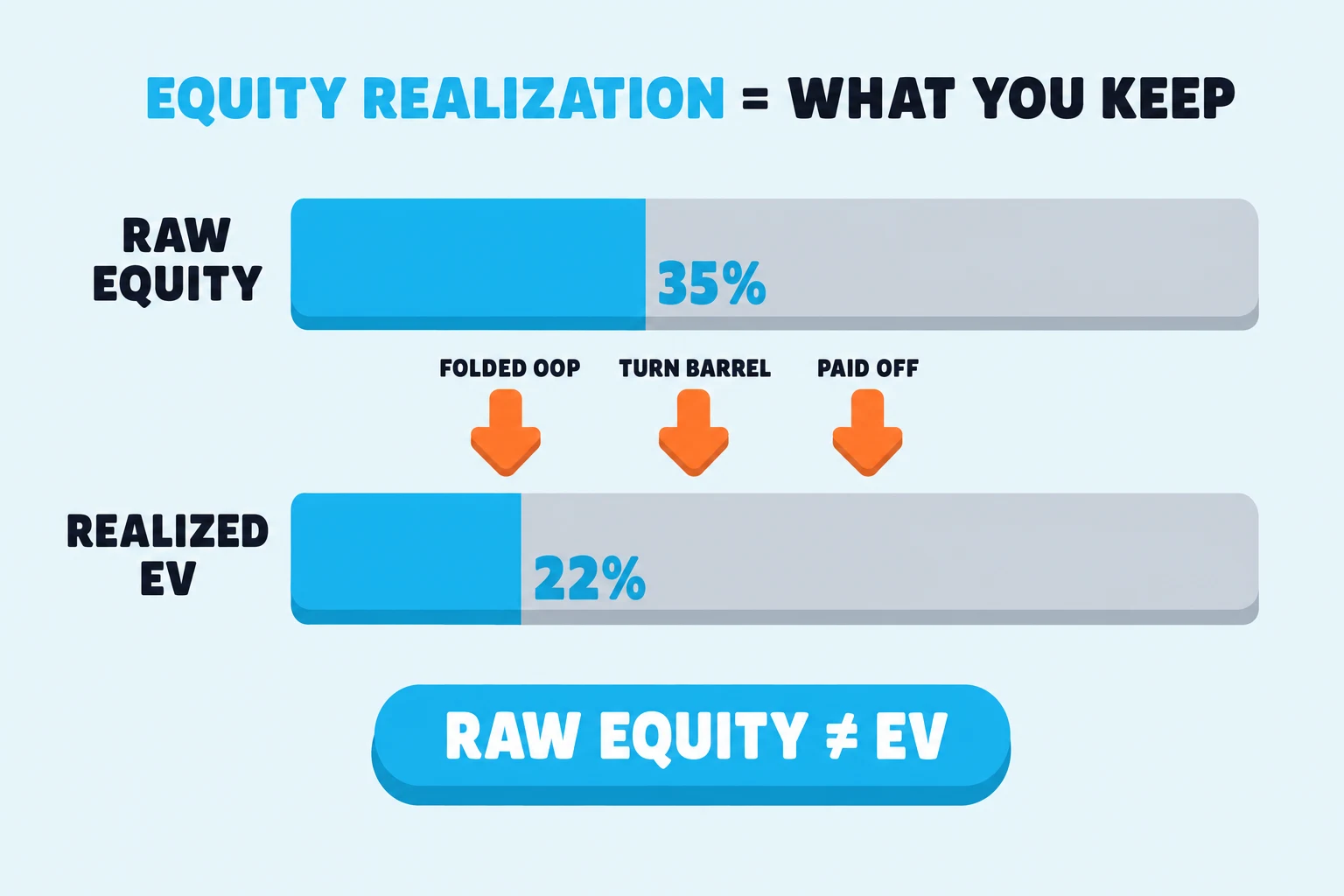
Equity realization is the fraction of your raw equity that actually turns into EV by the end of the hand. Position, sizing, stack depth, and playability decide whether you over-realize or under-realize, and why a 35% hand can still be a losing call.
Practice this in Poker Skill. Big blind defends in the lessons hinge on it: against an under-the-gun open, A♥ 4♥ calls because its wheel and flush draws help it realize equity out of position, while J♠ 8♣ folds because it realizes poorly there.
Get the free appEquity realization (EqR): how much of your equity actually becomes EV
Equity realization in plain English
Equity realization is the share of your raw equity that actually becomes expected value by the time the hand is over. Raw equity is the percentage of the pot you would win if all the money went in right now and the board ran out. In real poker, money does not all go in right now. Bets, folds, position, and future cards decide how much of that share you keep — and how much you give back.
A useful mental shortcut:
- If you capture more of the pot than your raw equity says you should, you over-realize your equity.
- If you capture less, you under-realize.
- In a toy game where you must run it out all-in every hand, every player realizes 100% of their equity. That is not the game we play.
Related terms
Equity realization vs raw equity, pot odds, and implied odds
People mix these four ideas constantly because they all live in the same pot. They are not the same thing.
| Concept | What it tells you | What it does NOT tell you |
|---|---|---|
| Raw equity | Your % chance to win the pot at showdown if no more betting happened | Whether you will actually reach showdown |
| Pot odds | The minimum equity you need right now to call this bet profitably | What happens on later streets |
| Implied odds | Extra money you expect to win on later streets when you improve | The price of getting outdrawn or bluffed off |
| Equity realization | The fraction of your raw equity you can actually convert into EV | The price tag on this exact call |
Pot odds price the call now. Equity realization is the answer to “and then what?” Implied odds and equity denial are the two sides that push realization up or down.
What changes how much equity you realize
A few inputs do most of the work. None of them are about your hole cards in isolation.
- Position. Acting last is the single biggest realization lever. In position you can check behind for a free card; out of position you face bets that often force folds, and folds before the river burn equity.
- Suitedness. On average, suited hands realize meaningfully more equity than offsuit hands because flush draws, backdoor flush draws, and combo draws give you ways to keep going.
- Connectedness. Connected cards make straights and combo draws. Offsuit, unconnected hands like Q2o flop weak pairs with no backup and tend to fold or peel and miss.
- Stack-to-pot ratio (SPR). Low SPR favors top-pair-type hands that want to commit. Higher SPR rewards speculative hands that need depth to get paid when they hit. Deeper stacks also raise the cost of reverse implied odds, which can pull realization back down for second-best hands.
- Range advantage. Weak hands inside a range that has a range-vs-range edge realize more, because the opponent cannot bet aggressively into a range that has them beat.
- Hand strength. Very strong and very weak hands are easy to realize — call/raise or fold. Medium-strength hands are the hardest, because they want showdown but cannot stand pressure.
Example: K9o vs 75s in the big blind
Same seat, same opponent, same price. Different realization stories.
Setup: 6-max NLHE cash, 100bb effective. Button opens to 2.5bb, you defend in the big blind.
Hand A: K9o — out of position, offsuit, weakly connected.
- Raw equity versus a typical button opening range is decent — somewhere around 38–42%, depending on the exact range.
- Realized EV is much worse. On most flops your hand turns into king-high or a weak top pair with a poor kicker. A flop c-bet folds out the live king-high and the gutshots that had a piece of the pot, and a turn barrel makes the rest of your made-pair holdings sweat. The K9 part of your equity that came from “I’ll spike a king” gets paid only when you are dominated.
- This is under-realization. You had the equity. You did not get to keep it.
Hand B: 75s — out of position, suited, connected.
- Raw equity is lower than K9o, often closer to 33–37%.
- Realized EV is much closer to its raw share, and sometimes better. It can flop flush draws, open-enders, pair-plus-draws, or backdoor equity that lets it continue through pressure. When it hits a disguised straight or flush, the implied-odds payoff can be large. Even when it misses, those draw paths give it credible semi-bluff chances.
- This is over-realization. The hand has fewer ways to win at showdown but more ways to keep going to showdown.
The lesson: K9o looked like the better defend on the equity number alone. 75s is often the better defend after realization is priced in.
Common mistakes
1) Treating raw equity as money in the bank
Raw equity is the share of the pot you would win if the cards ran out right now. The cards do not run out right now. If you fold before the river, that share goes to the other player. The money is real; the percentage is provisional.
2) Calling because “I have 35% versus his range”
The textbook trap: pot odds price the call at 30%, you have 35% raw equity, you click call. Then you fold the flop unimproved, fold the turn unimproved, or get bluffed off third pair. The hand needed to realize roughly 35% of the pot to break even. It realized 22%. The call was −EV the whole time.
3) Ignoring position when judging a defend
The same hand defended in the big blind versus defended on the button realizes wildly different equity. Out of position you eat c-bets and barrels; in position you take free cards and price your own continues. A defending range that ignores position is a range that loses money on the OOP half.
4) Forgetting stack depth
Implied odds rise and reverse implied odds rise with stack depth. The same suited connector that under-realizes at 30bb can over-realize at 200bb because the times you make a flush get paid much harder. The same dominated kicker that scrapes by at 50bb leaks more at 200bb because the times you make second-best get stacked.
FAQ
What is the simplest definition of equity realization?
Equity realization is the fraction of your raw equity that actually turns into EV. If you have 40% equity and you end up capturing 40% of the pot on average, you are realizing 100% of your equity. If you capture 32%, you are realizing 80%. Anything below 100% is under-realization; anything above is over-realization.
Why can a 35% equity hand be a losing call when pot odds say 30%?
Because pot odds only price the bet in front of you. Equity realization prices what happens after. If your hand has 35% raw equity but you only end up converting 28% of that pot into EV — because you fold flops you did not improve on, get bluffed off marginal made hands, or pay off when you make second-best — the call is −EV even though the price looked right.
Does position really change equity realization that much?
Yes. Acting last lets you take free cards, control the size of the pot, and react to the opponent’s action. Acting first forces you to commit to a plan with less information, and the bets you face often charge equity that you cannot fight back. The same hand routinely realizes 10–20% more of its raw equity in position than out of position, and that gap is wider on coordinated flops than on dry ones.
How do suited connectors over-realize?
Suited connectors keep finding new ways to continue. Flush draws, straight draws, backdoor draws, pair-plus-draw combos, semi-bluff barrels — every flop gives the hand at least one path forward. Offsuit unconnected cards do not. Even with lower raw equity, a hand that can credibly continue on most runouts ends up converting a bigger slice of that equity into EV than a hand that has to either pair up or fold.