


Cutoff
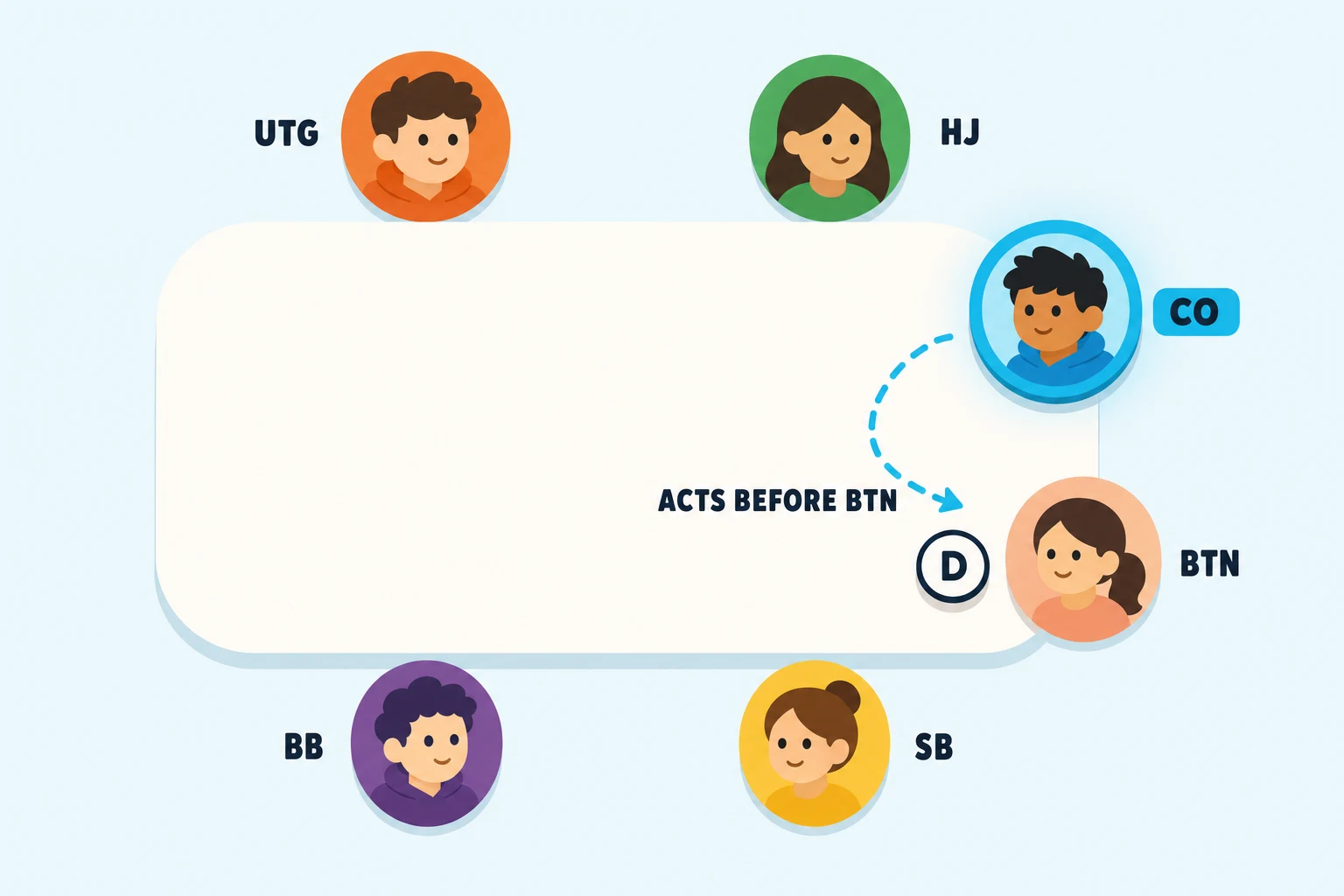
The Cutoff sits immediately to the right of the dealer button and acts just before it. The button marks the nominal dealer and, after the flop, acts last. Because you act late in most betting rounds, you see most opponents' choices before making your own.
Practice this in Poker Skill. When it folds to you in this seat, you open J♥ 10♠ and 7♣ 7♦ in the Cutoff: Raise or Fold lesson and fold K♣ 4♦ and 7♣ 6♦.
Get the free appCutoff
What the Cutoff Is and Why It Matters
The Cutoff sits immediately to the right of the dealer button and acts just before it. The button marks the nominal dealer and, after the flop, acts last. Because you act late in most betting rounds, you see most opponents’ choices before making your own.
Late action gives a core advantage. From the Cutoff you can apply pressure, steal pots, and open a wider range than earlier seats. Play aggressively to exploit opponents who fold too much or over-defend the blinds.
How to Shape Opening Ranges by Stack Depth
Stack size changes what you should open from the Cutoff at each depth.
- Short stacks (~10 big blinds). Around 10 big blinds, play a tight push/fold game and avoid speculative hands. Convert normal open-raises into shoves or folds because postflop maneuvering is limited.
- Medium stacks (20-40 big blinds). With 20-40 big blinds, favor raise/fold lines rather than shoving outright. Open a wider range that includes Broadways and suited aces, folding to strong resistance.
- Deep stacks (100+ big blinds). At 100+ big blinds, add speculative hands like suited connectors and small pairs. Deep stacks let you realize equity postflop and target multi-street value without committing chips immediately.
Examples: at 12bb you often shove hands like A9s or KQo to preserve fold equity. With 25-35bb, open those hands but favor raising and folding to heavy pressure. At deep stacks you can open 76s or 98s to play for implied odds.
Blind-Stealing and Preflop Pressure
The Cutoff is a natural blind-stealer and profits when blinds play tightly. Open-raising to pick up the blinds and antes becomes increasingly profitable.
How to attempt a steal:
- Open-raise to take the initiative and force folds from the button and blinds.
- Raise over limpers (players who just call the big blind) to seize the pot and prevent multiway hands.
- Increase steal frequency as antes rise in tournaments, since the pot becomes more valuable to pick up.
Steals work best against passive blinds; tighten your range versus defenders who fight back aggressively.
Postflop Plans and Tactical Choices
After opening or defending, use position to dictate the pace.
- Continuation bets (c-bets): a c-bet is a flop bet by the preflop aggressor. Favor c-betting flops that match your perceived range, such as ace-high or other high-card boards. These bets maintain initiative and fold out weaker hands.
- Pot control and value extraction: use position to keep pots small with marginal hands and build pots with strong ones. Check behind or make small bets to induce mistakes from opponents.
- Adjust aggression: change your line based on tendencies. Value-bet more versus players who call light, widen bluffs against frequent folders, and tighten versus players who raise often.
Adjusting to Button and Blind Responses
Watch players to your left; an experienced button may frequently three-bet your wide Cutoff range.
- Against aggressive left-players, tighten opens or add 3-bets and 4-bets with strong hands.
- Use stack depth to decide: shallow stacks often require committing all-in or folding. Mid stacks allow calling to play postflop or using 3-bets for bluff or value. Deep stacks favor more calls to exploit postflop play.
Let the button’s and blinds’ defense frequencies shape whether you widen, fold, or fight back.
Quick checklist
- Open wider from the Cutoff, but tighten versus aggressive left-seat players who three-bet frequently.
- Prioritize blind-steals and raise over limpers when blinds play passively and fold often.
- Adjust opening ranges by stack size: tight around 10bb, progressively wider as stacks deepen.
- C-bet favorable flops and use position to control pot size and extract value.
- Watch the button’s 3-bet frequency and plan counter-strategies: tighten, 3-bet, or 4-bet as appropriate.