


Counterfeit
Counterfeiting happens when the board duplicates a rank that one or both of your paired ranks have. That duplication reduces your hand's relative strength. In practice, a hand that looked strong - typically Two Pair - becomes weaker because the board removes the uniqueness of one of your pairs. Two Pair means you hold two different pairs, for example eights and fives. A kicker is the extra card that breaks ties when pairs are otherwise equal. Bottom two pair - your low pair plus a higher pair on the board - and top-and-bottom pair are especially vulnerable to counterfeiting. When the board later pairs, an opponent with a higher paired hole card or a matching rank can suddenly have the better hand.
Practice this in Poker Skill. The Counterfeits on the Board lesson deals the trap on A♥ K♦ 8♣: ace-eight flops two pair, the K♠ turn counterfeits it, and an ace with a queen kicker wins.
Get the free appCounterfeiting in No-Limit Texas Hold’em
What “counterfeit” means
Counterfeiting happens when the board duplicates a rank that one or both of your paired ranks have. That duplication reduces your hand’s relative strength. In practice, a hand that looked strong - typically Two Pair - becomes weaker because the board removes the uniqueness of one of your pairs. Two Pair means you hold two different pairs, for example eights and fives. A kicker is the extra card that breaks ties when pairs are otherwise equal. Bottom two pair - your low pair plus a higher pair on the board - and top-and-bottom pair are especially vulnerable to counterfeiting. When the board later pairs, an opponent with a higher paired hole card or a matching rank can suddenly have the better hand.
How counterfeiting happens on turn or river
You can have a secure two pair on the flop, then see the board pair on the turn or river. That new paired board changes which five cards make your best hand. When the board pairs with a rank that matches one of your pairs, that pair can become effectively “on the board.” Often your lower pair becomes little more than a kicker. The later the board pairs, the less opportunity you have to extract value or protect your hand, so those two-pair holdings become more vulnerable.
Concrete example you can visualize
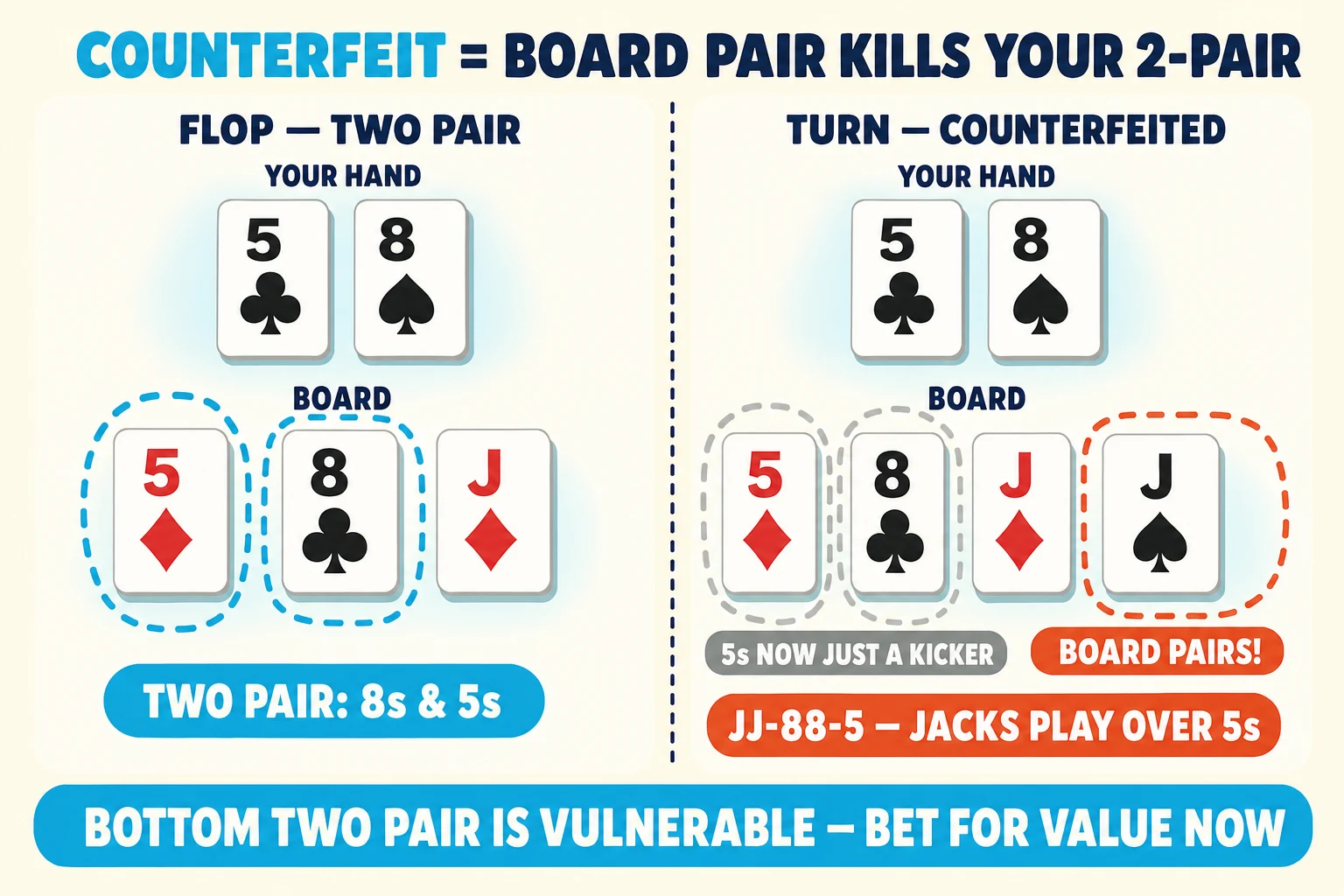
Hole cards: 5♣ 8♠ Flop: 5♦ 8♣ J♦
After the flop you have two pair: eights and fives. You are likely ahead of many single-pair and draw hands.
Turn or river: J♠ appears, making the board 5♦ 8♣ J♦ J♠.
Now the board contains a pair of jacks. Your best five-card hand becomes J J 8 8 5 - jacks and eights with a five kicker. Any opponent holding a jack plus a higher kicker now beats your hand. Similarly, an opponent with a higher paired hole card that pairs with the board can overtake you. Your bottom two pair (fives) has effectively been neutralized by the duplicated jack on the board.
Why counterfeiting makes slow-playing risky
Slow-playing - checking or calling to let opponents catch up - is risky with hands that can be counterfeited. If you check and the turn or river pairs the board, your earlier advantage can vanish and opponents can seize the initiative. Betting or raising extracts value now and charges opponents who need specific cards to beat you. Because counterfeiting can happen suddenly and late, delaying aggression often costs you value and reduces your fold equity after the board changes.
Simple table adjustments to avoid getting counterfeited
- Prioritize betting or raising vulnerable two-pair hands rather than checking. Charge draws and overcards to get value and protect your hand.
- Read board texture: if many overcards or a pairable rank remain, assume vulnerability and play for value now.
- If the board pairs on a later street, reassess immediately - treat your hand as weakened and reduce exposure if opponents show strength.
- Control pot size when uncertain about opponents’ holdings; avoid bloated pots with hands that one card can erase.
Quick checklist
- Identify bottom two pair and top-and-bottom pair as high-risk hands for counterfeiting.
- Prefer betting and raising for value and protection instead of slow-playing those hands.
- Watch turn and river ranks for potential board pairings.
- Reevaluate your hand strength and opponent ranges immediately after the board pairs.