


Cooler
A cooler is a poker hand where two strong holdings collide and the loser had no real way to fold. The classic example is pocket kings running into pocket aces preflop for stacks. The losing line was reasonable given the information available; the cards just lined up badly. A cooler is not a misplay, and it is not the same as a bad beat.
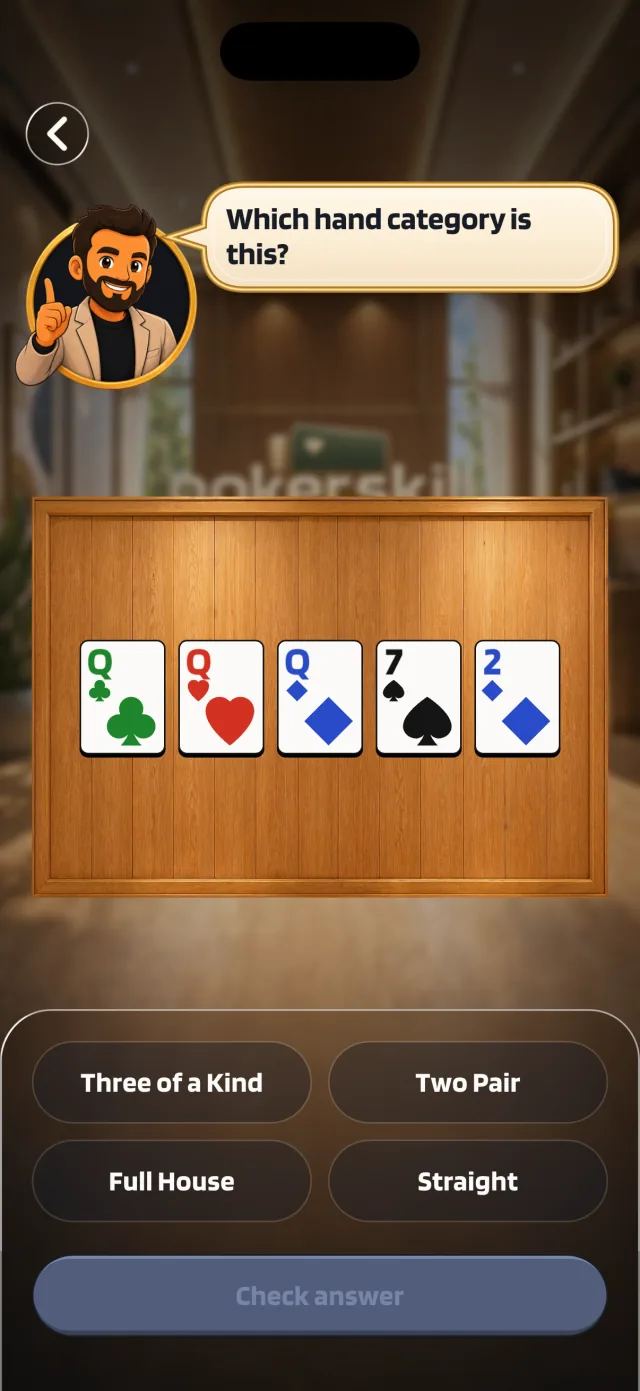
Practice this in Poker Skill. The Winners in Context capstone deals a cooler at showdown on 9♥ 9♦ 9♣ K♣ 2♦, where a full house loses to four nines.
Get the free appCooler (also “coolered” / “cold deck”)
What a cooler is
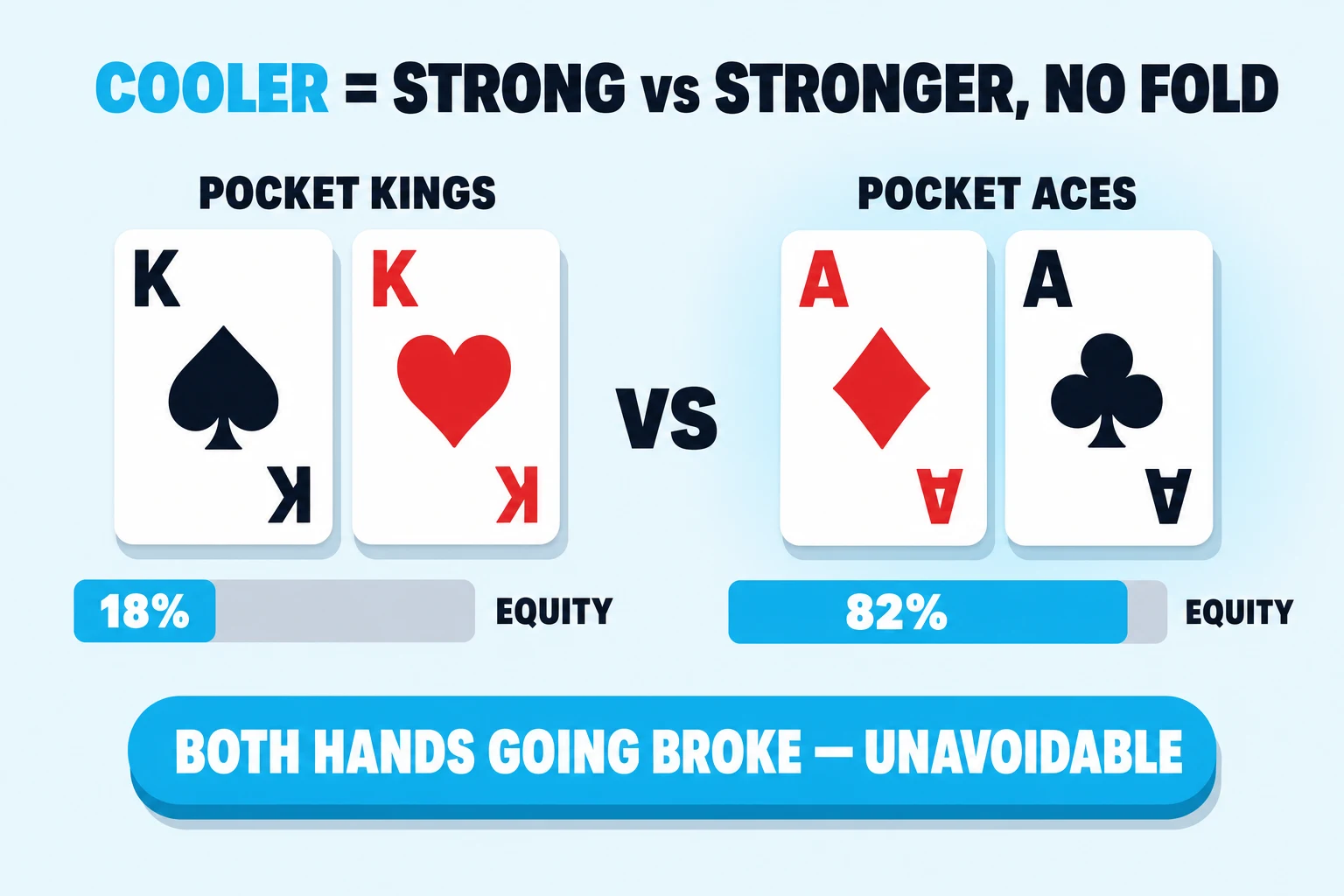
A cooler is a poker hand where two strong holdings collide and the player on the losing side had no real way to fold. The losing decisions were defensible with the information available; the cards lined up badly. The canonical example is pocket kings running into pocket aces preflop for stacks at 100 big blinds — the kings had ~18% equity and were never folding, the aces had ~82% and were never folding either. Both stacks went in. One got broken.
Related terms
A useful way to keep the term honest:
- Cooler = strong vs stronger, the loser was never folding given what they knew.
- Bad beat = strong was a favorite when chips went in, opponent caught a long-shot draw to overtake on a later street.
- Overplay = the loser thought they had a strong hand, but the opponent’s range had it crushed and a good fold was available. The label “cooler” is often misused here.
The decision-review test that draws the line: would I make the same play face-up? If yes, the loss was either a cooler or a bad beat. If no, it was an overplay wearing cooler clothing.
Cooler vs bad beat vs overplay
Same losing pot, three different shapes. Naming the right one is how a hand goes from “I ran bad” to “I learned something.”
| Frame | Both hands strong? | Did the loser have a fold? | Where the equity moved |
|---|---|---|---|
| Cooler | Yes — both hands made and committed | No — the loser was always going broke | Equity was already with the winner when chips went in |
| Bad beat | Loser was the favorite at the moment of all-in | Maybe, but the call was correct | A long-shot draw or one-card miracle hit on a later street |
| Overplay | Only the loser thought their hand was strong | Yes — a fold was available | Equity was never with the loser; the line ignored villain’s range |
A cooler is rare and unavoidable. A bad beat is rare and unavoidable. An overplay is common and fixable. Sorting losses into the right bucket is most of the work in showdown review.
When a hand really is a cooler
These are the matchups NLHE strategy books point at as canonical. Each one is rare on its own; collectively they explain almost every honest cooler claim.
- Pocket kings vs pocket aces preflop, all-in for stacks. KK has ~18% equity. When you have KK, the chance the table holds AA is roughly 1 in 26. Folding KK preflop in a normal cash spot is not a habit strong tournament or cash-game strategy wants. Going broke is the price of getting paid the other times.
- Set over set on the flop. Bottom or middle set collides with top set. Across the field this is about a 1-in-1,200 hand when both players hold a pocket pair. The lower set is drawing thin, the higher set is stacking off, and neither hand was foldable to standard postflop pressure.
- Bigger full house over smaller full house on a paired river. Both players make a full house when the river pairs the board, and the kicker decides it. Most of these complete on the river itself, which is exactly when both ranges are committed.
- Top set vs a flopped or turned straight on a coordinated board. The set was the strongest preflop hand; the straight was a draw that filled. On wet textures, top set is non-foldable to most lines and the straight is non-foldable to anything. This is the cooler that lives closest to the bad-beat border.
A non-cooler example for contrast: an overpair facing a flop check-raise on a low connected board. The overpair is one pair. The check-raising range is loaded with sets, two pair, and combo draws that have it crushed or close. Stacking off and calling the loss a cooler is the most common version of the misuse.
Example: pocket kings vs pocket aces, 100bb preflop
The canonical cooler, walked at 6-max NLHE cash, 100bb effective stack.
Setup: You open K♠K♥ to 2.5bb from the cutoff. The button 3-bets to 8bb. You 4-bet to 22bb. They jam for 100bb. You call.
The math:
- KK vs AA all-in preflop runs about 18% / 82%.
- The pot at the moment of call is ~125bb (your 22 + their 100 + small blind dead). You’re putting in another 78bb to win 122bb. Break-even equity = 78 / (78 + 122) = 39%.
- Your 18% is well below the line. EV(call) ≈ (0.18 × 122bb) − (0.82 × 78bb) ≈ 22 − 64 ≈ −42bb vs folding.
The face-up test: if both hands turn over before the runout, the call is a clear chip-EV mistake. So why is this still a cooler and not an overplay?
Because the question isn’t “what was the EV face-up?” It’s “what was the EV against the range that 5-bet jams 100bb?” That range is heavy with AA, KK, and AKs. KK is calling against most of that range and getting it in good against AKs. The number gets pulled down by the AA combos that show up roughly 1 in 26 times you hold KK, but the call is correct against the range. Folding KK to the jam concedes too much money the other times.
What changes if it’s QQ instead of KK: QQ vs the same jamming range starts losing money against the AA / KK combos plus loses to AKs more often. At the deepest stacks, QQ becomes a fold for many players. KK stays a call. That’s the difference between a cooler and a fold-able overpair: the matchup math at preflop range vs range, not the result of one runout.
The losing line is reasonable. The cards just sat where they sat.
Common mistakes when labeling a hand a cooler
1) Calling every overpair-vs-set loss a cooler
The overpair is one pair. Even AA on a low rainbow flop is one pair. When villain check-raises a connected board for two-thirds pot and jams the turn, their range is overweight on sets, two pair, and the rare big draw. Stacking off and saying “cooler” hides the leak: the player paid off a range that had them crushed. The fix is reading the board and the line, not folding fewer overpairs across the board.
2) Ignoring effective stack
A cooler at 100bb is a cooler. The same hand at 250bb is often something else. As stacks deepen, sets and full houses gain value over overpairs faster, and the case for slowing down with one pair gets stronger. The deeper you play, the more the “I had to call” framing earns its keep — and the deeper you play, the more often it doesn’t. Stack depth changes which losses get to call themselves coolers.
3) Treating bad beats and coolers as the same thing
Bad beats and coolers feel similar in the moment because both end with chips going the wrong direction. They aren’t the same. A bad beat means you were ahead when the chips went in and got drawn out. A cooler means you were behind when the chips went in and there was no obvious place to get out. Mixing them up muddles every review session: the fix for bad beats is patience, the fix for coolers is acceptance, and the fix for overplays is a different fold. Calling all three “coolers” hides which fix the player needs.
4) Letting the cooler label become tilt cover
After a cooler, the next ten hands are where most of the damage actually happens. The instinct is to win the chips back; the cooler label is a story that justifies looser calls and bigger bluffs as “earning back what was taken.” Real coolers are almost free of moral content. Treat them like a rake bill: a cost of doing business that does not change how the next hand should be played.
FAQ
Is a cooler the same as a bad beat?
No. A cooler is two strong hands colliding with no fold available; the loser was already behind when chips went in. A bad beat is a strong hand that was favored when chips went in and got run down by a long-shot draw on a later street. Same outcome, different mechanism. Calling them the same flattens two different lessons into one shrug.
How often does pocket kings run into pocket aces?
Roughly 1 in 26 hands when you hold KK at a full table. The number drops at a 6-max table and drops further heads-up because there are fewer hands that could be aces. KK still wins ~18% of the time when it does happen, so going broke with kings preflop in a normal cash spot is not a leak. Folding kings preflop because of the threat of aces is.
Can coolers be avoided?
Honestly held coolers — the matchups in this entry — are unavoidable in any serious sample. Trying to avoid them costs more than the coolers themselves. What can be reduced is the second category, the losses that wear cooler clothing but are actually overplay. Reading lines and ranges, respecting effective stack, and getting honest at the review desk are how that pile shrinks. The first pile stays the same size forever, and that is fine.