


Set
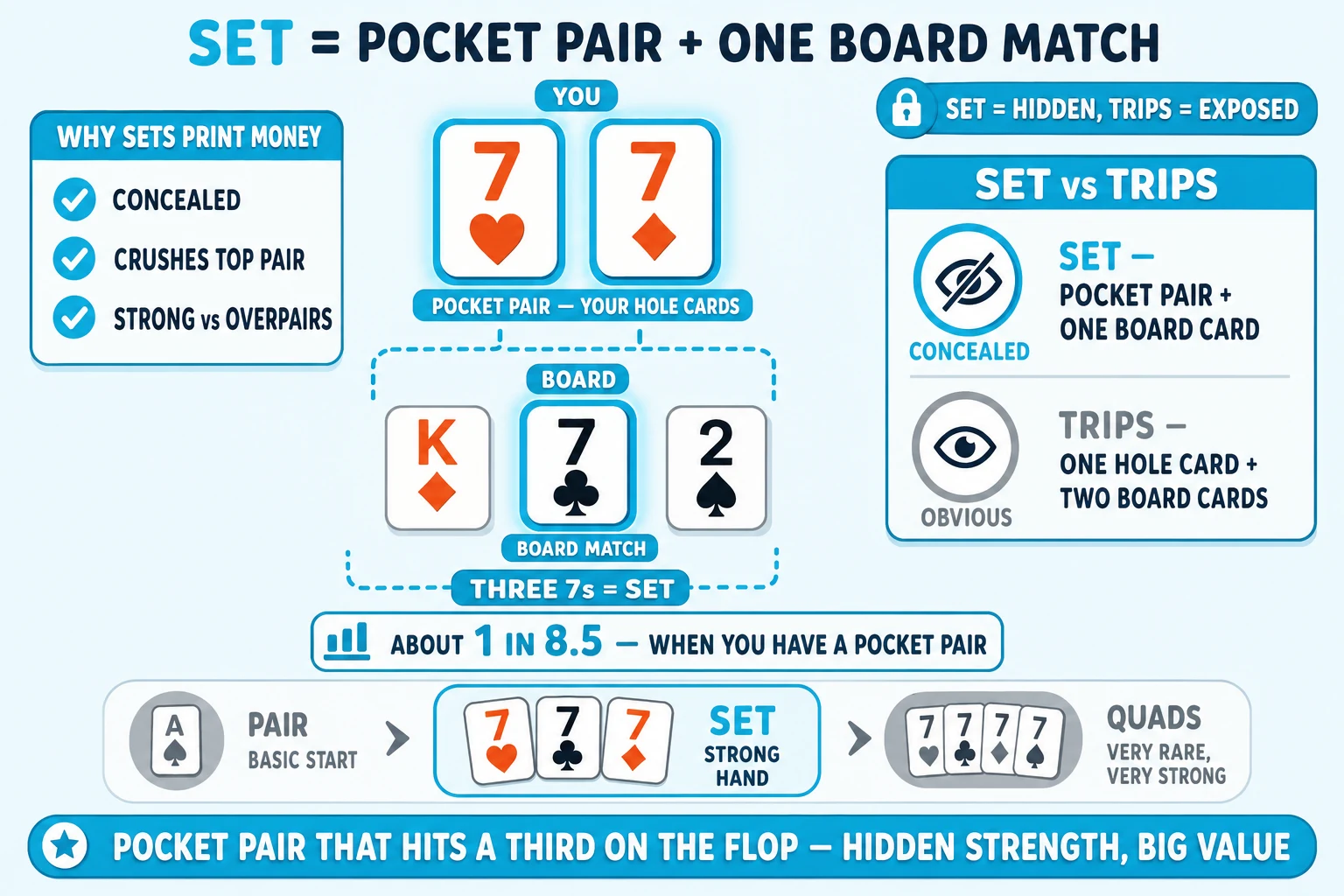
A set is three-of-a-kind made by holding a pocket pair and seeing one matching rank on the board. Example: you hold 7♠7♦ and the flop is K♦7♣2♠; you have a set of sevens.

Practice this in Poker Skill. The Button vs UTG Open lesson practices the call for set value, taking 44, 66 and 88 along because a small pair flops a set about one time in eight.
Get the free appSet (three-of-a-kind) in No-Limit Texas Hold’em
What a set is
A set is three-of-a-kind made by holding a pocket pair and seeing one matching rank on the board. Example: you hold 7♠7♦ and the flop is K♦7♣2♠; you have a set of sevens.
Flopping a set is among the strongest, most concealed hands in No-Limit Hold’em. Your strength comes from a hidden pocket pair, so opponents often misjudge the situation. That concealment creates chances to extract big value from players with overcards (single cards higher than the board) or top pair.
Why sets are high-value hands
Sets are often the best flop hand, especially when the board lacks heavy draws or overcards. Small pairs (3-3 through 9-9) derive most of their value from the times they hit a set. This strategy is set-mining: calling pre-flop hoping to flop a set and win a big pot.
A set has three cards to a rank, so opponents have fewer outs to beat you than versus a single pair. That justifies building bigger pots when opponents call with worse hands. For example, an opponent holding A♠A♥ or K♦Q♦ on a K-7-2 flop will often pay you off.
Pre-flop considerations for pocket pairs
Decide to call or fold by weighing implied odds-the extra money you expect to win if you hit-and stack depth.
- Call and set-mine small to medium pairs when stacks are deep enough. Deep stacks increase implied odds; hitting a set versus an overpair can win a big pot.
- In multiway pots (more than two players), small pairs gain value because someone is likelier to pay you off when you hit.
- Fold or avoid calling for set potential when stacks are shallow and implied odds are limited. A small payoff doesn’t justify the pre-flop investment if opponents won’t commit chips post-flop.
How to play when you flop a set
Use the hand’s disguise to extract value and control risk.
- Evaluate the board texture immediately. On a dry flop-few straight or flush possibilities-you can build the pot more aggressively.
- Mix actions-bet some flops and check others-to keep opponents guessing. Checking can induce a bluff or a bet from top pair; a small bet builds a pot while disguising full strength.
- Build the pot selectively. If an opponent shows willingness to commit-betting or calling with overcards or overpairs-increase sizing to maximize value.
- If the turn or river brings coordinated cards that complete straights or flushes, switch to pot control. Check more and avoid overcommitting without a clear read.
Example: you hold 8♣8♦ and the flop is 8♠K♣2♦. An opponent with A♦A♠ will likely call large bets; mix bets and checks to extract more value.
When a set becomes vulnerable
Sets lose value on coordinated boards. Multiple cards that create straight or flush draws increase the chance someone will draw out or already has a better hand. Heavy or sudden aggression often signals a made straight, flush, or two-pair-plus. Avoid overcommitting with perceived strong holdings like overpairs when opponents’ actions suggest a set or better, and tighten lines accordingly.
Quick checklist
- Only set-mine when stack depth gives strong implied odds.
- Use the set’s disguise to extract maximum value before turn/river texture changes.
- Watch board coordination; tighten lines if straights or flushes are possible.
- Be prepared to fold or control pot size if opponent action indicates a superior hand.