
Overcards
What overcards are
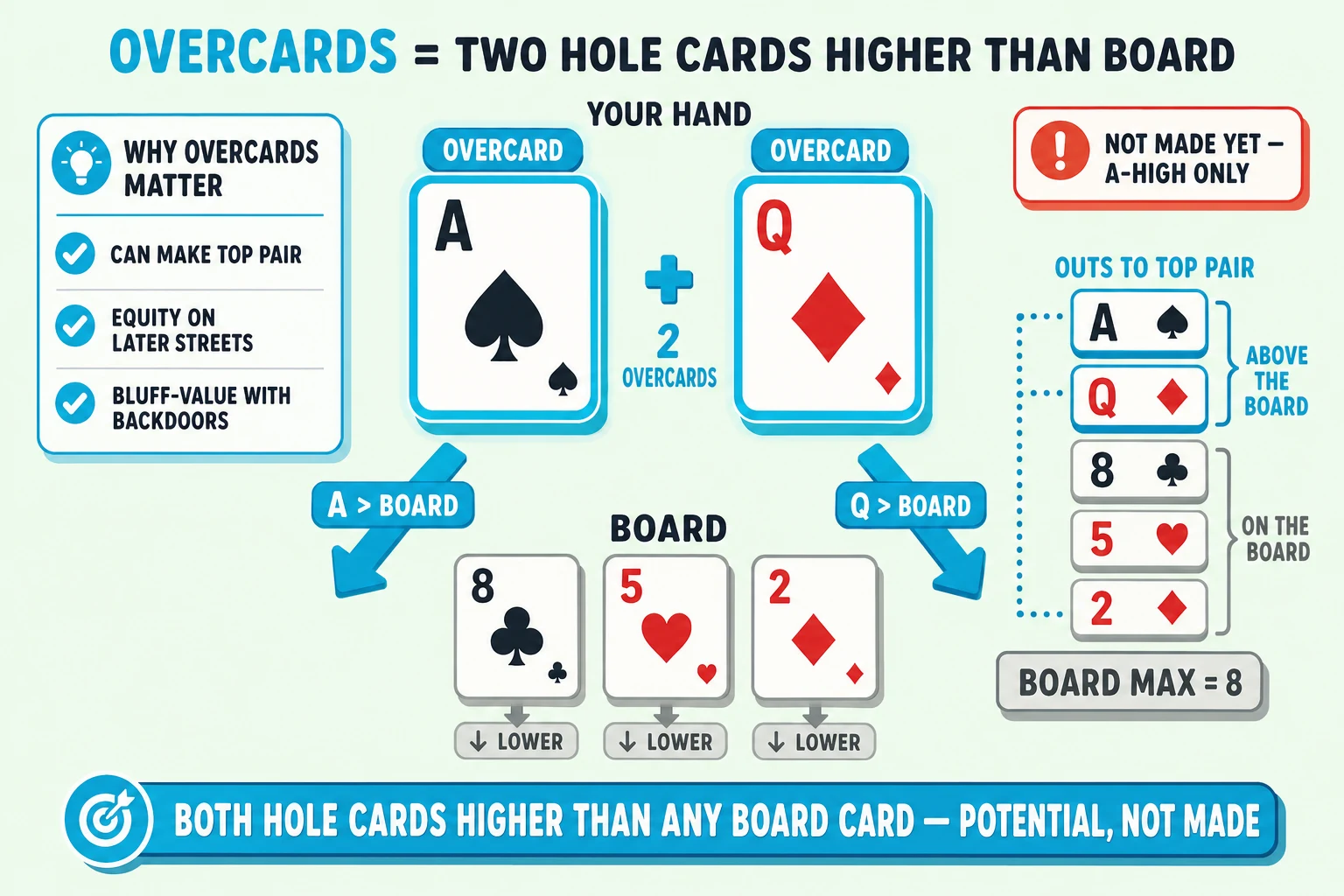
Overcards are your hole cards that rank higher than every community card on the board. For example, A-K or Q-J on a 7-4-2 flop are both overcards to the board. Overcards can appear on the flop, turn, or river and matter whenever your ranks exceed the board. They’re most useful on low, uncoordinated boards; fewer paired or made hands exist, and your high cards have equity to improve.
Using overcards to bluff (floating + late streets)
Many players float the flop with overcards. To float means to call a bet on the flop with the intention to bluff later streets. Example: hold K-Q on 7-4-2, call a small c-bet, then bet the turn if your opponent checks. Low, uncoordinated boards work best because missed high-card hands appear often in opponents’ ranges. On a 6-3-2 board with no flush or straight draws, a late bluff often folds out missed-but-high-card holdings. Overcards lose bluff value on Ace-high flops. For example, on A-9-3, K-Q looks weak; opponents without the Ace will fold small bets, while Ace-holders continue.
Continuation betting with overcards and sizing
A continuation bet (c-bet) is a bet by the preflop aggressor on the flop. C-betting with overcards is standard. Both players miss the flop roughly half the time, so betting can fold out weaker hands and win pots without improving. Sizing matters: smaller bets preserve fold equity while lowering cost when called. Practical sizing rules:
- On marginal or Ace-high boards, favor ~1/3-pot bets. They probe while limiting loss if called.
- On very dry, low boards, size up slightly because fewer draws threaten you and opponents fold more. Example: heads-up pot $60. A 1/3-pot c-bet equals $20; it folds many unpaired holdings while capping losses if called.
Responding when an opponent has overcards
Overcards threaten vulnerable made hands like small pocket pairs because they can pair on the turn or river and beat you. Decide whether to continue by assessing two things:
- The probability an overcard pairs on later streets - how many effective outs they have.
- The opponent’s tendencies: aggressive players often float and bluff; passive players usually continue only with real pairs. Against aggressive opponents, tighten your calling range or raise to charge bluffs and gain information. With a small pair on a dry board facing a large bet from a loose, aggressive player, folding is often correct. Versus passive lines, a call can be justified.
Practical play rules for overcards
Use overcards to float and plan a later bluff on low, uncoordinated boards. Don’t represent a higher-card story on Ace-high boards; check or size down there. Size c-bets to balance fold equity and risk, leaning smaller on marginal boards.
Quick checklist
- Float with overcards on low, uncoordinated boards; plan a late bluff or extract value if you pair.
- Don’t rely on overcards as bluff equity on Ace-high boards; check or size down.
- Use small, efficient c-bets (~1/3 pot) to exploit fold equity while limiting losses.
- Protect made hands by counting outs for opponent overcards and reading opponent tendencies.