


Overcard
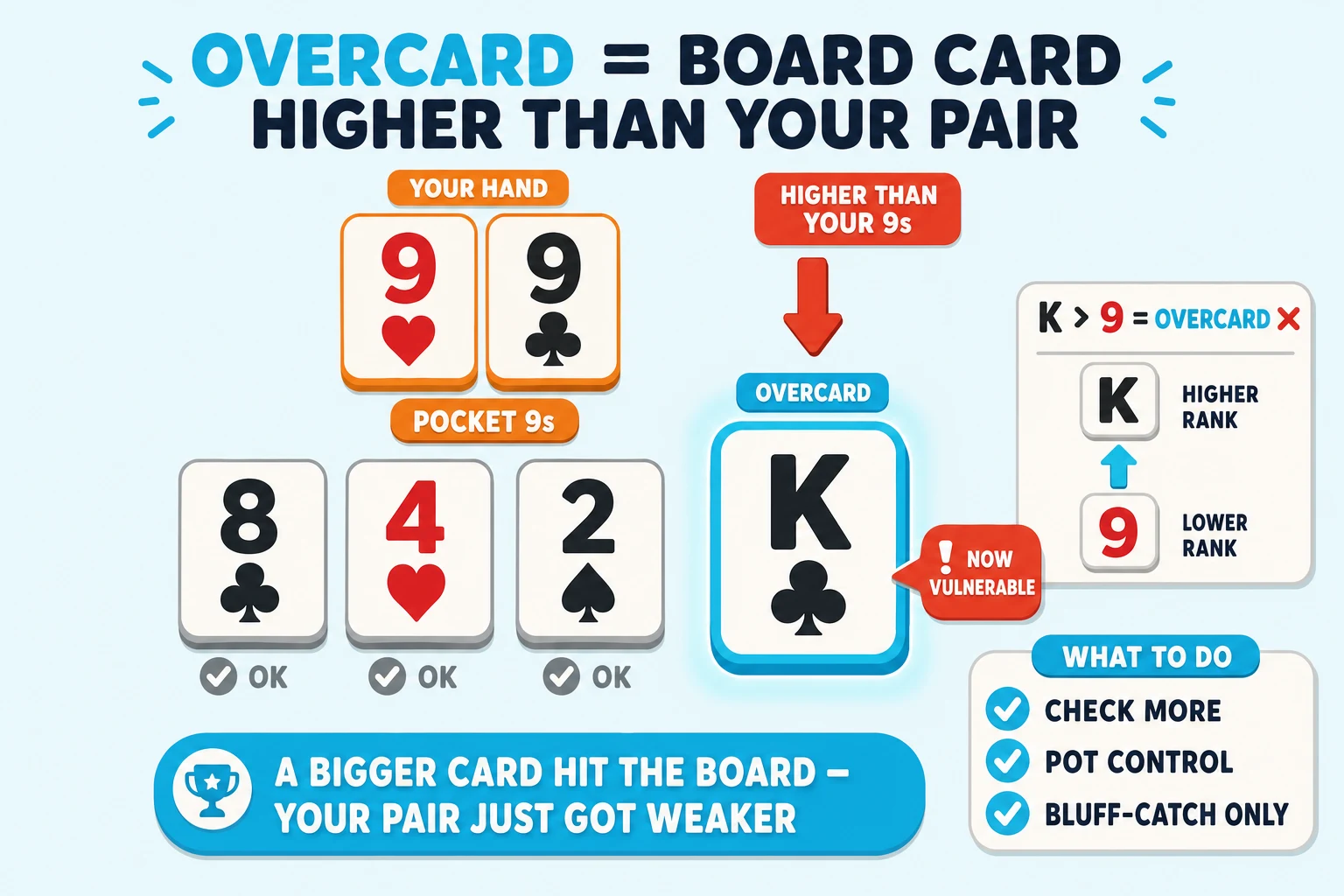
A card ranked higher than the card or pair you compare it to — either a hole card above the board or a board card above your pocket pair.
Practice this in Poker Skill. When an ace lands above your nines on the turn and misses you, the Read the Turn Card lesson has you check back rather than bet.
Get the free appOvercard
What an overcard is
An overcard in poker is a card ranked higher than the card or pair you are comparing it to. In Texas Hold’em, players usually use the term in two ways:
- Your hole cards are overcards to the board. For example, you hold A♠ K♦ on Q♣ 7♥ 2♠.
- A board card is an overcard to your pair. For example, you hold 8♣ 8♦ and the flop comes K♠ 7♥ 2♣.
That two-part meaning is what confuses most beginners. When someone says “I had two overcards,” they usually mean unpaired hole cards higher than the board. When someone says “an overcard hit,” they usually mean a new board card arrived that is higher than their pair.
The short version: overcards matter because they change equity, hand strength, and how comfortable you should be betting, calling, or bluff-catching.
Two common uses of “overcard”
1. Hole-card overcards
This is the more common glossary meaning.
If one or both of your hole cards rank above every card on the flop, turn, or river, those cards are overcards.
Example:
- You hold A♣ K♠
- The flop is Q♦ 7♣ 2♥
You have two overcards. You do not have a pair yet, but an Ace or King on a later street can make top pair.
That is why players sometimes continue with overcards even when they have not connected with the flop. The hand may still have reasonable equity, especially on a dry board or when the opponent’s range is weak.
2. An overcard on the board
This is the meaning behind phrases like “the turn brought an overcard” or “that Ace is an overcard to my pair.”
Example:
- You hold 9♠ 9♦
- The flop is 8♣ 4♥ 2♠
- The turn is Q♣
That Queen is an overcard on the board because it ranks above your pair of nines.
This matters because your hand just became less comfortable. A lower pocket pair can still be best, but it now loses to more one-pair hands, and it becomes a worse bluff-catcher against strong action.
That is also why it helps to understand the difference between an overcard and an overpair. If you hold Q-Q on J-7-2, you have an overpair. If the board later runs out with an Ace or King, that new high card can become an overcard to your pair.
Quick reference: what counts as an overcard?
| Situation | What counts as the overcard? | Why it matters |
|---|---|---|
| A♠ K♦ on Q♣ 7♥ 2♠ | Ace and King are overcards to the board | You can improve to top pair on later streets |
| A♣ 9♠ on J♦ 7♣ 3♥ | Ace is one overcard | You have some improvement potential, but less than two overcards |
| 8♣ 8♦ on K♠ 7♥ 2♣ | King is an overcard to your pair | Your pocket pair is more vulnerable |
| Q♠ Q♥ on J♦ 7♣ 2♠ | No board overcard; you have an overpair | You are ahead of many one-pair hands for now |
Worked examples
Example 1. A-K high vs 9-9 on a low flop
You hold A♠ K♣ and your opponent holds 9♥ 9♦.
The flop comes Q♣ 7♠ 2♦.
You have two overcards, but your opponent still has the best hand right now with a pair of nines.
What do your overcards give you?
- An Ace can improve you to top pair
- A King can improve you to top pair
- Certain runouts may also create backdoor straight or flush pressure
This is the classic “two overcards” spot. You are behind at the moment, but not dead. That is why two overcards often have enough equity to continue once, especially in position or versus a small bet. It is also why many players use range-bet strategies on boards where the preflop raiser still retains strong high-card advantage.
Example 2. An overcard on the turn vs middle pair
You hold 8♠ 8♥ on a flop of 7♣ 4♦ 2♠.
So far, your pair looks strong enough to bet for value and protection.
Then the turn is K♦.
Now the King is an overcard to your pair.
That does not automatically mean your eights are beaten. But it does mean:
- More hands in your opponent’s range now beat you
- Your pair has less showdown comfort
- Betting again becomes more opponent- and texture-dependent
Against a passive opponent who keeps calling, you may prefer pot control. Against aggressive action, your hand often shifts toward thin showdown value rather than value betting.
Example 3. Overcards plus draw potential
You hold A♥ J♥ on T♣ 6♥ 2♥.
Right now, Ace-high is not a made hand. But you have:
- Two overcards to the Ten-high board
- A live heart flush draw
- Additional ways to improve on later streets
This kind of hand matters because not all overcards are equal. Two clean overcards with extra draw potential are much stronger than two disconnected overcards on a coordinated board.
That is where board texture matters. On changing, draw-heavy boards, equity shifts quickly. On dry boards, overcards often keep more practical value because fewer scary runouts are competing with them.
Why overcards matter strategically
Overcards can improve you to top pair
If your hole cards are higher than the board, future streets can turn a missed hand into top pair. That future improvement potential is why overcards are not the same as pure air.
Of course, not every top pair is equally strong. A-K on Q-7-2 is very different from K-5 on J-7-2. Kicker strength still matters once you pair.
Overcards can weaken your made pair
When you already hold a pocket pair, a higher board card makes your hand less secure.
Example:
- 9-9 on 8-4-2 is comfortable
- 9-9 on 8-4-2-K is less comfortable
- 9-9 on 8-4-2-K-A is often just bluff-catching at best
This is why a turn or river overcard often changes betting plans. A hand that was strong enough to value-bet on the flop may become a check-call or check-fold later.
Overcards affect c-betting and bluff-catching
Overcards influence who can credibly represent strength.
If you were the preflop raiser, high-card runouts often favor your range more than the caller’s range. That can support continuation bets on some textures.
On the other side, when multiple overcards land above your medium pair, your bluff-catching threshold drops. You can still call sometimes, but you should do it more carefully, especially against players who do not bluff enough.
Not all overcards are equal
A single Ace overcard is not the same as two overcards. Two overcards are not the same as two overcards with backdoors. And a dry board is not the same as a connected one.
Things that change the value of overcards:
- Board texture
- Position
- Bet size
- Kicker quality
- Whether your outs are clean
- Whether the board already favors made hands or strong draws
That is why “I had overcards” is not a complete reason to continue in a hand. It is only one input.
Common mistakes
Treating all overcards the same
A-K on 8-3-2 rainbow is very different from K-J on T-9-8 with a flush draw on board. One spot is clean and simple. The other is messy and easy to overplay.
Falling in love with ace-high
Ace-high can have real value, especially heads-up. But it is still just ace-high until it improves. Beginners often call too much because the hand looks strong preflop.
Ignoring the board overcard problem
Players often understand “two overcards” but forget that a turn or river overcard can hurt their own pair. If you have second pair and the board keeps climbing, your hand usually wants more caution, not more hero calls.
Confusing overcard with top pair
An overcard is potential when it is in your hand. Top pair is a made hand when you actually connect with the board. That distinction matters.
FAQ
What is an overcard in poker?
An overcard in poker is a card ranked higher than the card or pair you are comparing it to. Most often, it means a hole card higher than every board card, or a board card higher than your pocket pair.
What does “two overcards” mean?
“Two overcards” means both of your hole cards rank above every card on the board. For example, A-K on a Q-7-2 flop gives you two overcards.
Why does an overcard on the board matter?
An overcard on the board matters because it makes your pair less secure. If you have 8-8 and a King appears, more one-pair hands now beat you, so your hand usually becomes a weaker value hand or a bluff-catcher.
Is ace-high the same as having overcards?
Not always. Ace-high can include one overcard or two overcards depending on the board. On J-7-3, A-9 has one overcard. On Q-7-2, A-K has two.
Final takeaway
The cleanest way to remember overcards poker meaning is this:
- In your hand: overcards are higher hole cards that can improve to top pair
- On the board: an overcard is a higher board card that makes your pair less comfortable
If you keep those two meanings separate, most strategy advice around overcards gets much easier to follow.
Quick checklist
- Identify whether the term is describing your hand versus the board or the board versus your pair
- Count whether you have one overcard or two, not just “some equity”
- Treat overcards with extra draw potential more aggressively than bare overcards
- Re-evaluate pocket pairs when turn or river overcards arrive
- Do not confuse an overcard with a made hand until you actually pair the board