


Overcall
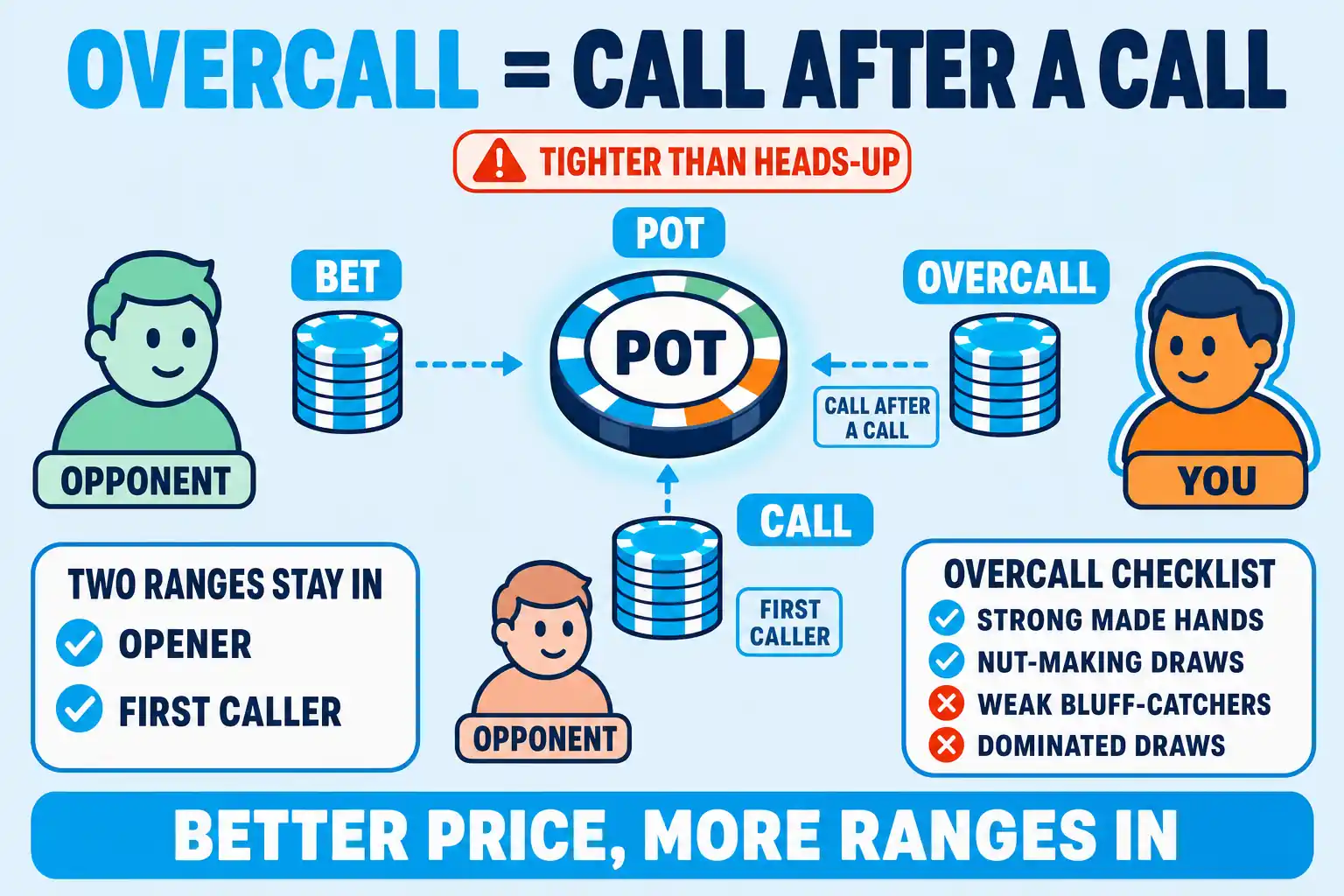
An overcall is a call made after a bet has already been called by at least one other player. It is most often a postflop, multiway decision: someone bets, someone else calls, and you decide whether to put in the same chips behind. The pot is bigger, so the price is better - but you now play against more than one continuing range, which forces overcalling ranges to be tighter than heads-up calling ranges.
Practice this in Poker Skill. The Multiway Continuation Bets lesson applies the same tightening from the bettor’s seat, where a set or a combo draw still bets three-way while middle pair and even top pair on a wet board check.
Get the free appOvercall in No-Limit Texas Hold’em
What an overcall is and where it shows up
An overcall is a call made after a bet has already been called by at least one other player. It is most often a postflop, multiway decision: someone bets, someone else calls, and you decide whether to put in the same chips behind. The pot is bigger, so the price is better - but you now play against more than one continuing range, which forces overcalling ranges to be tighter than heads-up calling ranges.
Brief jargon: a “range” is the set of hands an opponent could be holding in a given spot; “multiway” means three or more players still contesting the pot.
How an overcall differs from a call, cold-call, flat-call, or call-down
The names describe different shapes of the same chip-matching action. Keeping them separate avoids muddled decisions.
- A plain call just matches the current bet, with no constraint on what came before.
- A cold-call is preflop only: calling a raise with no prior voluntary chips in the pot - it does not require a caller in front of you.
- A flat-call is also preflop, and emphasises the choice not to 3-bet a raise. It can be heads-up or in front of further action.
- A call-down is a multi-street decision - calling flop, turn, and river - usually heads-up with a marginal hand.
- An overcall is shape-specific: a bet has been made and at least one player has already called before you act. The defining feature is that more than one range is staying in. That is what changes the math.
The “first caller” still has to act on later streets, but they have already advertised continuing strength - your overcall puts you behind the bettor and beside another live range until the action is done.
Why overcalling ranges are tighter than heads-up ranges
When you face a bet heads-up, you compare your hand against a single continuing range. When you overcall, you are inside a multiway pot with two opposing ranges still alive: the original bettor and at least one caller. Two adjustments follow.
- The first caller has filtered out their worst hands. Whatever they continue with is, on average, stronger than the bettor’s whole-range distribution. Your hand has to beat both of those filtered ranges often enough to justify the call.
- There is more action behind. Players still to act may raise, which can fold you off equity or charge you to continue. A hand that is comfortable heads-up may be uncomfortable when a third player can put in a big raise after you commit.
The improved pot odds do help. The pot now contains the bet plus the first caller’s matching chips, so the price-to-call ratio is better than it was heads-up. But that price has to be weighed against:
- More ways to be dominated. Reverse implied odds get worse multiway because someone holding a bigger draw or a bigger made hand becomes more likely as ranges add up.
- More streets where the pot can swell. The bigger the starting pot, the larger the bets behind it tend to be, which raises the cost of being second-best at showdown.
The practical result: keep nut-making draws and clearly-ahead value hands; cut the marginal calls that survive heads-up but lose value when a second range is in.
Worked examples: a flop draw and a river bluff-catch
Two common spots make the tightening rule concrete.
Flop overcall with a draw
Effective stacks 100bb in a 6-max cash game. Three players see a flop of K♠ 8♠ 4♦ for 9bb. The preflop raiser bets 5bb. The next player calls. Action is on you with A♠ 7♠ - a nut flush draw with backdoor straight outs.
- Heads-up against the bettor alone, this is a routine call: you have nine flush outs to the nut flush, plus runner-runner equity, and you are not closing the action yet so a raise is also live.
- The overcall here is also reasonable, but specifically because the draw is to the nuts. A K♠ flush blocker makes someone else holding a smaller flush combo less catastrophic, and when the flush comes in, two ranges are around to pay it off.
- If you swap the same hand for K♠ 9♠ - second-nut flush draw, top-pair-no-kicker on the K - the overcall is much closer to a fold or a fold-or-raise. The draw is dominated more often, and the made-hand piece does not improve well in a multiway pot.
The teaching point: nut-making draws survive the move from heads-up to multiway; non-nut draws and weak made hands stop surviving.
River overcall with a bluff-catcher
Same game. Three players reach the river. The pot is 80bb. Player A bets 50bb on a board where missed-draw bluff combos are present. Player B calls. You hold a bluff-catcher - middle pair, no real blocker on Player A’s bluff candidates.
- Heads-up against Player A alone, the math may justify a call. You only need to win some fraction of the time to break even on price.
- Once Player B has called, your hand has to beat both ranges. Player B’s call is itself a value-leaning move: they are rarely in there with a pure bluff-catcher of their own. Your middle pair is now behind two ranges that are mostly value.
- If your hand additionally blocks Player A’s bluffs (for example, you hold a card that turns missed-draw combos into impossible combos), the overcall is even worse, because you remove the very combos that paid you off.
The disciplined response is to fold most overcalls in this shape, even at attractive heads-up prices. An overcall here is primarily for hands that beat parts of Player B’s value range, not just Player A’s bluffs.
Common overcalling mistakes and how to fix them
- Mistake: treating the better pot odds as a green light. Fix: count how many opposing ranges are still in, then ask whether the hand beats all of them often enough.
- Mistake: overcalling weak top pair multiway. Fix: prefer hands that can become the nuts (sets, two pair, nut-making draws), not hands that mostly cap at one pair.
- Mistake: overcalling when there is more action behind. Fix: weight the chance of a raise from a player still to act, which can shut down speculative calls.
- Mistake: river overcalls based only on the bettor’s bluff frequency. Fix: model the first caller’s range too - their continuing hands are filtered and rarely include pure air.
- Mistake: confusing the term with a cold-call or with overlimping. Fix: keep the definition strict - bet, call, then your matching call.
FAQ
Is an overcall the same as a “second call”? Functionally yes - it is the call that comes in after the first call. The label “overcall” is the standard poker term and emphasises that you are calling on top of an existing call.
Can an overcall happen preflop? It can, in a limped pot if a bet is made and someone calls before you, or in a 3-bet pot when one player has already called the 3-bet. The defining shape is the same: a bet, a call, and your call. Most spots discussed under this name are postflop, because that is where the multiway pressure is highest.
Should I overcall to keep more players in for set value? Be careful. Set-mining math relies on implied odds when you hit. Overcalling can grow the pot, but it also risks more squeezes and harder spots when you miss. The hand needs to be one that benefits from a bigger multiway pot, not one that just suffers from worse reverse implied odds.
How does an overcall change who closes the action? The same way any other call does. Action keeps moving until the last seat with a live decision finishes; overcalling does not by itself end the round unless you are the last player who needs to act.
Checklist
- Confirm the shape: a bet has been made and at least one player has already called before you decide.
- Count how many opposing ranges are still in - the first caller adds a filtered, value-leaning range you also have to beat.
- Tighten standards versus heads-up: prefer nut-making draws and clearly-ahead value, drop marginal bluff-catchers and dominated draws.
- Watch for action behind that could raise and shut down the call.
- Weigh better pot odds against worse reverse implied odds and bigger possible bets on later streets.