


Call Down
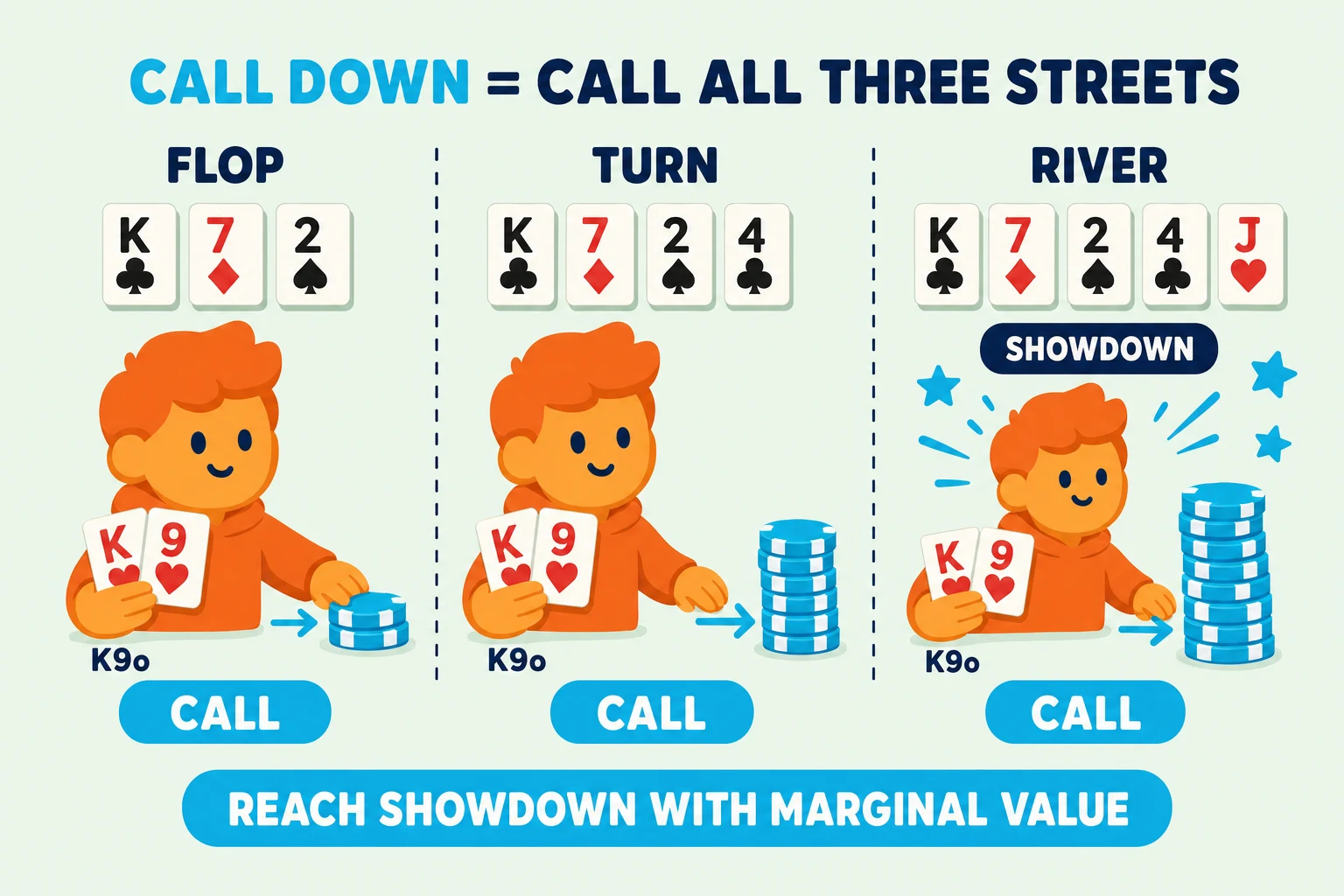
A call down is calling bets on the flop, turn and river to reach a showdown, often with a marginal or medium-strength hand. Players call down when they think the opponent's range-the set of hands the opponent might hold-contains enough bluffs or weaker value hands to make calling profitable. You'll see call downs when a bettor fires multiple streets but their story can include bluffs, like a missed draw turned into a bluff. Decide to call down based on your hand's strength versus that range, the opponent's tendencies, your table position, and the pot odds you receive.
Practice this in Poker Skill. The turn lessons practice one street of a call down: facing a bet with J♦ 8♦ on 2♠ 3♦ J♠ 2♦, you call, since top pair with a flush draw keeps real ways to win.
Get the free appCall Down in No-Limit Texas Hold’em
What “call down” means and when you see it
A call down is calling bets on the flop, turn and river to reach a showdown, often with a marginal or medium-strength hand. Players call down when they think the opponent’s range-the set of hands the opponent might hold-contains enough bluffs or weaker value hands to make calling profitable. You’ll see call downs when a bettor fires multiple streets but their story can include bluffs, like a missed draw turned into a bluff. Decide to call down based on your hand’s strength versus that range, the opponent’s tendencies, your table position, and the pot odds you receive.
Evaluating your hand versus opponent range
Before adding chips, place your hand within the opponent’s likely range. Ask which hands your opponent bets on the flop, turn and river, and estimate how many of those you beat.
- Sort the range into value hands (strong made hands), bluffs, and missed draws.
- Judge where your hand sits: do you beat mainly bluffs and some weak value, or only pure bluffs?
- Adjust for opponent type: tight players weight toward value and bluff much less; loose/aggressive players include more bluffs and thin value.
Example: You hold K♥9♥ on K♣7♦2♠. You have top pair on the flop. If the opponent continuation-bets and then barrels turn and river, decide whether your top pair still beats enough of their range-missed draws, bluffs, worse pairs-to call twice more. Avoid calling down when your hand only beats a very small slice of the range, especially versus tight opponents.
Using pot odds and bluff frequency to justify calls
Pot odds compare the cost to call with the size of the pot; calculate how often you must win to break even. Higher opponent bluff frequency lowers the win rate you need.
Example: The pot is $100 and your opponent bets $50. Calling $50 gives you $150 to win, so you must win one time in four (about 25%) to break even. If you estimate the opponent bluffs more than 25% in this spot, calling is justified. On the river, combine pot odds with table reads: if the bettor’s line looks like a bluff and the odds are acceptable, call. If their sequence strongly represents value and bluff frequency seems low, fold.
Position and table dynamics that change call-downs
Position matters. Acting later gives you more information about what the opponent bets and when, making call-downs easier and more accurate. Acting out of position forces tougher calls because you act first on future streets and have less information. Adjust to table dynamics: a bluff-heavy, aggressive table warrants looser call downs; a tight table requires stricter standards. Don’t habitually overdefend weak hands from the big blind against tight early-position ranges.
Tournament context and chip-management considerations
Tournaments change the calculus. Marginal call downs can cost you tournament life. Short and medium stacks should be conservative: avoid multi-street calls that risk elimination unless you have a strong read or pot-odds justification. When stack depth allows, exploit obvious over-bluffers; when survival matters, prioritize preserving chips.
Quick checklist
- Compare your hand’s relative strength to the opponent’s range before calling further.
- Calculate pot odds and consider opponent bluff frequency on each street.
- Factor your position-prefer calling more when acting later.
- Do not overdefend weak hands from the big blind against tight ranges.
- In tournaments, weigh survival and stack size heavily in call-down decisions.