


Call Off
A "call off" occurs when an opponent shoves all their chips and you must call or fold. All-in means a player bets their entire stack; No-Limit allows this at any time. These spots create high pressure because they directly decide tournament survival or cash-game stack health. Good calls combine math (pot odds, equity) with reads and player tendencies. Equity here means your hand's probability of winning the pot at showdown.

Practice this in Poker Skill. Facing an all-in in Practice vs AI, where you play full hands against AI opponents, Coach Max, the AI poker coach, can state the price for you: offered 3-to-1, you need to be good about 1 in 4.
Get the free appCall off (No-Limit Texas Hold’em)
What “call off” means
A call off is calling an opponent’s all-in for the rest of your stack, or as much of it as the shove asks for. The decision collapses to two options, call or fold, and the math is unusually clean: there are no future streets to worry about, only your equity against the shoving range. The pressure is high because tournament survival or cash-game stack health turns on a single decision. Good call-offs blend pot-odds math with reads on the player and the line.
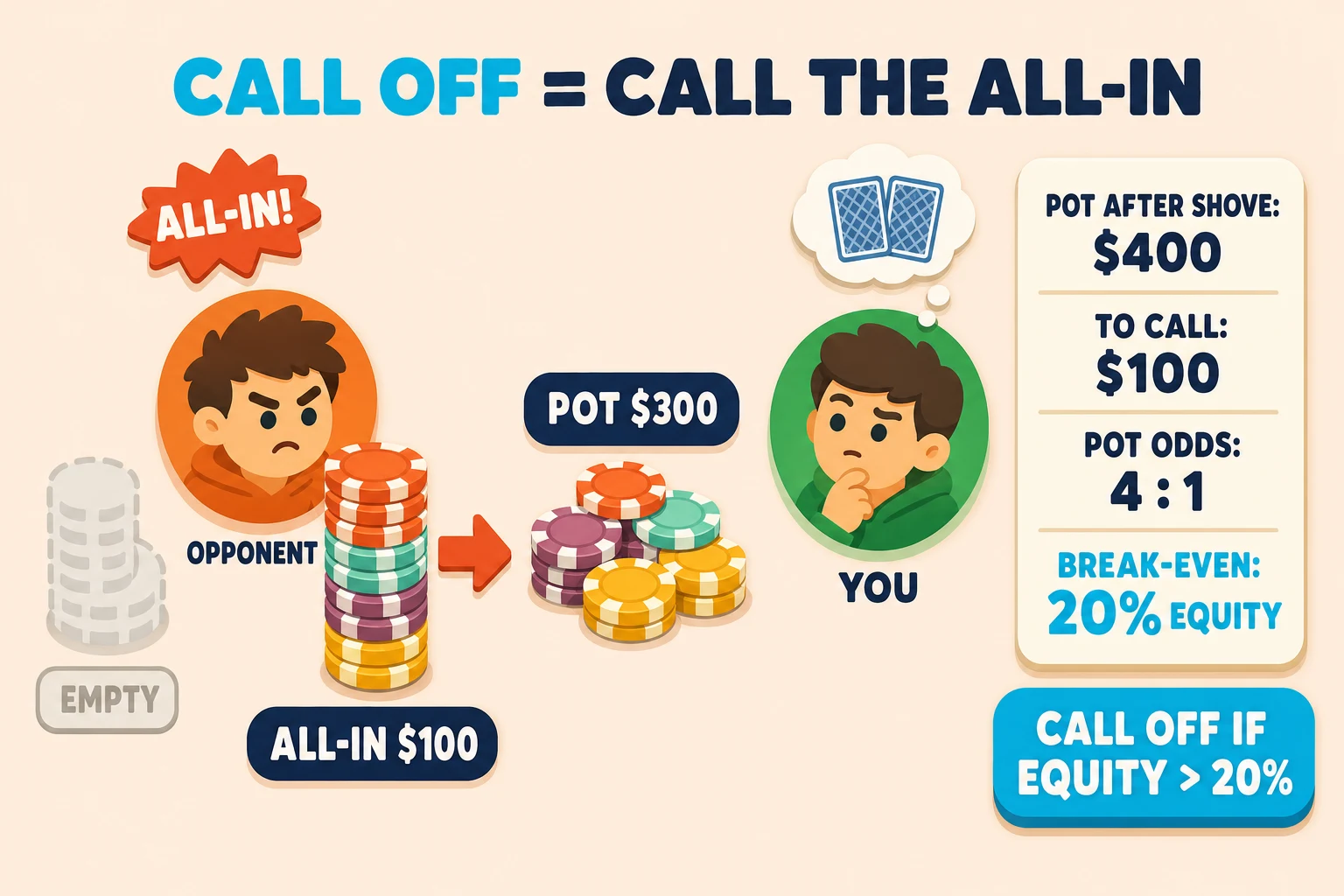
Calculating pot odds for a call-off
Pot odds give the break-even chance you need to win to justify a call. Compute the ratio of the total pot after the shove to the amount you must call, then convert the ratio to a percentage.
Example method:
- Find the total pot after the shove. If the pot was $300 and your opponent shoves $100, the pot becomes $400.
- The amount required to call is $100, so the pot odds ratio is 400:100 = 4-to-1.
- Convert to break-even equity: with 4-to-1 you need 1/(4+1) = 20% chance to win.
Quick rule: if you’re offered 3-to-1 on a call, you need at least 25% equity (1/(3+1)). If your hand’s equity versus the opponent’s range exceeds the break-even percentage, math alone justifies the call.
(“Pot odds” means the ratio between the pot size and the cost to call.)
Estimating opponent ranges
A “range” is the set of hands an opponent could plausibly hold. Narrower ranges lower your hand’s equity; wider ranges raise it. Use these cues to refine ranges:
- Preflop action (raises, 3-bets) narrows likely holdings.
- Postflop action (bets, checks) filters hands further.
- Position and tendencies (tight vs. loose, aggressive vs. passive) adjust probabilities.
Strong players study common shove ranges and shove/call frequencies. If an opponent’s range tightens to strong pairs, your hand needs more equity to call. If their range widens with bluffs, required equity drops.
Stack size, position, and game-type effects
Effective stack depth drives shove/call frequency; short stacks (around 15 big blinds) produce many all-in spots. Empirical call frequencies vary by position and stack, roughly 27% up to over 50% depending on context. For example, a cutoff facing a big blind shove with ~15 BBs might call about 45.1% of the time in certain tables. Tournament ICM makes folding more attractive than pure pot-odds math because survival and payout equity matter. Cash games focus on chip EV, so calls justified by pot odds occur more often. Calling off out of position generally costs more because you lose postflop informational advantage.
Practical decision framework for calling off
Use this quick checklist at the table:
- Calculate pot odds and convert to break-even equity immediately.
- Estimate the opponent’s range from preflop and postflop action, position, and tendencies.
- Compare your hand’s equity versus that range; if equity exceeds the break-even percentage, math favors a call.
- Adjust for stack size, position, and tournament considerations (ICM and survival) before making the final decision.
Quick checklist
- Calculate pot odds and break-even percentage before emotion drives the call.
- Assess opponent range quickly using recent actions, position, and tendencies.
- Factor stack size and game type (tournament ICM vs cash EV) into the final decision.