


Calling Range
A calling range is the set of hands you continue with by calling rather than folding or raising. The shape of that range, what it keeps and what it cuts, depends on position, price, stack depth, opponent sizing, and the street.
Practice this in Poker Skill. The Button vs CO Open lesson builds this range hand by hand: A9s, 98s and J9s call because position helps them realize their equity, while KQs 3-bets.
Get the free appCalling Range: the hands you continue with by calling, not folding or raising
What a calling range is
A calling range is the set of hands a player continues with by calling at a given decision point: the slice of their range that doesn’t fold and doesn’t raise. It’s the middle fork of a three-way decision. Strong hands often raise, weak hands often fold and what stays in between is the calling range. The shape of that middle changes with position, price, stack depth, the bet you’re facing and whether the action is preflop or postflop. A button-vs-cutoff calling range looks nothing like a big-blind defense calling range, and a river call-down range looks nothing like a flop peel.
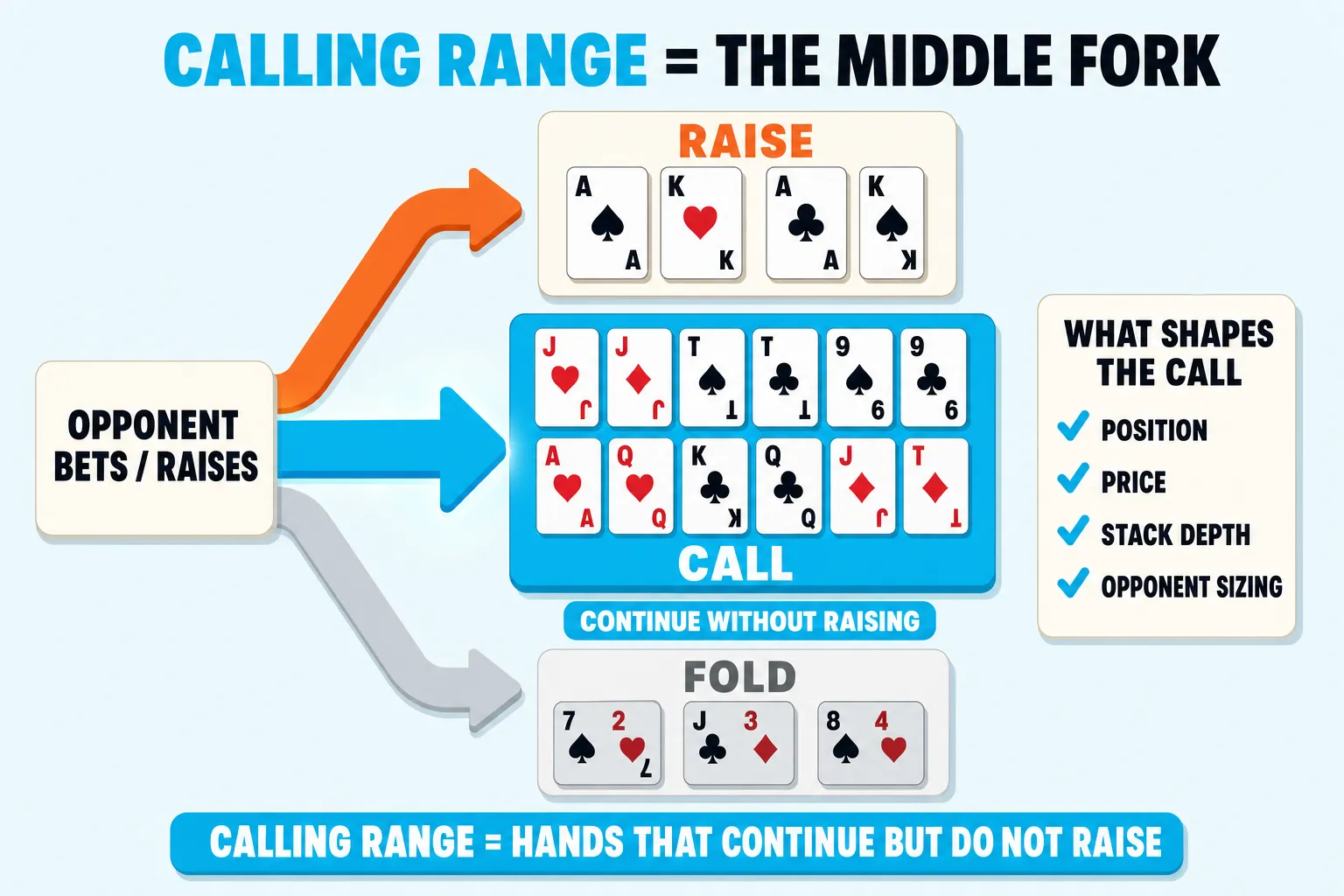
A useful way to read it: a calling range is what’s left after the strongest hands take the raise fork and the weakest hands take the fold fork. The middle is the answer to “what do I continue with that I didn’t want to raise?”
Related terms
Calling range vs the neighbors people confuse it with
Several terms live close to “calling range” and they aren’t synonyms. The distinctions matter because each one points at a different lever.
| Term | What it names | What it does NOT name |
|---|---|---|
| Range | The full set of hands a player could hold at a decision point | Which fork they’ll take with each hand |
| Calling range | The slice of the range that calls (not folds, not raises) | The slice that raises or folds |
| Call | The single action of matching a bet | A range (one action, not a set) |
| Cold-call | A call where you have no prior voluntary chips in this round | Any call after you’ve already invested |
| Flat-call | Calling a raise instead of re-raising preflop | Postflop calls |
| Bluff-catcher | A specific hand that beats bluffs but not value | A whole range (one hand class inside a range) |
| Pot odds | The price you’re being offered to call | What hands you should call with at that price |
| Minimum defense frequency | The share of your range you must continue with | Which hands inside that share continue |
| Equity realization | How much of raw equity you actually convert to EV | The hands themselves |
| Condensed range | A specific shape: middle-only, no nuts, no air | All calling ranges (capped is broader; condensed is one shape) |
| Capped range | A range with no top-tier hands | A guarantee that the range is calling |
The important distinctions inside that table:
- A call is one action; a calling range is the set of hands that take that action.
- Cold-call and flat-call are flavor labels for preflop calls in particular sequences. The hands inside both are part of a calling range, but “calling range” is the broader concept and applies postflop too.
- Pot odds and MDF answer “how often” or “at what price”; the calling range is the hand-by-hand answer that lives downstream of those numbers.
- Bluff-catcher is a hand class that often shows up in river calling ranges, but the river calling range can also include strong hands you trapped with and merged value.
- Condensed and capped describe shapes a calling range often takes (most flat-call ranges are condensed, most check-call lines end up capped), but the labels apply to ranges in general, the calling fork included.
What changes the calling range
Five inputs do most of the work. None are about your hole cards in isolation.
- Position. Acting last lifts every hand’s equity realization, which lets you call wider with marginal hands. Out of position, the same hand under-realizes and drops out of the calling range.
- Price. Pot odds set the floor: the worse the price, the more equity each calling hand needs and the tighter the calling range gets. A half-pot bet asks for ~25% equity to break even; a 2x-pot overbet asks for ~40%. The calling range shrinks as the bet grows.
- Stack depth. Deep stacks raise both implied odds and reverse implied odds. Suited connectors and small pairs gain calling value with depth because their make-the-nuts payoff scales; dominated kickers lose calling value because their second-best price tag scales too.
- Opponent sizing and the bet’s polarity. A small probe bet from a wide range invites a wide call; a polarized overbet from a narrow range condenses the call to the hands that beat bluffs. The same hand can be a clear call against one sizing and an easy fold against another.
- Preflop vs postflop. Preflop calling ranges are built off opening-range charts and 3-bet/cold-call splits, so they sit pre-set before the hand starts. Postflop calling ranges are built street-by-street off equity, pot odds and read. The shape changes from “this is my chart” preflop to “this is what survives on this board against this bet” postflop.
When the calling range matters most
The concept earns its keep in three places.
- Big-blind defense. Closing the action and getting the blind discount makes the BB call wider than any other seat. The BB calling range is the widest calling range in poker; misreading its size leaks money on both sides. Poker Skill still counts 88, KQs and JTs as big blind calls against an under-the-gun open.
- River decisions facing a polarized bet. With no more cards to come, the river calling range collapses to bluff-catchers vs value. MDF sets the share; the actual hands inside the range come from blockers, opponent reads and which combos beat the value side.
- 3-bet pots after a flop c-bet. The preflop caller’s range is already condensed; the c-bet narrows it again. Knowing which hands belong in your check-call range here is the difference between defending correctly and either over-folding or paying off.
It matters less in spots where the right answer is rarely “call.” Short stacks shoving over an open mostly choose between jam and fold; the calling range there is small. A min-bet on a paired board with no draws often gets read as a “raise or fold” decision rather than a wide calling spot.
Example: BB defending vs a button open
6-max NLHE cash, 100bb effective. The button opens to 2.5bb. You’re in the big blind facing 1.5bb to call into a 4bb pot: about 2.7-to-1, or roughly 27% raw equity to break even.
The BB has three forks here: 3-bet, call, fold. Strong hands and a chunk of bluffs go into the 3-bet range. Junk goes into the fold range. The calling range is everything in between that has enough equity, enough playability and enough realization to keep the call breakeven-or-better from out of position.
A typical BB calling range against a 2.5bb button open looks roughly like:
- Most pocket pairs that didn’t 3-bet (22-TT in part), since they make sets and have decent showdown value.
- Suited broadways and suited connectors (KQs-K9s, QJs-Q9s, JTs-J9s, T9s, 98s, 87s, 76s, 65s, 54s), which realize their equity well.
- Suited aces below the 3-bet threshold (A9s-A2s in part, depending on chart), which call for the times they make pairs, flushes or wheel straights.
- A wide block of offsuit broadways and middle offsuit aces that have enough showdown but realize less of their equity (KJo-KTo, QJo-QTo, JTo, A9o-A5o in part).
- A long tail of offsuit one-gappers and connectors that some charts include and some skip.
Notice what the range is not. It is not “everything that beats 27% equity vs the open.” Hands like K3o have raw equity above the price but realize so badly out of position that they’re folds. The calling range is the slice where raw equity and realization both clear the bar.
Now the same seat, river spot. Pot is $100, button bets $100 polarized on a K♠ 8♥ 4♣ 7♦ 2♠ runout after you check-called flop and turn with K♥ T♥ (top pair, ten kicker). Your river calling range here is condensed: the strongest hands two-paired or bluff-raised earlier streets, the weakest hands folded already and what’s left is roughly “weak top pair, second pair, ace-high backdoor flush misses.” Top pair with a ten kicker is near the top of that calling range. The right answer is to call: at a pot-sized bet, MDF says you defend ~50% of your river range, and your hand is a clean bluff-catcher that beats every busted draw the button can show up with.
Common mistakes
1) Conflating “I called” with “the right calling range”
Showing up with the call doesn’t validate the call. Plenty of -EV calling ranges look defensible in the moment because at least one hand in them was right. Build the range first, then ask whether your hand is in it. Reverse the order and you’re rationalizing.
2) Using one calling range for every sizing
The bet size sets the price, the price sets the equity bar and the equity bar sets the calling range. The same flop call versus a one-third-pot probe and a 1.5x-pot overbet are different decisions with different calling ranges. Treating sizing as decoration rather than input is the most common river leak.
3) Calling out of position with hands that don’t realize
The classic equity realization trap: raw equity says call, position and offsuit-disconnectedness say the hand will miss the flop about two times in three and fold. If the hand has no path forward when it misses, it doesn’t belong in the OOP calling range no matter what the equity number says.
4) Calling river bets without checking which range you’re defending
A condensed call-down range and a merged call-down range want different bottoms. If your calling range coming into the river is mostly bluff-catchers, your river call decisions live or die on whether the opponent’s range is polarized. If your calling range still has strong hands in it, the call is easier on every sizing because some of those strong hands beat value too. Know the shape of the range you’re defending before you decide which hand inside it gets called or folded.
FAQ
How do I build a calling range from scratch?
Start with three filters in order. First, pot odds: what equity does this price demand? Second, equity realization: how much of that equity does each hand actually convert given position, suitedness and stack depth? Third, the opponent profile: does this player bluff, value-bet thin or under-bluff? The calling range is the set of hands that clear the price, realize their equity and match the opponent’s tendencies. Use blockers as a tiebreaker on the river: hands that block value combos and don’t block bluff combos are the strongest call candidates inside an already-qualified group.
Is a calling range always condensed?
Often, but not always. A flat-call against an open is condensed by construction: the strongest hands 3-bet away and the weakest hands fold, leaving the middle. A check-call line on a wet board with a wide opening range can stay closer to capped-but-wide rather than condensed: you keep top pair, second pair, every draw and a long tail of overcards, because none of them wanted to raise. The shape depends on which forks the strongest and weakest hands took before this call.
Does big-blind defense really call that wide?
Yes, against small opens. The BB closes the action, gets a price discount because of the posted blind and only needs to clear a low equity bar to break even. That price discount is why the BB calling range against a 2bb-2.5bb button open includes hands that look junky in isolation; the price is what makes them callable. The same hands stop being calls against a 4bb open because the price has changed; the calling range tracks the bet size, not the seat.
How does a calling range differ from a calling station’s behavior?
A calling range is a strategy concept: the set of hands that should call at this price, in this seat, on this street, against this sizing, given correct realization and opponent reads. A calling station is a player tendency: someone whose calling range is far wider than the math justifies. The first is a normative tool; the second is a descriptive read. You build calling ranges to defend correctly; you spot calling stations so you can value-bet them thinner.