


Condensed Range
A condensed range is a hand range built around medium-strength, showdown-value hands, with the very strongest hands and pure air both removed. It typically shows up when a player flat-calls instead of raising or folding: strong hands raise, weak hands fold, and the middle stays.
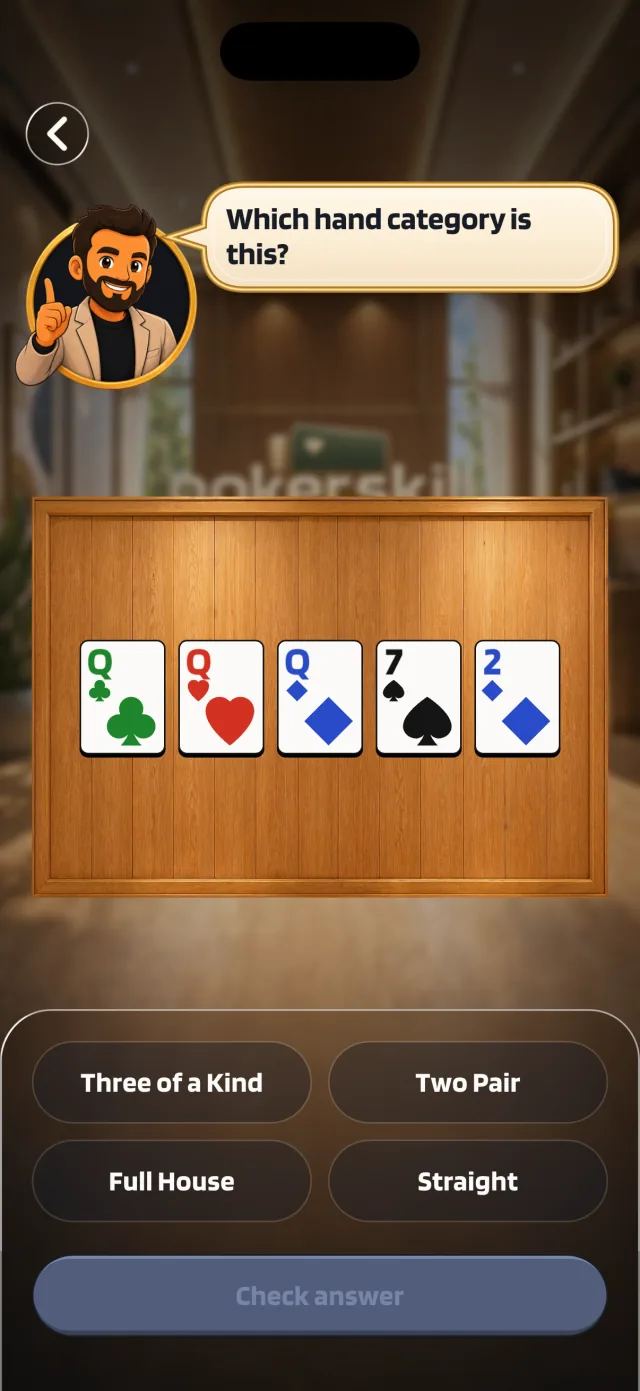
Practice this in Poker Skill. The defender lessons make the same split after you check: two pair raises the bet and a hand with no pair or draw folds, while top pair or a pair with a flush draw calls.
Get the free appCondensed Range: medium-strength hands only, no nuts, no air
What a condensed range is
A condensed range is the set of hands that survive a line where strong hands raised away and weak hands folded away, leaving only the middle. It mostly contains medium-strength holdings with decent showdown value: small and middle pocket pairs, weak-to-medium broadways, suited one-gappers. Both the very top of the rankings (which would 3-bet or 4-bet for value) and the bottom (which would just fold) are excluded. You will hear this called a “depolarized” range; same shape, opposite of polarized.
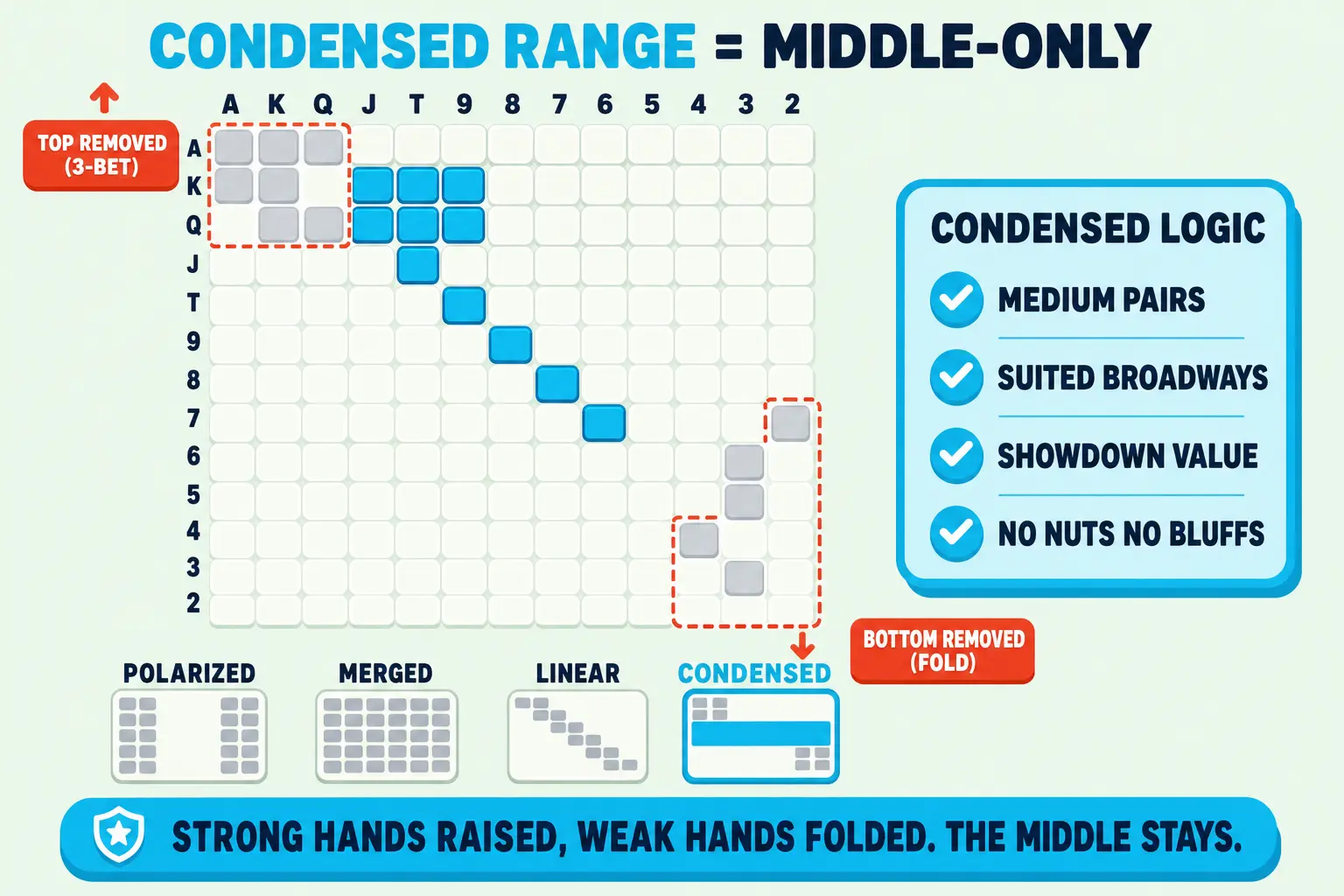
A simple way to read it: if your line is “I called and didn’t raise,” you almost certainly have a condensed range. The hands that wanted to raise are gone, the hands that wanted to fold are gone, and the middle stayed.
Related terms
How condensed compares to the other range shapes
Range shape is shorthand for which hands you keep and which you cut. The four shapes show up everywhere; learning to spot them is half the read.
| Shape | Top-tier hands | Medium hands | Pure-air bluffs | Typical line that creates it |
|---|---|---|---|---|
| Linear | yes | yes | no | First-in raise, all-in calling range. |
| Polarized | yes | no | yes | Big-bet line on the river, deep 3-bet bluffs. |
| Merged | yes | yes | no | 3-bet against a calling station; thick value block. |
| Condensed | no | yes | no | Flat-call instead of raise; check-call line postflop. |
| Capped (umbrella) | no | varies | varies | Any passive line that rules out the nuts. |
Polarized and condensed are mirror images. Polarized is “the extremes only”; condensed is “the middle only.” That mirror is exactly why polarized over-bets target condensed callers: the over-bet sizing hits the medium hands where the bettor’s nuts and the caller’s bluff-catchers meet.
Capped is a broader umbrella. Every condensed range is also capped (no nuts), but not every capped range is condensed. A capped range can still contain weak air. The cap is about the top; the condensation is about the top and the bottom.
When this matters most
Condensed ranges show up most reliably in three situations.
- Preflop flat-calls. When you call a raise instead of 3-betting or folding, your range condenses by definition. The strongest hands chose to 3-bet, the weakest chose to fold, and the middle stayed in the pot.
- Preflop callers in 3-bet pots. When the original raiser faces a 3-bet and just calls, the same logic applies one level up: the very best hands 4-bet for value, the worst fold, and the middle calls. The 4-bet caller’s range is one of the most condensed ranges in poker.
- Postflop check-call lines. When you check the flop and call a bet with a hand like middle pair, you’re keeping showdown value alive without inflating the pot. Repeat that on the turn, and your river range is densely packed with bluff-catchers.
It matters less in spots where you can credibly hold the nuts: river over-bet lines, all-in shoves, and deep 3-bet pots where every street has been aggressive. Those lines are usually polarized or linear, not condensed.
Worked example
You’re on the button at $1/$2 with $200 stacks. The cutoff opens to $6. You have a default 100bb defending strategy that splits hands three ways:
- 3-bet for value: JJ+, AK.
- 3-bet as a bluff: suited aces (A2s–A5s), KQs, KJs, suited connectors 54s, 65s, 76s.
- Flat-call: 77–TT, AQ, AJs, ATs, KTs, QJs, JTs.
- Fold: everything else.
You call with J♠ T♠.
The flop is K♣ 9♥ 5♦. Cutoff bets one-third pot.
Look at what’s in your range right now. Your strongest preflop hands (JJ+, AK) chose to 3-bet, so they’re not in this pot. Your weakest hands folded. What’s left is exactly the condensed middle: a few mid pocket pairs, a few broadway combos, and some suited connectors that might pick up draws. On a K-high flop, none of these hands are nuts and none are pure air. They’re all bluff-catchers or backdoor draws.
The right answer is to call wide and stay calm. Your hand (J♠ T♠) has gutshot equity, backdoor flush equity, and overcards. You aren’t folding it, but you also aren’t raising it: nothing in your range wants to bloat the pot, because your whole range is condensed and your job is to defend with bluff-catchers, not to manufacture value. Call the flop, reassess on the turn.
Compare that to the cutoff’s range. The cutoff is the preflop raiser, has top-pair-plus combos with the king, and can credibly bet with a pair, with overcards, or as a bluff. Their range is wider and stronger at the top, so they have range advantage. You have a condensed range and a defending job. Different sides of the same hand call for different lines.
Common mistakes
1) Trying to bluff-raise from a condensed range
A bluff-raise only works if your raising line could credibly contain the nuts. If your range is condensed, it can’t: by construction, the nuts already left the range when you flat-called. Raising as a bluff with a condensed range gets read as exactly what it is, namely middle-strength hands trying to look strong. Stay disciplined and call when called for.
2) Over-folding to polarized over-bets
Polarized over-bets are designed to beat up condensed ranges. The over-bet sizing prices out medium hands, which is the wrong response to be tempted by. Your hand class is bluff-catcher; you’re supposed to call enough of them to keep the over-bettor honest. Folding every bluff-catcher hands them a free profit on every bluff combo.
3) Confusing condensed with capped
Capped means the top is missing. Condensed means the top and the bottom are missing. A capped range can still contain pure-air hands that have to be folded; a condensed range mostly doesn’t. The strategy implication: a capped range often wants to bluff its weakest hands (since they have no showdown value); a condensed range almost never wants to bluff (since every hand has some showdown value worth realizing).
4) Treating “I called” as a single shape
Not every flat-call gives you a condensed range. A check-call from the big blind on a 9-high flop with 60% of your defending range is closer to a wide, capped range. Too many junky combos to be condensed. Condensed ranges show up when there’s a clear “strong fork” the strongest hands took (3-bet, raise, or shove) and a clear “weak fork” the weakest hands took (fold). Without both forks, your range is just wide.
FAQ
What’s the difference between a condensed range and a capped range?
A capped range is missing the very strongest hands; that’s the only requirement. A condensed range is missing the strongest and the weakest, leaving the middle. Every condensed range is capped, but a capped range can still contain a lot of weak air the condensed range would have folded.
Should I bet big or small with a condensed range?
Small or medium when you bet, and check more often than you’d think. Big bets only carry weight when your range can credibly contain the nuts. A condensed range can’t, so over-betting bluffs none of the hands you’d want to fold out and gets called by everything you beat. Smaller sizes preserve showdown value with hands that already have it.
Is “depolarized range” the same thing as condensed?
Yes. Different books use different words for the same shape. “Depolarized” leans on the contrast with polarized: the middle stays, the extremes leave. “Condensed” describes the result: the range collapses around medium-strength hands. Both names point at the same set of hands.