


Connected Board
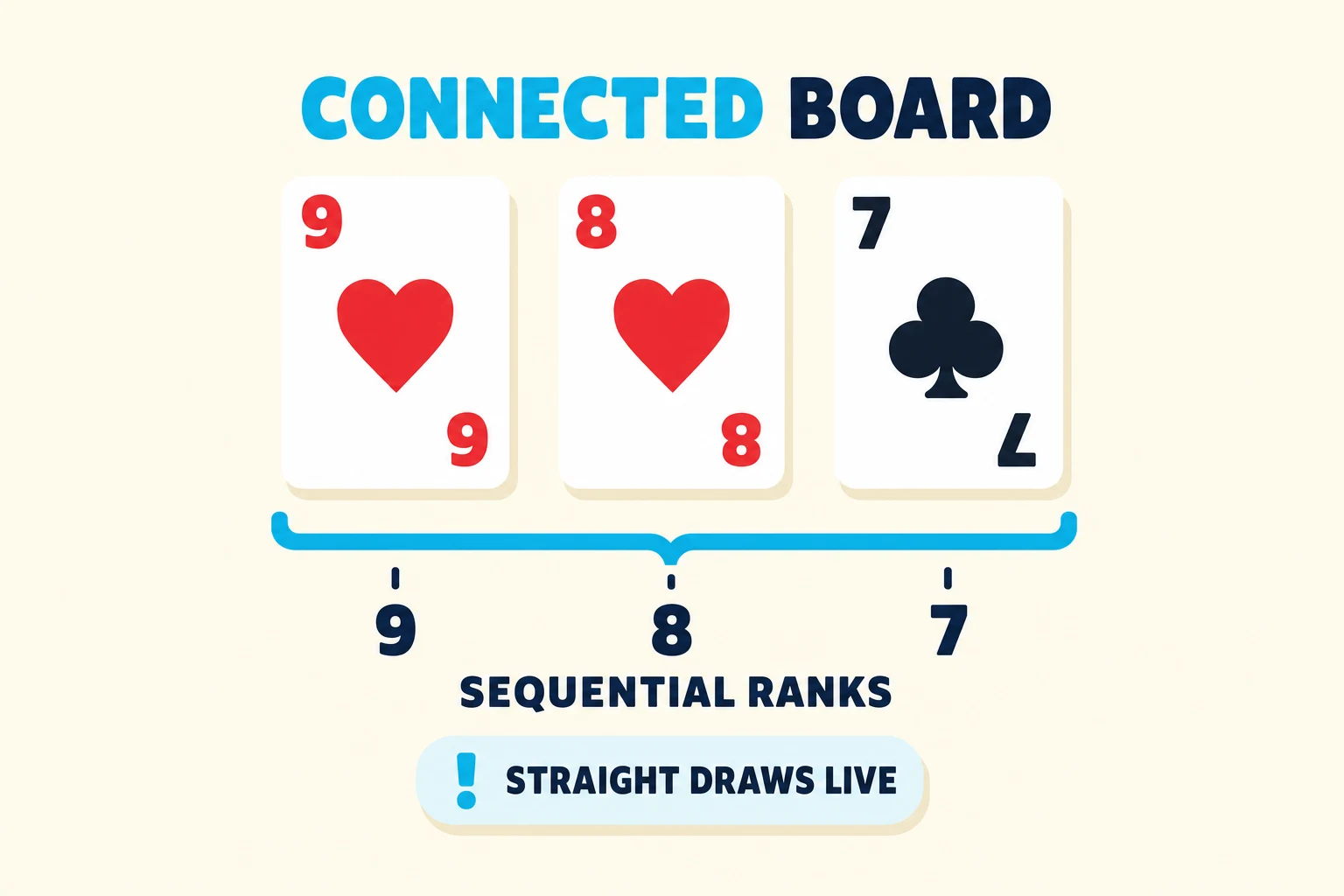
A connected board is a flop whose ranks sit close enough together to make straights live. The classic shape is three sequential cards like 9-8-7. Connected textures shrink the preflop raiser's range advantage, raise check-back frequencies, and demand bigger bets on the spots you do choose to fire.
Practice this in Poker Skill. Even top pair slows down on these flops in the c-bet lessons, where K♥ 10♠ checks on 10♣ 9♦ 8♠: ten-nine-eight fits the caller far better than it fits the raiser.
Get the free appConnected Board
What is a connected board?
A connected board is a flop whose ranks sit close enough together to make straights live. The textbook shape is three sequential cards like 9-8-7 or T-9-8, but the family also covers near-connected flops with one or two gaps (9-7-6, T-8-7, 9-7-5). The single useful test is to count how many flopped straights the board allows. AQ7 has zero. KT9 has one. 8-7-5 has two. JT9 has three. The more straights the texture supports, the more “connected” the flop is.
Connected vs near-connected: what counts
Three sub-shapes show up in practice. Sequential flops are the textbook case (9-8-7, T-9-8, 7-6-5). Any two-card combination from a wide neighbourhood already has a straight or a strong straight draw on these. One-gappers leave one rank missing (9-7-6, T-8-7, J-9-8); they still allow one made straight and a thick layer of open-ended and gutshot draws. Two-gappers stretch the gap further (9-7-5, J-9-7) and lose some draw density, but the BB defends enough connector and suited-gapper combos that range advantage still drifts back toward parity.
Related terms
- Wet board — the parent category that bundles connected and flush-heavy textures together.
- Dry board — the direct contrast: ranks far apart, ranges miss.
- Straight draw — the draw type connected boards activate by definition.
- Open-ended straight draw — the strongest straight-draw shape connected flops produce.
- Gutshot — the weaker straight-draw shape that shows up everywhere on these textures.
- Board texture — the parent concept this entry sits under.
- Runout — what you are planning for as the turn and river drop.
Connected vs other “wet” textures
Coordinated boards come in different shapes. The table below reads left to right from the calmest to the most volatile texture in a single-raised pot.
| Board type | Example | Flopped straights | Defining draw | C-bet posture |
|---|---|---|---|---|
| Dry / disconnected | A♣ 7♦ 2♠ | 0 | None | High frequency, smaller size |
| Two-tone, semi-connected | K♠ 9♠ 4♥ | 0 | Flush + gutshot | Mixed, medium size |
| One-gapper connected | T♥ 8♣ 7♦ | 1 | OESD + gutshot | Lower frequency, larger size |
| Sequential connected | 9♥ 8♥ 7♣ | 2 | OESD + flush draw | Lower frequency, larger size |
| Sequential + monotone | 7♣ 6♣ 5♣ | 2 | Flush, straight, straight flush | Mostly check, polarize when you bet |
A connected board does not need to be wet in the flush sense to behave like a tough texture; the rank coordination alone is enough to flatten range advantage and force you to either check more often or size up.
When connected boards matter most
The texture punches above its weight in a few specific spots:
- BTN or CO opens, BB calls. The BB defends a wide range loaded with connectors and suited gappers. Sequential mid-low flops hit that range disproportionately and shrink the in-position player’s range advantage.
- Multiway pots. Each additional caller adds another shot at a flopped straight or a strong draw. With two callers, somebody connects with a 9-8-7 type flop most of the time.
- Deep stacks. Implied odds reward chasing draws when there are stacks left to win, so opponents will continue with marginal straight draws they would fold short-stacked.
- Blind-vs-blind. SB and BB both defend a lot of small connectors. Sequential flops favour the caller’s nut share more than they favour the opener’s.
The texture matters less in single-raised pots against a tight EP open, where the caller’s range is heavier in pocket pairs and broadways than in connectors, and on high-card sequential flops like KQJ where the raiser’s range coverage is genuinely strong.
Worked example
You open the cutoff to 2.5bb with K♠ Q♠. The BB calls. The flop comes 9♥ 8♥ 7♣ in a single-raised pot, ~100bb effective.
Hand-read first: the BB’s calling range is full of suited connectors and one-gappers (T9, 98, 87, 76, JT, T8, 86) plus pocket pairs that just made sets or overpairs. Two flopped straights are live (JT and 65), every overpair from 99 down is a set or a pair-plus-draw, and the two hearts add a flush draw on top of everything else. K♠ Q♠ has two overcards and a gutshot to the nut straight with any J. Equity against the BB’s continue range is roughly coin-flip, but the playability is poor: when you are called, you rarely improve to a hand that wants to fire two more streets.
The textbook response is to lean into the check-back. The same hand on K♠ 7♣ 2♦ is a near-automatic small c-bet because the BB has almost nothing that connects; on 9♥ 8♥ 7♣ the BB connects more than half the time and you are out of position-equivalent on the turn even though you are technically IP. If you do bet, size big (~⅔ pot or more) so a call narrows the BB’s range to genuine continuing hands and a turn barrel still threatens stack pressure.
Common mistakes
1) Auto-c-betting at dry-board frequency
The biggest leak. Players carry the half-pot c-bet habit from K♣ 7♦ 2♠ over to 9-8-7 and bleed chips into ranges that do not fold. The check-back is a real strategic tool here, not a cop-out.
2) Undersizing on the bets you do fire
When the texture is loaded with draws, a quarter-pot bet gives every gutshot and flush draw correct odds to call. If you are betting for value or to deny equity, size up to roughly ⅔ pot or larger so the draws pay full price.
3) Overplaying overpairs
A♠ A♣ on 9♥ 8♥ 7♣ is one pair on a board where the BB has flopped two pair, sets, made straights, combo draws, and naked open-enders. Stacking off three streets in a single-raised pot is rarely the right plan; pot-control on the turn is usually better than blind aggression.
4) Ignoring multiway
Two callers on a sequential flop is a different game than heads-up. With three players seeing the flop the chance somebody connected is high enough that thin value bets and ambitious bluffs both lose money. Tighten your continuing range and size value bets larger.
FAQ
Is a connected board the same as a wet board?
No. “Wet” is the umbrella for any high-equity-shift texture, including connected, monotone, and two-tone with high cards. “Connected” is one specific way a board can be wet, by stacking ranks close enough to make straights live. Every connected flop is wet, but plenty of wet flops (like K♥ 7♥ 2♥ monotone) are not connected.
How many gaps still count as connected?
A flop with one gap (9-7-6, T-8-7) plays a lot like a sequential flop because the same straight-draw families still hold up. Two-gappers (9-7-5) lose draw density but keep enough range overlap with the BB’s calling range that you should still check more often than you would on a true dry board. Past three gaps you are usually back into dry-board territory.
Should I ever c-bet small on a connected flop?
Rarely, and only on textures where your range advantage is intact (sequential flops with two Broadway cards, like Q♣ J♦ T♠, can support a smaller, mixed-size c-bet because the opener has more sets and two-pair combos than the caller). On mid-low sequential flops, a small c-bet just gives draws cheap continues; either size up or check.