


Continuation Bet
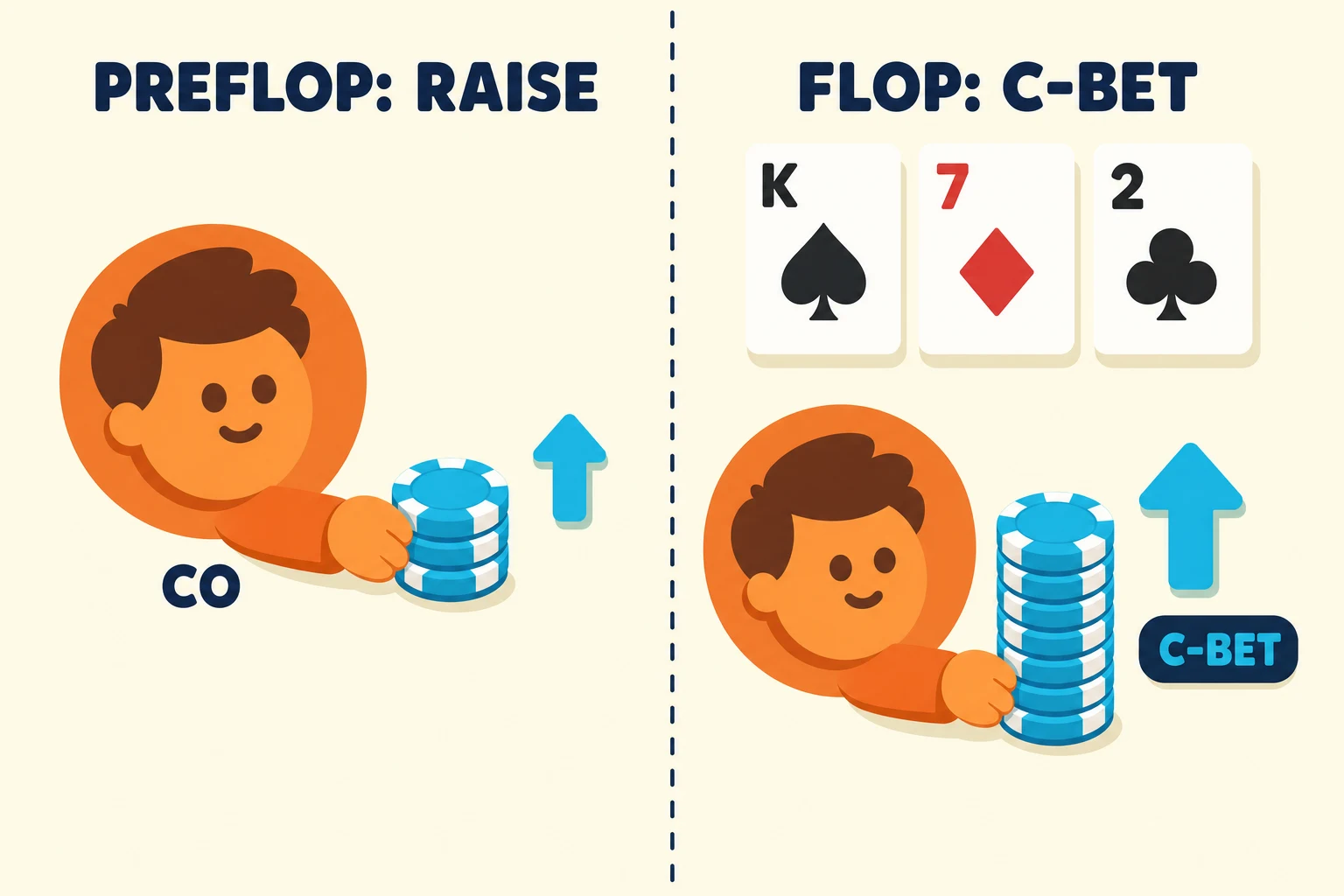
A continuation bet (C-Bet) is a flop-sized bet by the last preflop aggressor, usually the raiser. Its main goals are to win pots when opponents fold and to pressure marginal hands into difficult decisions. Example: You open to 3x from the cutoff with AK and the big blind calls. The flop is K-7-2 rainbow. A C-Bet represents strength whether you hit or not, and often wins when opponents miss.
Practice this in Poker Skill. Both sides of the c-bet decision come up in the Intro to Continuation Betting lesson: J♦ J♠ bets its overpair for value on 2♣ 9♣ 5♠, while 10♠ 10♦ checks on K♠ 9♠ J♣, a wet flop with two overcards.
Get the free appContinuation Bet: A Practical Outline for No-Limit Hold’em
What a Continuation Bet Is
A continuation bet (C-Bet) is a flop-sized bet by the last preflop aggressor, usually the raiser. Its main goals are to win pots when opponents fold and to pressure marginal hands into difficult decisions. Example: You open to 3x from the cutoff with AK and the big blind calls. The flop is K-7-2 rainbow. A C-Bet represents strength whether you hit or not, and often wins when opponents miss.
Start with the main C-Bet entry for the definition and the sizing cheat sheet; this page goes deeper on which hands bet and which check. For the board-by-board strategy split, read when to c-bet the flop.
When to C-Bet: Board Texture and Position
Board texture and position determine how often you should C-Bet. Dry boards have disconnected cards and few draws; wet or coordinated boards offer many draws or straight possibilities. Being in position (IP) means you act after your opponent and gives you more information. Being out of position (OOP) means you act before them and requires greater caution. Example: On A-2-9 rainbow (dry), C-Bet frequently because opponents rarely connect. On 9-8-7 with two hearts (wet), reduce your C-Bet frequency because many hands have draws or made straights.
What to Include in Your C-Bet Range
Balance value bets, bluffs, and semi-bluffs (draws that can improve to strong hands). Bet strong value hands regularly, but occasionally check very strong hands as traps. Mix bluffs to prevent opponents from folding only to your value hands. Example: From the button you raise and see J-6-2. Include value hands that hit (JJ+, AJ) in your betting range. Add backdoor draws or unpaired broadways as bluffs to keep opponents honest.
Sizing Your C-Bets
Use sizing to manage fold equity and pot growth.
- Small (~1/3 pot): Use as a default to pressure opponents economically and keep pots manageable.
- Large (~2/3 pot): Use to gain fold equity against sticky callers and to charge draws on wet boards.
- Simplify: Pick a default size to simplify decisions, then deviate when the board or opponent demands it.
Example: On K-7-2 rainbow, a 1/3 pot bet pressures without bloating the pot. On 9-8-7 with two hearts, a 2/3 pot bet folds out medium hands and charges draws.
Adjustments vs Opponents and Stack Dynamics
Exploit opponent tendencies and consider stack-to-pot ratio (SPR)-the effective stacks divided by the pot. Shallow SPRs favor straightforward value betting; deeper SPRs favor balanced ranges and selective bluffs.
- Against players who fold too often: raise frequency and sizing.
- Against calling stations: cut bluffs, tighten up, and focus on value.
- Versus strong defenders from the big blind: find specific leaks to exploit rather than blindly following equilibrium.
Example: With deep stacks and a flush draw, semi-bluff more often. With short stacks, prefer thin value bets instead.
Common Mistakes and Practical Habits
Common mistakes include betting every flop regardless of texture and never checking as the preflop aggressor. Both extremes cost EV. Adopt these habits: review hands to balance bluffs and value, practice mixing sizes on representative boards, and note when checking as the aggressor is appropriate.
Quick checklist
- You were the last preflop aggressor before attempting a C-Bet.
- Choose frequency based on board texture (dry = more, wet = less).
- Mix value hands, bluffs, and semi-bluffs to stay balanced.
- Use sizing deliberately (default small, larger when warranted).
- Adjust to opponent tendencies and SPR; exploit visible leaks.
- Avoid the extremes of always betting or always checking.