
In Position (IP): Using Positional Advantage in No-Limit Texas Hold’em
What “In Position” (IP) Means
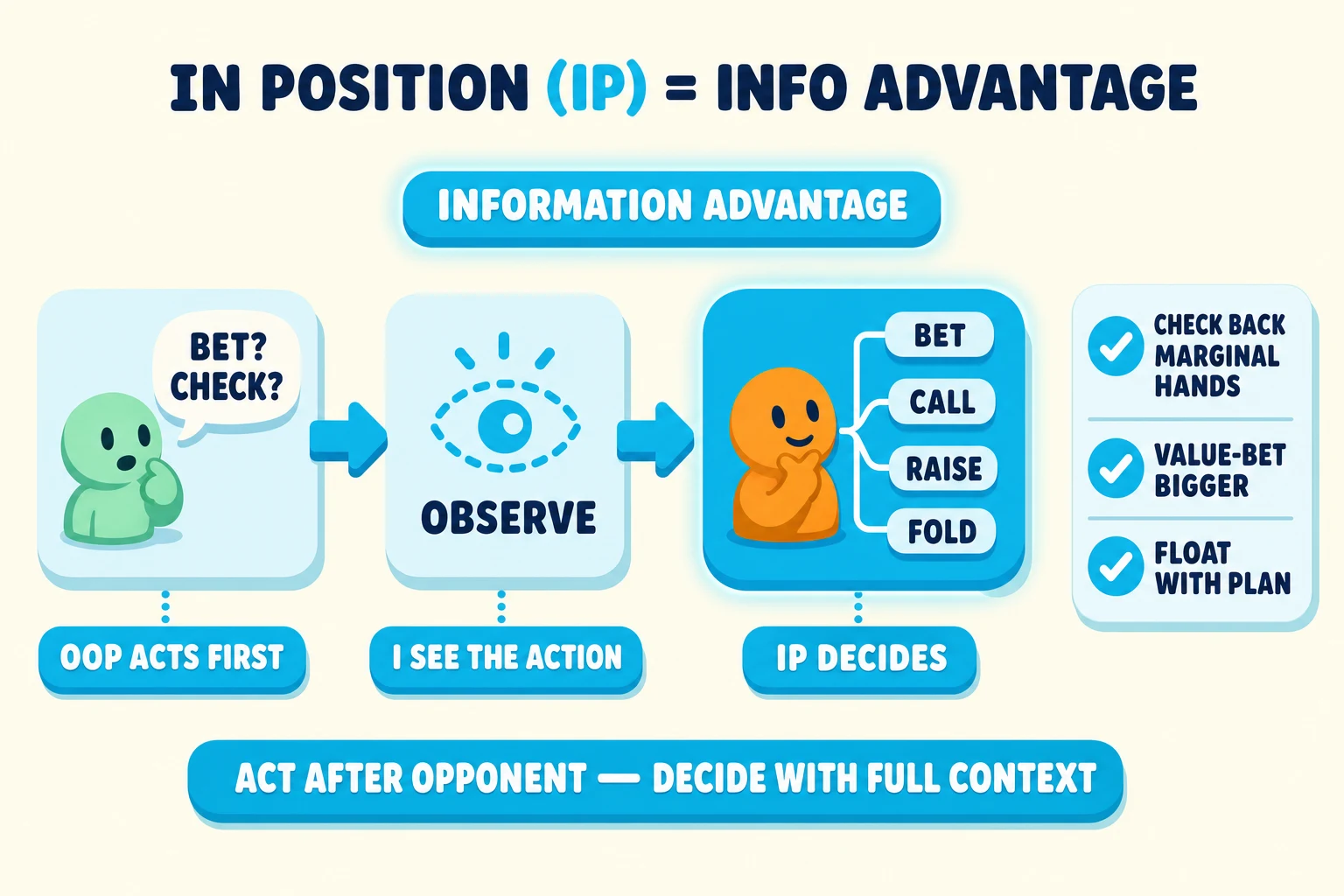
“In Position” (IP) means you act after your opponent on a betting street. Acting last lets you see your opponent’s bets, checks, or raises before deciding to bet, raise, call, or fold. This extra information simplifies turn and river decisions and gives you control over pot development. Example: You raise to 3 bb from the button and the big blind calls. On a K♠7♦2♣ flop the pot is 6 bb; as IP you choose to c-bet or check after seeing the big blind’s preflop action and the flop texture. (Brief jargon: c-bet = continuation bet, a post-flop bet by the pre-flop aggressor. OOP = out of position, the player acting earlier.)
Why Position Matters: Core Strategic Advantages
- Information edge: Acting last reduces guesswork and lets you size bets based on your opponent’s action.
- Pot control and equity realization: IP lets you inflate the pot when ahead or keep it small to realize equity (the chance your hand improves).
- More room for aggression: IP bluffs and value bets land harder because the action came to you first; shift between value-heavy lines and more bluffs depending on opponent tendencies.
C-Betting and Post-Flop Bet Sizing
Common IP approaches:
- In many 3-bet pots IP favors small continuation bets, roughly 1/4-pot, to apply pressure while limiting risk. If the pot is 8 bb after a 3-bet line, a 1/4-pot c-bet is about 2 bb.
- Mix in checks. Checking the flop roughly 38% of the time, including with some strong hands, keeps your range balanced.
- Let board texture and opponent tendencies guide you. Dry, uncoordinated boards fit frequent small c-bets; coordinated, draw-heavy boards favor checks and pot control.
Simple sizing steps:
- Estimate pot size after preflop action.
- On static boards, default to a small c-bet (~1/4-pot) to deny equity cheaply.
- On coordinated or drawy boards, check more and use small bets only when you can fold to raises.
Range Advantage and Flop/Turn Dynamics
IP often holds a range advantage, especially versus the big blind in single-raised pots. Your opening range contains more strong hands and high-card combinations, letting you apply pressure across many runouts. When your range is stronger, pressure OOP calling ranges with targeted bets and realize more equity on later streets. Conversely, if the board favors the pre-flop caller (many connected or suited cards), check more and use smaller bets to manage downside risk.
Practical Adjustments and Common Pitfalls
Actionable adjustments:
- Don’t over-bluff just because you’re IP; balance aggression with checks and protect strong hands.
- Use controlled aggression: size bets to deny equity cheaply or extract value without bloating the pot.
- Adjust to opponents: tighten checks versus aggressive OOP raisers and increase pressure versus passive callers.
Common mistakes:
- Betting too large under the assumption position alone solves post-flop issues. Large bets hamper pot control.
- Never checking strong hands. Check some strong hands (part of the ~38%) to avoid predictability.
Quick checklist
- Act after your opponent each street to use the information edge.
- Use small c-bets (≈1/4-pot) often in 3-bet pots to apply pressure while controlling risk.
- Check back about 38% of flops, including some strong hands, to stay balanced.
- Favor pot control and more checking on dynamic, draw-heavy boards.
- Exploit your range advantage versus the big blind in single-raised pots.