


Out of Position (OOP)
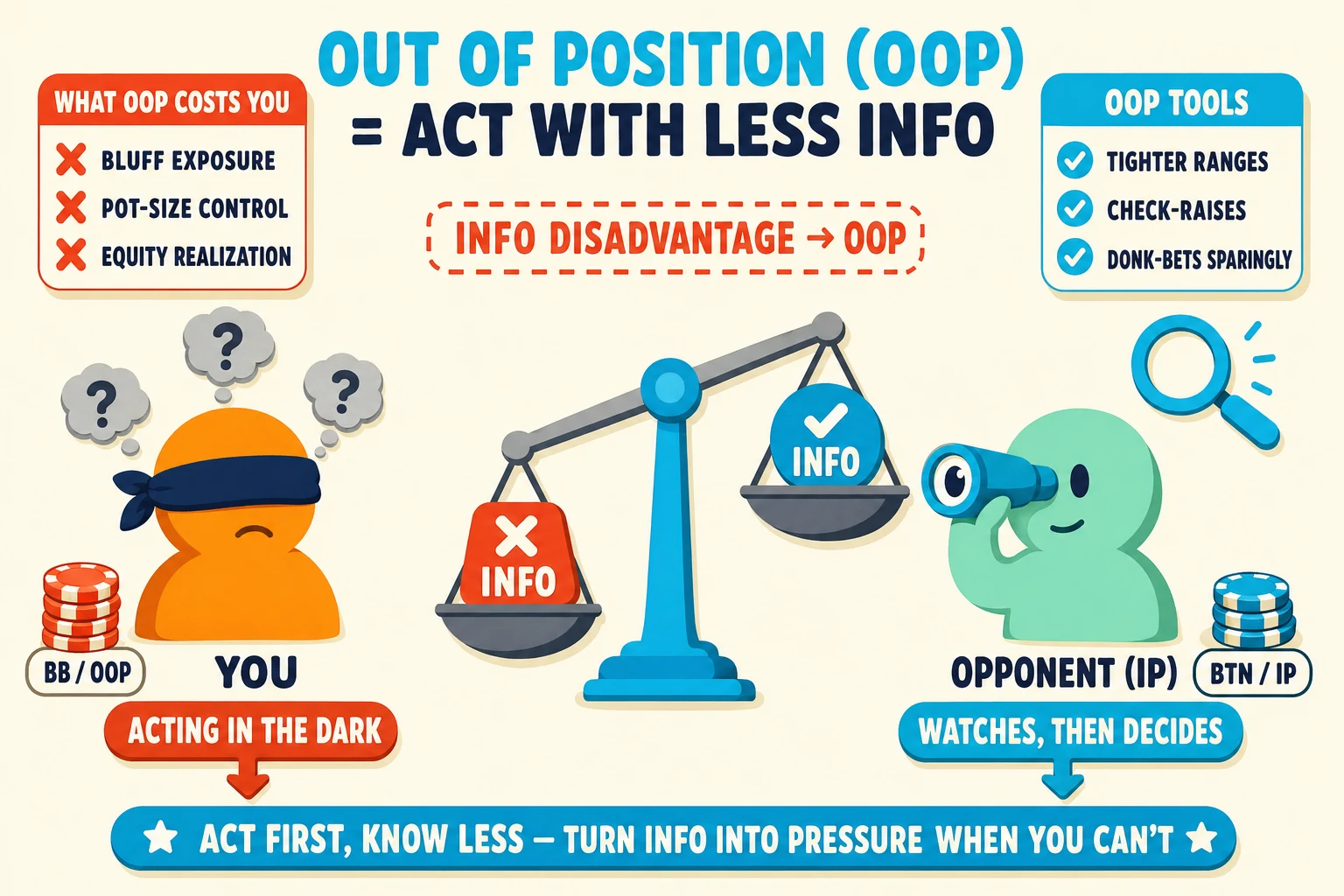
A player is out of position (OOP) when they must act before their opponent on a betting round. The player who acts after you is in position (IP). Acting later gives IP extra information to size bets, choose bluffs, or extract value. That information gap forces OOP players to make many decisions with less context. On later streets OOP players often must commit or fold without knowing whether IP will check, bet small, or shove.
Practice this in Poker Skill. The Lead and Donk Bets lesson takes a strict line out of position: every hand checks to the preflop raiser, king-high and flopped straights alike.
Get the free appOut of Position (OOP) in No-Limit Texas Hold’em
Definition: What “Out of Position” Means
A player is out of position (OOP) when they must act before their opponent on a betting round. The player who acts after you is in position (IP). Acting later gives IP extra information to size bets, choose bluffs, or extract value. That information gap forces OOP players to make many decisions with less context. On later streets OOP players often must commit or fold without knowing whether IP will check, bet small, or shove.
Why Being OOP Is a Strategic Disadvantage
OOP players lose control of pot size and initiative. An IP opponent can apply multi-street pressure, using bet sizes that deny correct odds. IP can also check back to keep pots small when it suits them. Medium-strength hands struggle to extract value because IP can call small then raise big, or simply slow-play. Bluffs are less effective since IP can call probes and punish further aggression. Overall, OOP play often forces more defensive lines, increasing the risk of folding equity or losing big later.
Preflop Adjustments When OOP
- Tighten your ranges. From spots like the small blind (SB) or big blind (BB), avoid marginal hands that need a positional edge to win.
- Prefer hands that perform without initiative. Strong made hands, like high pocket pairs, and hands that realize equity easily, such as suited broadways, fare better OOP than speculative offsuit connectors.
- Be selective with 3-bets and cold calls. Widen only against opponents who fold too much to 3-bets or who call too wide. Otherwise fold or 4-bet with hands that play well when action continues.
Postflop Play: How to Navigate OOP
Check more often and avoid barreling without a strong hand or a clear polarized plan. Aggression OOP works best with obvious strength or a credible bluff; middle-ground hands are difficult to play. Recognize equity-realization problems: IP can size bets to deny you correct odds to continue with draws. For example, holding 8♠6♠ on a 9♠7♣2♦ flop, a large IP bet can make calling costly despite decent equity. Use selective aggression when the board texture favors your preflop range - a dry flop after your raise can be a good spot to seize initiative.
Tactical Tools to Counter the OOP Disadvantage
- Donk-betting: lead into the preflop aggressor sparingly. It can disrupt IP timing on favorable boards or when you have clear equity and a plan.
- Defensive betting and check-raises: useful to regain initiative occasionally. They require accurate hand reading and frequency awareness to avoid predictability.
- Adjust bet sizes by stack depth and pot dynamics: shallow stacks and single-raised pots change optimal sizing. Multi-way pots and deep stacks worsen OOP problems; avoid marginal confrontations in those spots.
Quick checklist
- Tighten preflop ranges when OOP, especially from the blinds.
- Check more often postflop; reserve aggression for strong or polarized hands.
- Use donk-bets and check-raises sparingly and always with a plan.
- Watch stack depth and multi-way pots - they exacerbate OOP problems.
- Practice hand reading, discipline, and range management to improve OOP results.
Playing OOP is unavoidable sometimes. Treat it as a different game: play fewer marginal hands, choose aggression deliberately, and exploit spots where the board or opponent tendencies let you tell a believable story despite acting first.