
Small Blind (SB)
What the Small Blind is
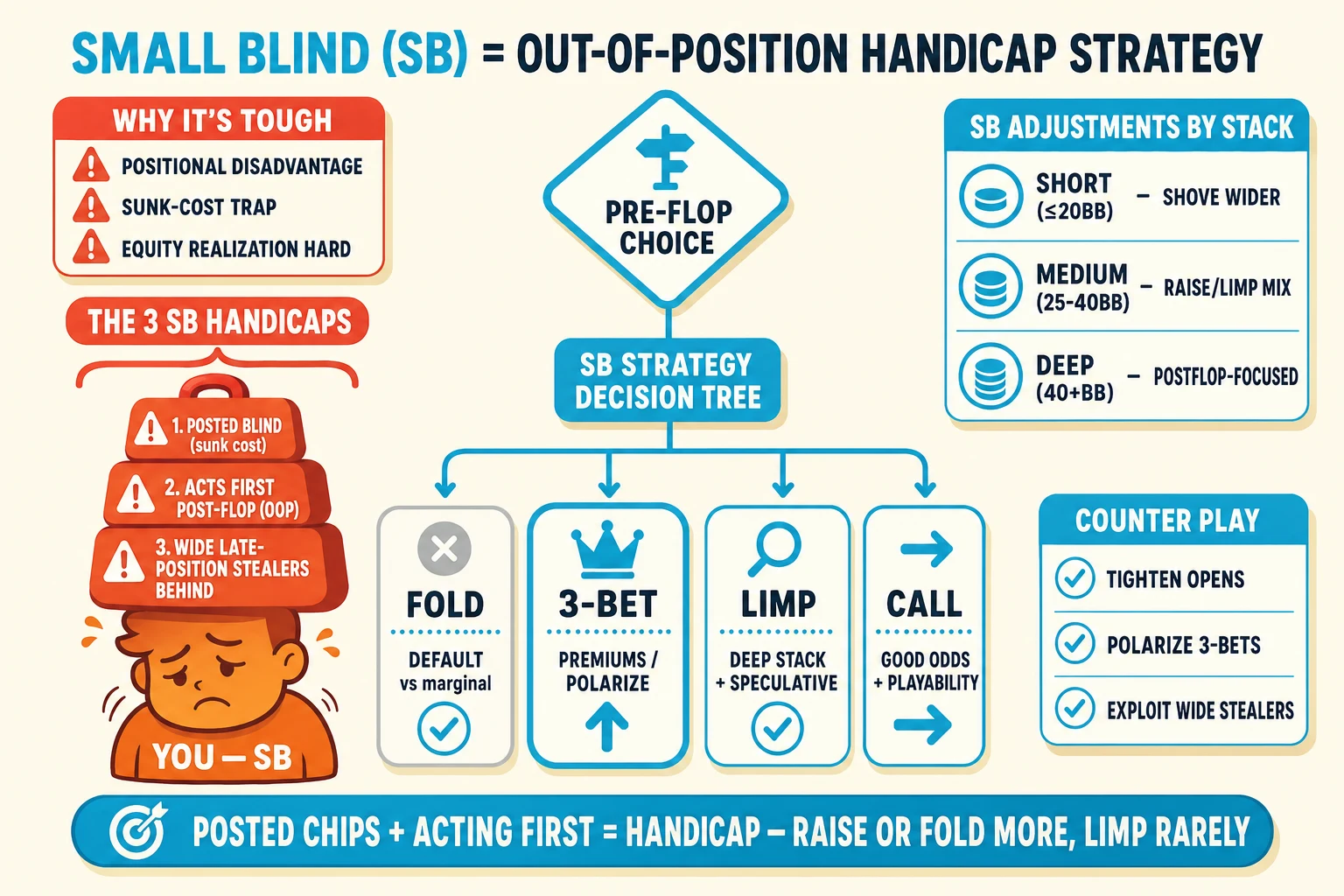
The Small Blind (SB) sits immediately to the left of the dealer button. The SB posts a mandatory bet before cards are dealt, usually about half the Big Blind. For example, in a $1/$2 game the SB typically posts $1. Because the SB posts without seeing cards, the player starts each hand at a disadvantage. After the flop the SB acts before most opponents on every betting round, increasing decision difficulty.
How the SB shapes table dynamics
The SB and BB fund every pot through forced blinds, creating immediate incentive to play. Those forced bets encourage late-position opens and steal attempts, since there is always money to win. The BB retains post-flop positional advantage, acting after the SB on later streets. That positional edge forces the SB to adjust both preflop and post-flop choices. This dynamic produces frequent heads-up blind battles, limp/raise play, and polarized 3-bet strategies.
Preflop choices from the SB
Preflop the SB has three common options: fold, limp, or raise.
- Fold: surrender the blind when the hand is weak or when facing aggressive opens.
- Limp: call the BB’s blind without raising; limp means entering the pot passively. Limping can work in deep-stack games or against predictable opponents, but it invites multiway pots.
- Raise: open the pot or 3-bet, which is a re-raise after an initial raise. Because the SB will be out of position, its 3-bet range should be stronger and more deliberate. Favor hands with clear playability or meaningful fold equity when 3-betting from the SB.
Tighten your opening range when multiway pots are likely, and widen it selectively in heads-up blind battles.
Post-flop play and dealing with positional disadvantage
Acting first after the flop changes how you construct lines and extract value. Acting early reduces your ability to get paid off with marginal hands and makes bluffing riskier.
To compensate:
- Avoid marginal hands in multiway pots where you must act first on later streets.
- Use selective aggression heads-up: well-timed continuation bets and occasional check-raises regain initiative.
- Choose bet sizes with purpose: smaller bets control pot size; larger bets generate fold equity when needed.
Steer hands toward clear equity (made hands, strong draws) or spots where you can credibly represent strength.
Adjusting SB strategy by opponent type and stack depth
Adjustments matter and should be opponent-specific.
- Versus habitual stealers or late-position openers, use a polarized 3-betting approach: some strong value, some targeted bluffs.
- In heads-up blind battles, mix limps and raises based on the BB’s tendencies. Exploit a passive BB with more raises.
- Stack depth matters: short stacks widen shove ranges to avoid post-flop disadvantage.
- Deeper stacks allow nuanced limps, varied raise sizes, and more post-flop maneuvering.
Quick reminders
- SB sits left of the dealer and posts a forced bet, roughly half the BB.
- Favor tighter, selective openings in multiway pots.
- 3-bets from the SB should be stronger and more deliberate than those from the BB.
- Short stacks: shove wider; deep stacks: use varied raises and limp options.
- Always account for the BB’s positional advantage when planning preflop and post-flop lines.