


Small Stakes
Small stakes is a band of cash games that sits above the very smallest micro-stakes games but below mid-stakes. The exact dollar cutoffs vary by site, room, and live versus online context. Small stakes is a stake label, not a strategy — but the typical pool, rake pressure, and bankroll math at this level shape how you adjust.
Small Stakes in NLHE Cash
What small stakes means
Small stakes is the band of cash games that sits above the very smallest micro-stakes games but below mid-stakes. There is no single official cutoff. The exact dollar boundaries shift by site, by cardroom, and by whether you are playing live or online. As a working frame, small stakes typically covers $1/$2 No-Limit Hold’em through $2/$5 NLHE live, and roughly $0.10/$0.25 through $0.50/$1 online. Some books extend the band up to $5/$10 NLHE live, especially in markets where rake and pool composition still feel like a low-stakes game.
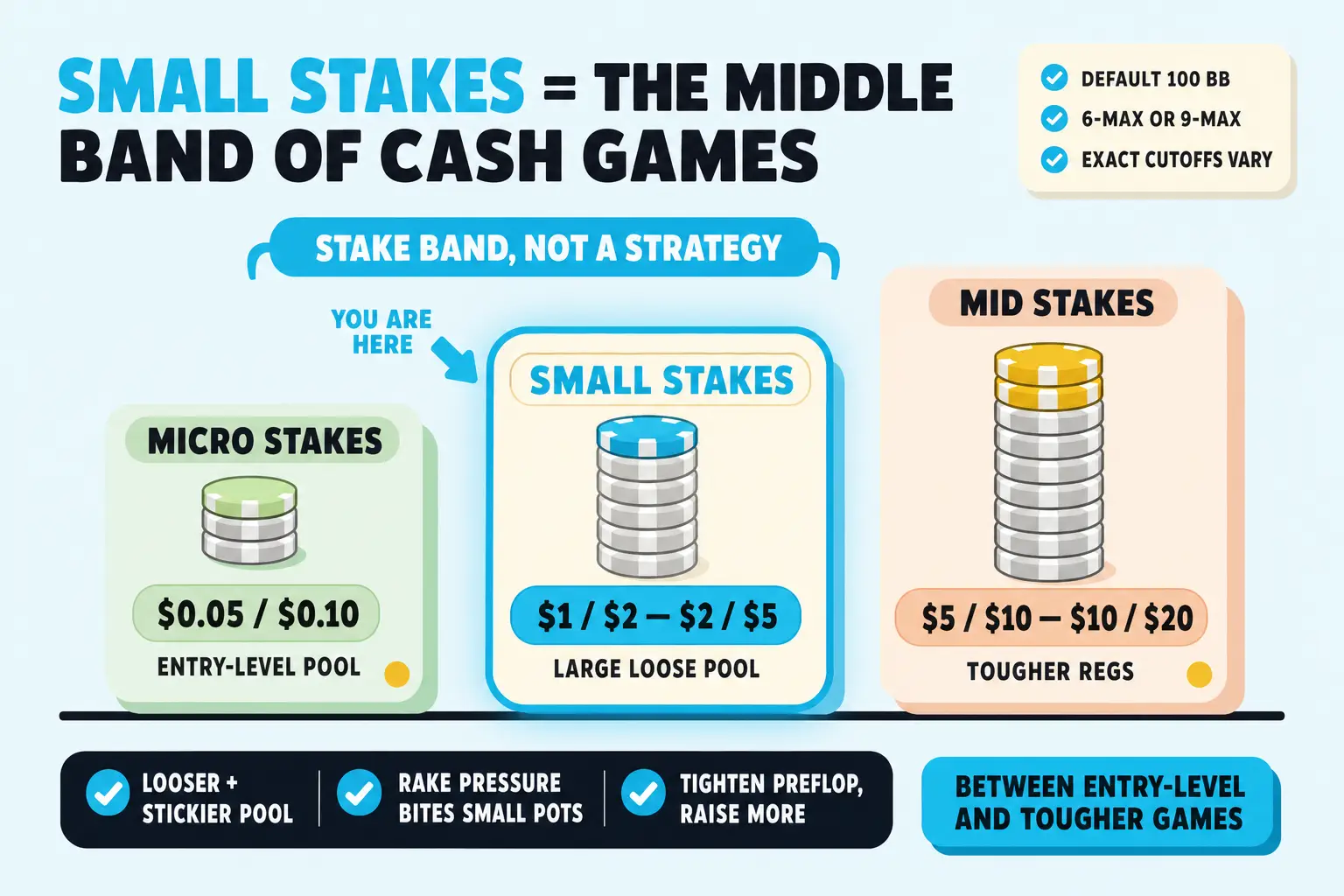
The label is a stake band, not a strategy. Two players sitting in different small-stakes games can be playing very different versions of poker. A $1/$2 home-game regular and a $0.50/$1 online four-tabler are both at “small stakes” in name, but the pool tendencies, the rake structure, and the average pot size at each game shape the decisions they should make.
Related terms
- Big blind: the unit stakes are quoted in (a $1/$2 game has a $2 big blind).
- Blinds: the paired forced bets that name the level (small blind / big blind).
- Rake: the house fee that bites small-pot small-stakes math hardest.
- Stack depth: the chip count in big blinds; small stakes default is around 100bb.
- Expected value: the long-run scoreboard the band sits inside.
- Value bet: a thin-value line behaves differently in a sticky small-stakes pool.
- Position: positional discipline pays more against loose small-stakes opponents.
- Preflop: the simplest small-stakes adjustments live preflop.
How small stakes compares to other bands
| Band | Typical live | Typical online | Pool feel |
|---|---|---|---|
| Micro stakes | under $1/$2 (rare live) | $0.01/$0.02 to $0.10/$0.25 | Entry-level, very loose, very small money |
| Small stakes | $1/$2 to $2/$5 (sometimes $5/$10) | $0.10/$0.25 to $0.50/$1 | Loose to medium, casual heavy, sticky callers |
| Mid stakes | $5/$10 to $25/$50 | $1/$2 to $5/$10 | More regulars, fewer obvious mistakes |
The exact line between these bands is fuzzy. One book defines small stakes as live cash up to $2/$5 plus online up to $0.50/$1; a second book groups the cash ladder as micro $0.01/$0.02 to $0.50/$1, low $1/$2 to $5/$10, and mid $10/$20 to $50/$100. Different sources, different lines, same underlying point: small stakes is the level between “first time you sit at a real-money table” and “the game where most opponents already study away from the table.”
Why small stakes plays differently
The label changes very little about the rules and a lot about the room you are sitting in. Three things tend to shift at small stakes compared to higher levels.
- The pool runs looser and stickier. Small-stakes pools include more casual social players, more calling stations, more loose raisers, and more straightforward postflop play. Many opponents call wide preflop and play face-up postflop, which is where most of the small-stakes edge comes from. Some players also limp marginally playable hands instead of raising.
- Rake takes a bigger bite of small pots. A capped percentage rake (often around 5% capped at 3 to 5 big blinds) takes a larger share of a small pot than of a big one. At $1/$2 the cap is a meaningful share of the average pot; at $5/$10 the same cap is a much smaller share. Solver outputs adjusted for small-stakes rake levels raise more, limp less, and fold a little more often than rake-free models.
- Stack depth is usually around 100bb. Most small-stakes cash games are played at the standard 100bb buy-in, give or take. That is the depth most preflop charts and most postflop heuristics are built for. Some players short-buy and some carry stacks deeper after winning a few pots, but 100bb is the default reference.
The combined effect: small-stakes 6-max NLHE cash is the same game as mid-stakes NLHE, played in a room where opponents make more mistakes and rake takes a bigger bite of every pot you win.
Example: a thin-value spot at $1/$2
A $1/$2 6-max cash game with 5% rake capped at $5. You open ♠A♠Q on the button to $6. The big blind, a loose-passive caller, defends to $6. Flop comes ♠Q♥7♣4: top pair, top kicker, big blind checks, you bet $9 for value, big blind calls. Turn ♠2: big blind checks, you bet $20 for value plus equity, big blind calls. River ♣9: big blind checks. Pot is $71 net of rake.
Two reads pull in different directions on this river:
- Pool tendency: small-stakes loose-passive callers reach the river with a lot of weaker queens, second-pair hands, and pocket pairs below queens. That argues for a thin value bet.
- Rake adjustment: the pot has already paid the cap. Any further bet has to win directly more often than the equity edge would suggest at gross-pot odds. That argues for picking a clean, not-too-thin value size that the loose-passive range will still pay off.
A $35 to $40 river bet hits both reads: it is large enough to scare off truly weak hands, small enough to keep weak queens and middle pairs in the pool’s call range. The thinner alternative, a $20 bet that gets called by a wider range of weaker hands but also by more chops and slim losers, is closer to break-even after rake than it looks.
The point of the spot is not the exact size. The point is that thin value at small stakes lives in the gap between “the pool will call wide” and “rake has already raised your bar.” Both forces pull on the same hand.
Common mistakes at small stakes
1) Treating “easy game” as license to play looser
The pool is sticky, but rake is not. A loose-passive table is exploitable with a tight, position-aware preflop range and clear value bets postflop, not with wide opens and thin bluffs. Calling stations are not helpful when you are the one trying to bluff them. Tight in, big in, value-driven beats loose in, hopeful out at this band.
Poker Skill plays for no money at any stake, but its raise-or-fold lessons teach the tight, position-aware preflop range this fix starts from, seat by seat at 100 big blinds.
2) Skipping the rake adjustment
A line that breaks even at gross-pot odds is a small loser at net-pot odds. Heavily raked small-stakes games reward the same shifts that solver outputs already encode: more raising, less limping, fewer thin marginal calls. Players who carry no-rake assumptions into a $1/$2 game pay the cap on every borderline call.
3) Confusing the band with the game
Small stakes is a label, not a fixed style. A $1/$2 live home game with seven recreational players is not the same animal as $0.50/$1 online six-max with four regulars at the table. Treating “small stakes” as one strategy assumes a pool that does not always exist. The fix is to read the actual table — opening frequencies, sizing tells, fold tendencies — instead of importing a generic small-stakes plan.
FAQ
What dollar amounts count as small stakes?
There is no single answer. As a practical frame: small stakes typically covers $1/$2 through $2/$5 No-Limit Hold’em live, and roughly $0.10/$0.25 through $0.50/$1 online. Some sources extend small stakes up to $5/$10 live; others draw the line at $2/$5. The boundary between micro stakes and small stakes is just as fuzzy. Treat the band labels as approximate guides, not exact rules.
Is small stakes easier to beat than mid stakes?
The pool is usually softer, but rake is usually heavier. Small-stakes pools include more casual and loose-passive players, which makes thin technical edges easier to find. The flip side is that capped rake takes a bigger share of every small pot, which raises the floor on what a profitable line has to look like. Beating small stakes is not “automatic”; it rewards discipline, table selection, and the basic exploit toolkit more than fancy play.
How is small stakes different from micro stakes?
Micro stakes are the lowest band on the cash ladder, generally below $0.50/$1 online, and rarely a category live. The pool is even looser and the dollar amounts are very small. Small stakes is the next step up, where the pool tightens slightly, the dollar amounts become real to most recreational players, and rake pressure is at its harshest as a share of average pot. Many players cycle through micro stakes as a learning band before moving to the small-stakes level where they spend most of their cash-game career.