


Smooth Call
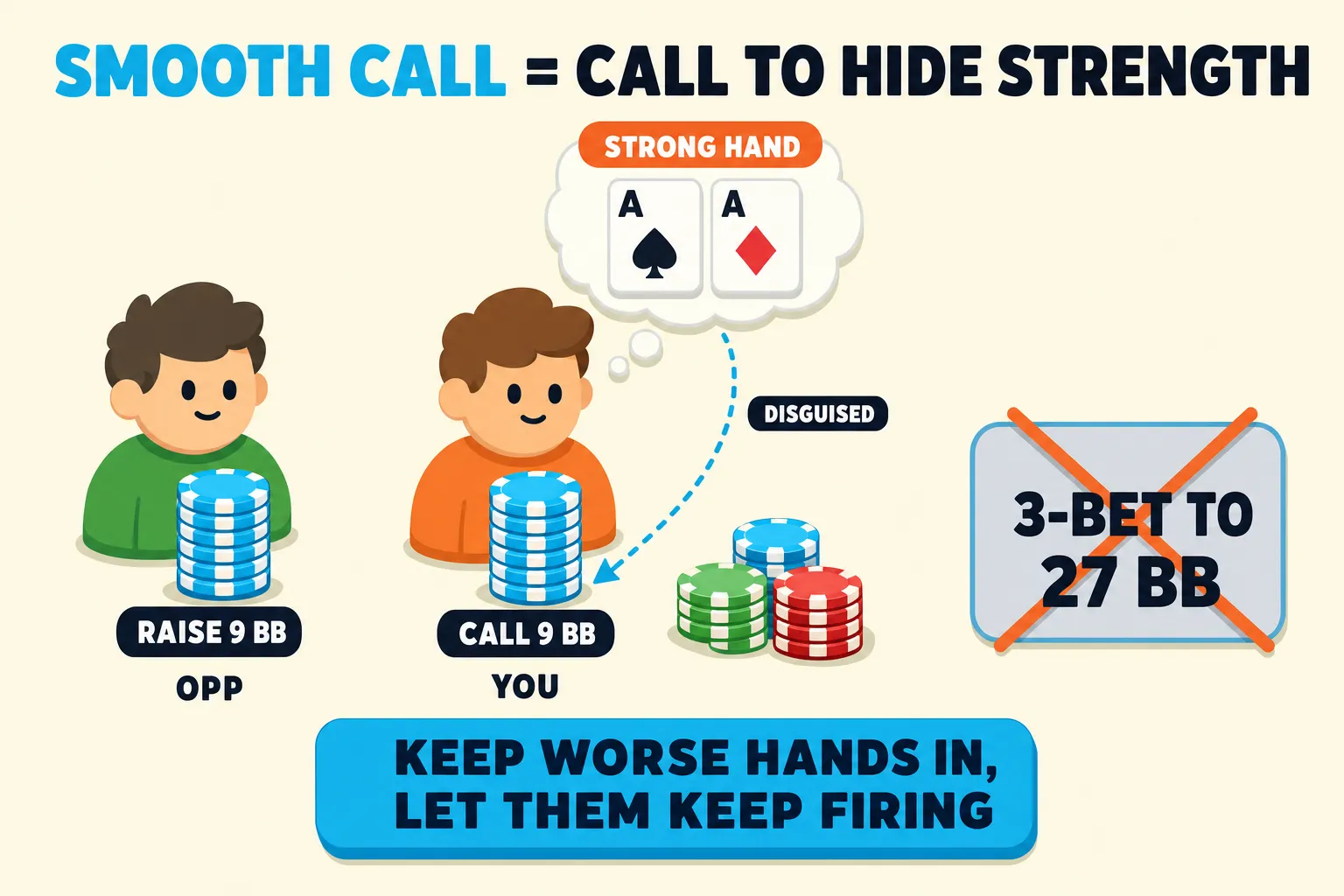
A smooth call is calling with a strong or playable hand when raising is also available, choosing the call to disguise strength, keep weaker hands in, or let an aggressive opponent keep firing. It overlaps heavily with flat-call (more often a preflop term) and slow play (more often postflop), but it is not the default with strong hands; the bet or raise usually plays better.
Practice this in Poker Skill. The Button vs UTG Open lesson takes the default line with suited ace-king, 3-betting because a flat underplays the premium and lets the blinds in cheaply.
Get the free appSmooth Call: calling instead of raising to disguise strength
What a smooth call actually is
A smooth call is calling with a strong or playable hand on a street where raising is also available, choosing the call so the opponent does not learn how strong you are. It shows up preflop, when you flat an open-raise with a hand that could 3-bet, and postflop, when you call a c-bet or barrel with a hand that could raise. The point is the same in both places: hide strength, keep worse hands in the pot, and let an aggressive opponent keep firing into you.
A useful contrast, since the four neighboring terms get blended:
- Smooth call vs. flat-call: In everyday usage the two are near-synonyms. The narrower distinction most players honor is that flat-call is usually preflop, when you call an open-raise instead of 3-betting, while smooth call travels comfortably across both preflop and postflop. If you want a single rule: every flat-call is a smooth call; not every smooth call is a flat-call.
- Smooth call vs. slow play: Slow play is a broader action category, covering any check or call with a strong hand instead of betting. A smooth call is the call version of that idea on a street where someone has bet. Smooth-calling a preflop open is a slow play; checking a flopped set is also a slow play, but it is not a smooth call because no one has bet yet for you to call.
- Smooth call vs. trap: A trap is the multi-street plan: pick a villain you expect to keep firing and build the pot they think they are leading. A smooth call is one move that often opens a trap, but it is not the trap by itself. If you smooth-call the flop and the opponent shuts down on the turn, you smooth-called; the trap simply did not spring.
Related terms
- Flat-call: the preflop sibling most players reach for first.
- Slow play: the wider action category smooth calls live inside.
- Trap: the plan a smooth call often opens.
- Call: the base action a smooth call is built on.
- Cold-call: smooth-calling an open before anyone else has entered the pot.
- 3-bet: the alternative preflop line a smooth call declines.
- Set: the canonical postflop smooth-call hand.
Smooth call vs. flat call vs. slow play vs. trap
| Term | Where it shows up | Action shape | Framing |
|---|---|---|---|
| Smooth call | Preflop or postflop | Call when a raise is available | Hide strength on a street where someone bet |
| Flat-call | Usually preflop | Call instead of 3-betting | Pot control, range disguise, position-realization |
| Slow play | Usually postflop | Check or call with a strong hand | Action category covering any passive line with strength |
| Trap | Multi-street | A line built around a specific bettor | Plan, not action; the smooth call is one move inside it |
The row that matters most: smooth call is named for the call. There is a bet or raise in front of you, and you choose to match it with a hand strong enough to do more. If no one has bet yet, you cannot be smooth-calling.
When a smooth call earns its keep
A smooth call works in a narrow set of conditions. The default with strong hands is still the bet or raise, which builds the pot, charges draws, and gets called by hands that fold later. The smooth call is the deliberate exception, not the starting point.
- The opponent is more likely to keep firing if you call than to call if you raise. Aggressive openers, players who 4-bet light, players who automatically c-bet and barrel are the ones who pay you for smooth-calling. A smooth call into a tight, disciplined opponent who shuts down to resistance just hides your hand from someone who was already going to give up the pot.
- Worse hands stay in if you call. Preflop, smooth-calling AA against a wide opener keeps every offsuit broadway and small pair in the pot that a 3-bet would have folded. Postflop, calling a c-bet with bottom set keeps one-pair hands in. If a raise would not actually fold out hands you can value-bet later, smooth-calling forfeits the build for nothing.
- Position is on your side, or your hand is far enough ahead that out-of-position is acceptable. Smooth-calling out of position with a hand that needs to play three streets multiway is how value gets missed. The cleanest smooth calls are in position with a hand that crushes the opponent’s bet range.
- Stack depth supports the deferred bet. At ~100bb in 6-max cash, a preflop smooth call leaves stacks deep enough for a meaningful turn or river bet. At 25bb, the smooth call collapses the math; you are usually better off raising now.
- The board (or the runout) does not give the opponent’s draws cheap equity. Smooth-calling a postflop bet on a coordinated board lets every draw catch up at the price of a single bet. Dry, rainbow, low-card boards are the textbook smooth-call surface.
When two or more of those break, smooth-calling tends to leak. The hand stays disguised, but the disguise costs more than it earns.
Worked example
Postflop smooth call. You hold 7♣7♦ in the big blind. The button opens to 2.5bb, you call. Heads-up to the flop: 7♠ K♦ 2♥. Pot ~6bb, effective stacks ~95bb.
You flop bottom set on a dry, rainbow board. The button raised preflop, so their range is full of kings, broadway combos, and overpairs that c-bet most flops. If you check-raise, you fold out one-pair hands you crush and only get called by hands that beat you or have outs. Smooth-calling keeps every king, every overpair, and every overcard floating along.
Check. The button c-bets 4bb. You call. Turn 4♣, board 7♠ K♦ 2♥ 4♣. Check; the button fires another 9bb. Now you can keep smooth-calling against a triple-barreler, or check-raise for value against a double-or-give-up player. River 8♠. Bet ~two-thirds pot for value if checked to. Most of the value goes in on a street where you are still ahead of one pair.
Now change one input. Replace the flop with 7♠ 8♠ 9♠. Same set, but three spades, a live straight, and overcards. Smooth-calling here lets every flush draw and every straight draw catch up cheaply. Bet small or check-raise; this is a board for charging draws, not for hiding the set.
Preflop smooth call. You hold A♠A♦ in the cutoff. UTG opens to 3bb. There is a known squeeze-happy regular in the small blind who 3-bets every cutoff flat from the blinds. A smooth call here is calling 3bb with aces and inviting that 3-bet. When it comes, the small blind squeezes to 13bb, UTG folds, and you 4-bet to ~30bb. You have built a much larger preflop pot with the best hand than a standard 3-bet to 9bb would have produced.
If the squeeze-happy regular is not in the pot, the smooth call is just hiding aces from a single opponent who was already going to add chips. 3-bet instead and let the big stack of preflop value flow normally.
Common mistakes
1) Smooth-calling as the default with strong hands
The biggest leak is treating “I have a strong hand, I’ll smooth-call to be tricky” as a starting line. The vast majority of strong hands play better fast. The bet or raise builds the pot, charges draws, and gets called by hands that would fold later. Smooth-calling earns its keep in the narrow spots above; the rest of the time, raising is the line that comes out ahead.
2) Smooth-calling out of position with a hand that needs three streets
Calling preflop with a strong hand from the small blind against a button opener leaves you out of position for the rest of the hand. Even with a real holding, you are taking the worse seat. Reserve smooth calls for position, or for hands strong enough that out-of-position multiway is still fine.
3) Smooth-calling on coordinated boards
Bottom set on K♣ 7♣ 6♣ is not a smooth-call hand. Three flush cards, a straight draw, and overcards mean every free card costs you equity. Bet your strong hands on draw-heavy boards almost without exception; the smooth call belongs on dry textures where the opponent’s bluffs and one-pair hands keep firing on their own.
4) Smooth-calling weak holdings to “look balanced”
Mixing in a smooth call with marginal hands to disguise strong ones sounds clean and almost never matters in live or low-stakes online play. The opponents who would punish a transparent calling range mostly are not at the table. Smooth-call when the spot earns it; do not call hands that are not strong or playable just to round out a frequency that nobody is tracking.
5) Confusing smooth call with pot-control
Pot control is checking back or calling small with a medium-strength hand to keep the pot manageable. A smooth call is usually a strong hand pretending to be medium. Same physical action, different motive, and the line that follows on later streets is opposite. Pot control reaches showdown cheaply; a smooth call is angling for a fatter bet later.
FAQ
Is a smooth call the same as a flat-call?
In everyday table talk, yes. The strict-usage difference is small but real: flat-call is usually a preflop word for calling an open-raise instead of 3-betting, while smooth call travels into postflop too, where it means calling a bet or raise with a hand that could have raised back. If you only learn one of the two, “flat-call” covers more ground in beginner material; “smooth call” is the version that survives all the way to the river.
Is a smooth call the same as slow play or a trap?
It overlaps with both, but the words are not interchangeable. Slow play is the broader action category, covering any passive line with a hand strong enough to bet, including a check. A smooth call is specifically the call version of that idea on a street where someone has bet. A trap is the multi-street plan, with a named villain you expect to keep firing. A smooth call is often the first move of a trap; it is not the whole trap.
Should smooth-calling be the default line with strong hands?
No. The default with a hand strong enough to bet or raise is to bet or raise. Smooth-calling earns its keep against opponents who keep firing into resistance, on boards or runouts where free cards do not threaten you, with stacks deep enough that the deferred bet is real. When two of those three are missing, smooth-calling hides the hand and gives up value the straight line would have collected.