


Split Pot
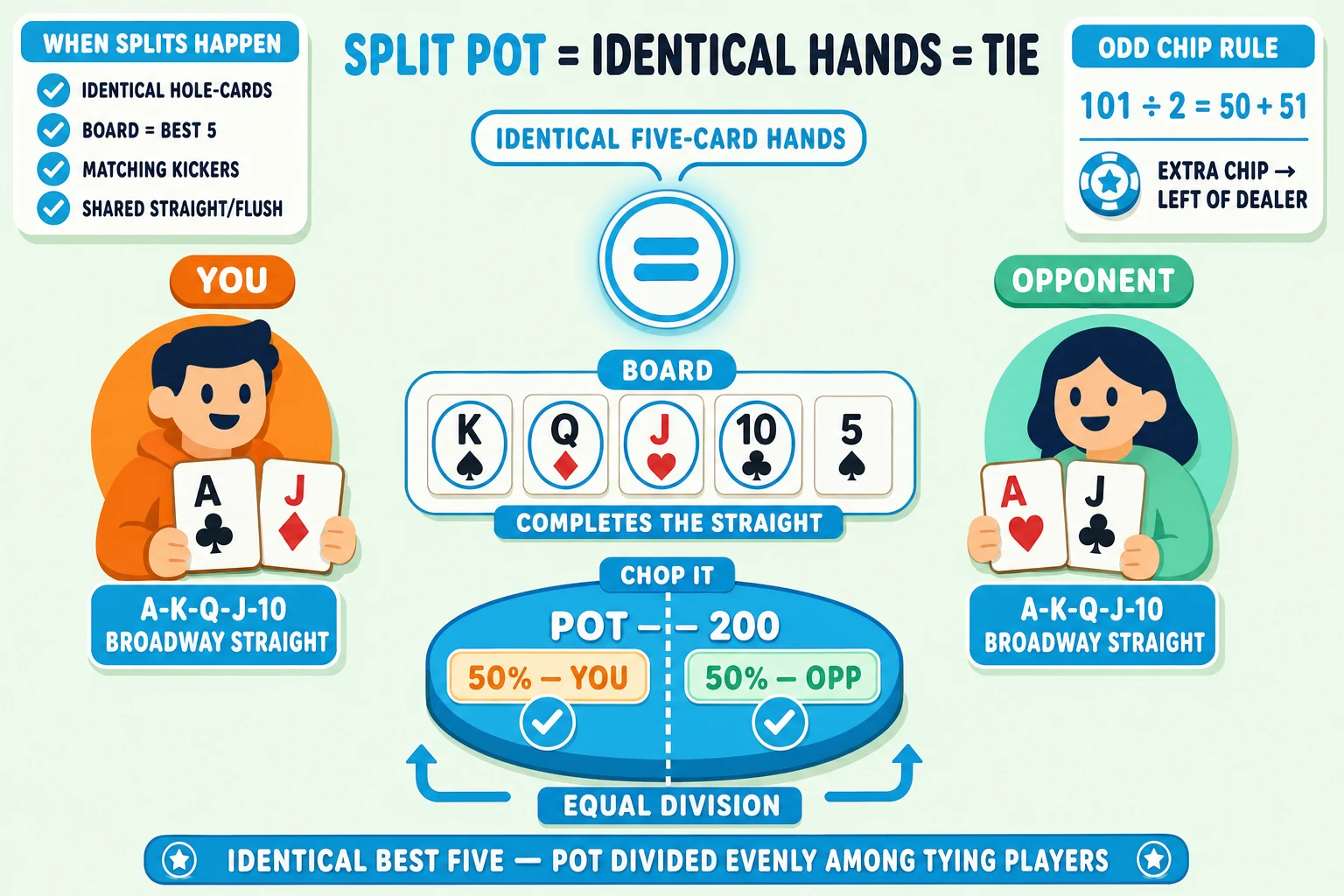
A split pot in No-Limit Texas Hold'em occurs when two or more players show identical best five-card hands at showdown. Each player makes their best five-card hand from any combination of their two hole cards and the five community cards. When those best hands rank exactly the same, the pot is divided equally among the tying players.
Practice this in Poker Skill. One of its showdown questions on 6♠ 3♣ 7♣ 5♥ 4♦ pits A♥ K♦ against 9♥ 9♦, and they split the pot, because both play the board’s seven-high straight.
Get the free appSplit Pot
What a split pot is
A split pot in No-Limit Texas Hold’em occurs when two or more players show identical best five-card hands at showdown. Each player makes their best five-card hand from any combination of their two hole cards and the five community cards. When those best hands rank exactly the same, the pot is divided equally among the tying players.
Example: The board reads A♠ K♣ Q♦ J♥ 10♠. The best hand available is the Broadway straight A-K-Q-J-10. If two or more players reach showdown, they split the pot.
How split pots are determined
Follow these steps to decide a split:
- Construct each player’s best five-card hand using their two hole cards plus the five community cards.
- Compare hand ranks; the highest-ranking five-card hand wins, from royal flush down to high card.
- Compare kickers when primary hand ranks tie; a kicker is a side card used to break ties.
- If the full five-card hands, kickers included, are identical, the players tie and split the pot.
Concrete example: Board = K♦ 9♣ 7♥ 3♠ 2♣. Player A has A♣ J♦, Player B has A♦ J♠. Both make the same ace-high hand, A-K-J-9-7. Their best five-card hands are identical, so they split the pot.
If the five community cards alone make the best five-card hand for the winners (no player’s hole cards improve it), the pot is chopped among all remaining players.
Typical scenarios that lead to split pots
- Board-only winners: The five community cards form the best hand, so every active player shares it.
- Identical hole-card combinations: Two players’ hole cards produce the same five-card result.
- Matching kickers: Players share the same primary hand and identical kickers, so no tie-breaker exists.
- Shared straights/flushes: A community straight or flush often gives multiple players the exact same hand.
Handling indivisible chips and pot division rules
After winners are determined, divide the total pot equally among them. If the pot can’t split evenly because of an odd chip, give the smallest denomination chip to the tying player closest to the dealer’s left (the earliest winner clockwise from the dealer). Example: A $101 pot between two winners becomes $50 and $51; the extra $1 goes to the winner nearest the dealer’s left.
Strategic considerations around split-pot situations
- Recognize boards that produce chops (paired boards, complete straights or flushes) and avoid over-committing when you can’t win outright.
- On the river, ask whether your hole cards improve the board or only make a shared hand; this affects value-bet versus check decisions.
- Use hand reading: if multiple opponents can share the same board-made hand, aggressive bets risk building pots you cannot win outright.
- In multi-way pots, splits are more common; tighten criteria for bluffing and value-betting in those spots.
Quick checklist
- A split pot means identical best five-card hands at showdown.
- Always form each player’s best five-card hand from hole plus community cards.
- Watch for boards that produce community-only winners (chopped pots).
- If chips don’t divide evenly, the smallest chip goes to the tying player closest to the dealer’s left.
- Use split-pot awareness to guide river decisions and avoid unnecessary over-commitment.