


High Card
The lowest-ranking poker hand. Five unmatched cards with no pair, straight, or flush. The highest card wins; kickers break ties down the line.
Practice this in Poker Skill. Ace-high gets played both ways in the flop lessons: A♠ 5♠ bets K♦ 9♣ 3♥ when both players missed, while A♠ 3♠ checks 6♦ 7♣ K♠ to reach a cheap showdown.
Get the free appHigh card
What a high-card hand is
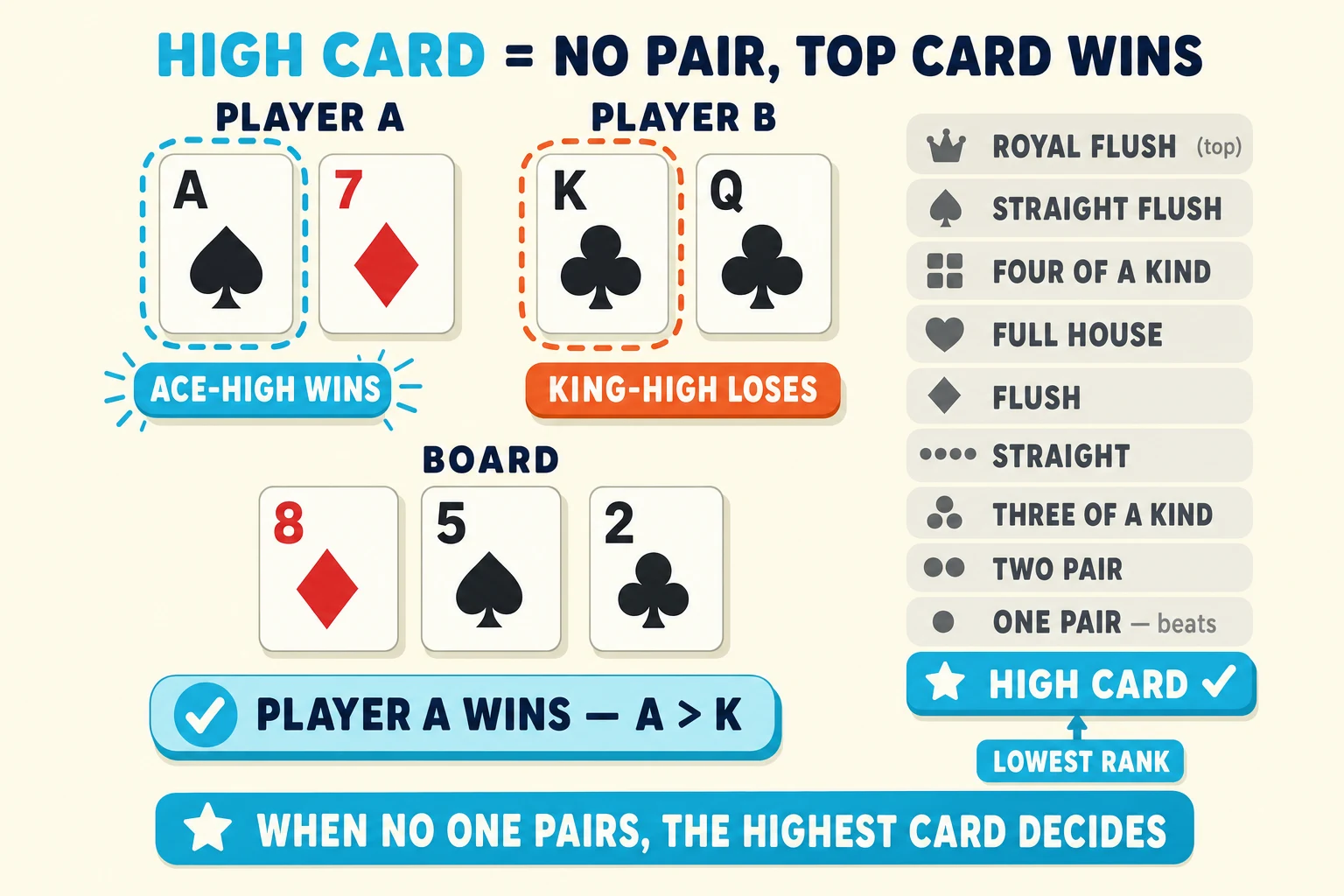
A high card is what you have when no one at showdown makes a pair or a stronger combination. The five-card hand’s value is just its highest card. Hands are named by that top card: Ace-high, King-high, Jack-high, and so on. High card is the lowest ranking category in poker. If top cards tie, the remaining cards (kickers) break the tie in descending order.
Example: Board 8♦ 5♠ 2♣. Player A holds A♠7♦ (Ace-high). Player B holds K♣Q♣ (King-high). Player A’s Ace-high beats Player B’s King-high because the highest card is higher.
For the full order of hands, odds, and tie-break examples, see the poker hand rankings chart. For the card-by-card comparison walk and when ace-high is a real hand, read high card in poker.
How high cards are compared and kickers work
When comparing five-card high card hands, follow this order:
- Compare the highest card. A higher top card wins (Ace > King > Queen, etc.). Suits do not matter.
- If top cards tie, compare the second-highest card (the first kicker).
- If those tie, compare the third-highest, then the fourth, and finally the fifth.
Example of kickers deciding: Board K♦ 5♣ 2♠. Player A: A♠7♦ -> best five A-K-7-5-2. Player B: A♥6♣ -> A-K-6-5-2. Both are Ace-high, but Player A wins because the 7 kicker beats the 6 kicker.
Practical implication: kicker strength can turn a weak-looking holding into the pot winner in heads-up showdowns. Always consider the full five-card lineup, not just your top card.
When high card actually wins pots
High card wins when no one pairs the board and no straights or flushes form. That happens most often on dry, uncoordinated boards with mixed suits and low cards. Heads-up pots increase the chance a strong single card, especially Ace-high or King-high, holds up at showdown.
Common scenarios:
- Everyone missed draws: flush and straight draws fail to connect, leaving the best single card to win.
- Low, uncoordinated board: e.g., 8-5-2, where high hole cards are unlikely to pair.
Because these situations occur frequently, understanding high card outcomes matters despite the hand’s low rank.
Playing high card hands preflop and postflop
Preflop: prioritize position and relative card strength. A single high card (Ace or King) gains value in late position or heads-up pots because you can apply pressure or see actions before committing chips.
Postflop: evaluate the board texture. If the flop is dry and likely to leave players with only high card or missed draws, use aggression and fold equity to win pots. If you plan to go to showdown with a likely high card, check your kickers: are your side cards high enough to beat reasonable parts of opponents’ ranges?
Example decisions:
- Late position with A♦9♦ on an 8♣5♠2♠ flop: a bet can often take down the pot against missed ranges.
- Early position with Q7 on a J-T-9 coordinated flop: fold, since pairs and straights are likely across ranges.
Strategic uses and common mistakes with high card
Use high card holdings as bluff-catchers or as part of an aggressive plan when the board blocks stronger combinations. For example, your Ace can block some opponent Ace-high combos. Still, don’t overvalue weak top cards without positional or betting advantages.
Common mistakes:
- Going to showdown without checking kickers and opponent ranges.
- Overbetting medium top cards (like Jack-high) on coordinated boards where pairs or draws are likely.
Read opponent ranges and kicker strength when a pot may be decided by high card. That reading often separates winning from losing showdowns.
Compare all ten poker hand rankings, best to worst to see where high card sits.
For the whole ordering as one matchup table, see what beats what in poker.
Quick checklist
- Recognize when your best hand is only a high card.
- Compare top cards and kickers before committing to a showdown.
- Use position and aggression to win uncontested pots with high card holdings.
- Treat strong top cards (Ace/King) as more valuable in heads-up or missed-draw scenarios.
- Read opponents’ likely holdings to avoid losing kicker-decided showdowns.