


Hijack
The seat two to the right of the button. Late enough to widen opens and steal blinds, but the cutoff, button, and blinds still act after you.
Practice this in Poker Skill. The HJ vs UTG Caller lesson drills this seat behind an under-the-gun limp: you raise T♥ T♦, but with four players still to act behind the hijack you only call with 9♥ 9♦ and play for a set.
Get the free appThe hijack opens about 19% of hands on Poker Skill’s 6-max preflop chart, and the cutoff, one seat later, opens roughly a quarter of all hands; in Poker Skill’s lessons, a hand played first in from the hijack is a raise or a fold.
Hijack
What the Hijack Is (exact seat and role)
The hijack sits two positions to the right of the dealer button. It acts after early seats, such as Under the Gun (UTG - the first to act preflop), and immediately before the Cutoff and the Button. Because it acts late, the hijack sees more information than early players but not as much as the last two seats.
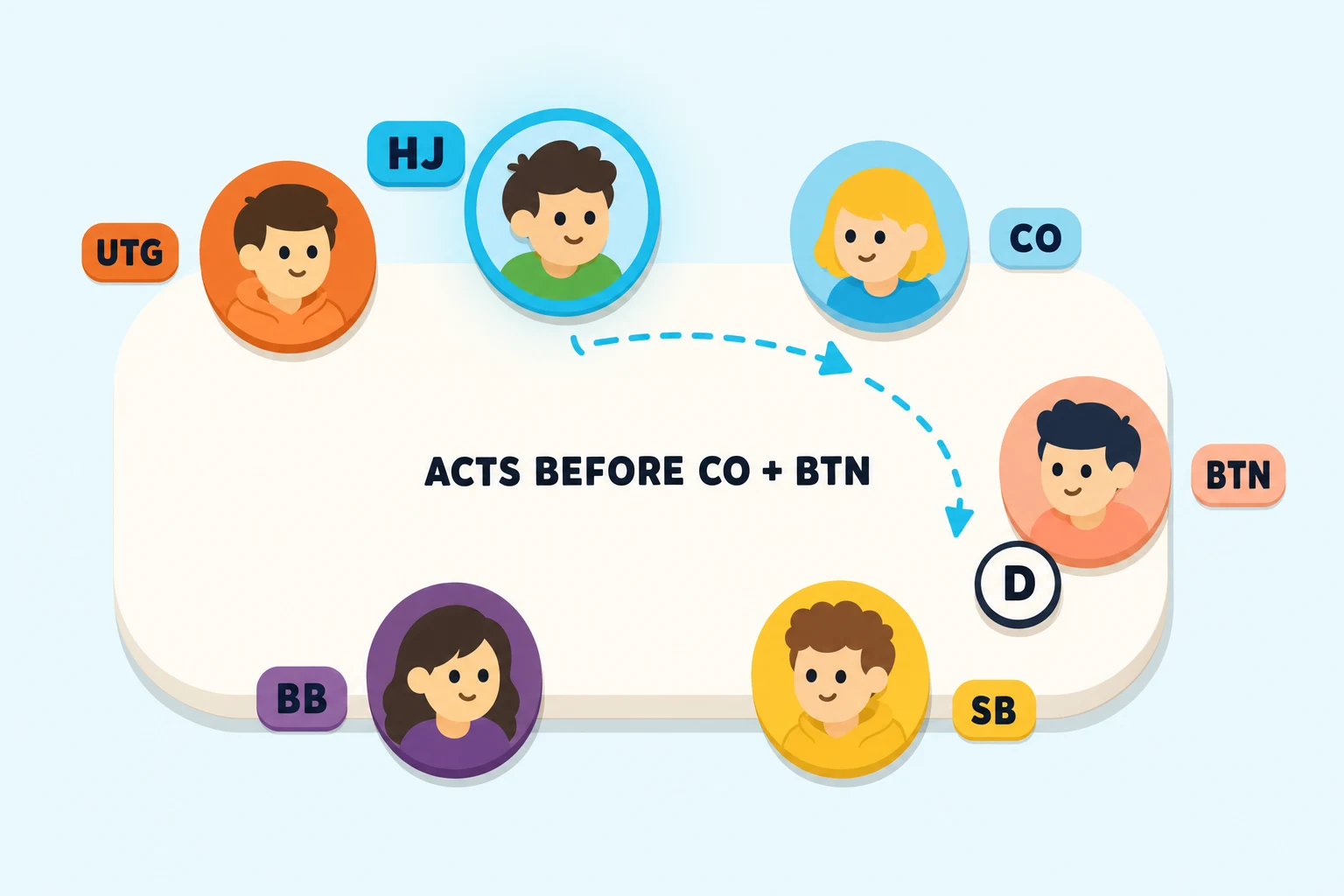
Where the hijack sits
| Seat | Where it sits | What it changes |
|---|---|---|
| Under the gun | first to act preflop | the tightest opening range at the table |
| Lojack | one seat before the hijack | early-middle: five seats still act behind you |
| Hijack | two seats before the button, one before the cutoff | the first seat where stealing the blinds is a plan |
| Cutoff | one seat before the button | wider still, with only the button and the blinds behind |
| Button | the seat holding the dealer button | acts last after the flop, the strongest seat |
| Small blind and big blind | the two seats after the button | post before the deal, act first after the flop |
The seats nearest the button keep their names as players are added, which is why a six-handed game has a hijack but no UTG+2. Bigger tables add seats in front of the lojack instead. For the full run-through of each seat, read poker positions in order.
Why the Hijack Is Strategically Important
The hijack gives built-in positional leverage. You can open a wider set of hands and apply pressure with raises. A well-timed hijack raise can fold earlier callers and steal the blinds when the Cutoff and Button fold. Acting relatively late also improves postflop decisions: you’ll know how many players entered the pot and can choose lines that exploit that information.
Typical Preflop Ranges from the Hijack
Compared with UTG, the hijack’s opening range is significantly wider. Typical hands to open from the hijack include:
- All pocket pairs (examples: 99, 66, TT).
- Many suited aces (examples: AJs, A5s).
- Broadway cards (Ten through Ace, e.g., AK, KQ, KJ).
- Suited connectors (examples: 76s, 98s).
The hijack’s range sits between early positions and the looser Cutoff or Button. Use this range to value-raise and to pressure opponents with steal attempts when action folds to you.
Postflop Objectives and Common Lines from the Hijack
After opening from the hijack you should:
- Convert preflop aggression into fold equity by continuation-betting (c-bet) on favorable flops.
- Control pot size and extract value when your hand connects.
- C-bet most often on dry, uncoordinated flops, because coordinated or two-tone flops give the caller more pairs and draws.
Concrete example: you open from the hijack with KQo and both the Cutoff and Button fold. The flop comes J-7-2 rainbow. A c-bet here can fold out many worse hands and protect your range. Conversely, on an A-9-3 flop with KQo, be cautious: many hands that called preflop will contain an ace.
Adjusting hijack play across tournaments and cash
- Tournaments: Rising blinds and antes increase the value of steals. From the hijack, widen your opening range and attempt more steals as folding becomes costlier.
- Cash games: Deeper stacks reward postflop skill. Plan deeper lines and extract value from marginal holdings when stacks allow.
- Opponent reads: Adjust ranges and sizing based on stack sizes, table image, and opponent tendencies. If opponents defend loosely, tighten or change sizing; if they fold often, widen your steal range.
Quick checklist
- Identify the hijack seat each hand (two seats to the right of the button).
- Open a wider but positionally appropriate range: pairs, suited connectors, broadways, suited aces.
- Use preflop raises to create postflop leverage and steal opportunities.
- C-bet and apply pressure on favorable runouts to capitalize on fold equity.
- Adjust aggression for tournament pressure, cash-game depth, and specific opponent tendencies.
FAQ
What is the hijack in poker?
The hijack is the seat two to the right of the dealer button, acting immediately before the cutoff. It is the first seat in the orbit late enough to open wide and attack the blinds, with only the cutoff, the button and the two blinds left to get through.
Does the hijack exist at every table size?
No. A heads-up or three-handed game has only the button and the blinds, and a fourth player adds only the cutoff. The hijack appears with the fifth player, two seats before the button, and keeps its name at every bigger table.
Hijack vs cutoff: which is better?
The cutoff, because it acts one seat later. The cutoff sees what the hijack does before it has to decide. It also has one fewer player left to get through. The hijack answers by opening a little tighter and by giving real credit to a cutoff that re-raises.