


UTG
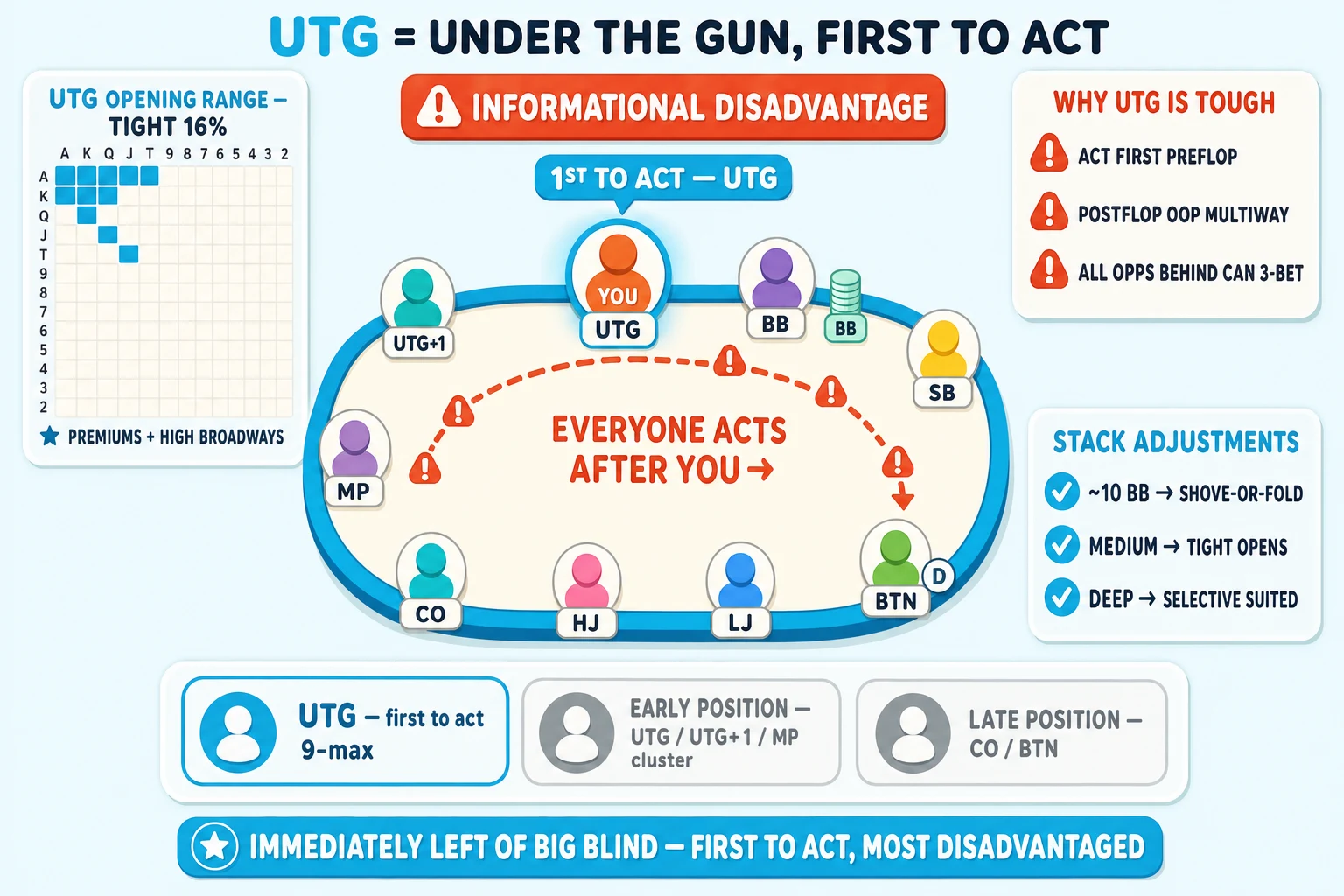
UTG (Under the Gun) sits immediately left of the big blind. UTG acts first in the preflop betting round, deciding to fold, call, or raise without seeing others' choices. Acting first creates a large informational disadvantage since you commit chips before knowing opponent count or aggression. UTG decisions shape the whole hand: a UTG raise signals strength and invites pressure from later positions. Opening too many hands from UTG often leads to uncomfortable post-flop spots against skilled opponents.
Practice this in Poker Skill. Six-handed, the UTG: Raise or Fold lesson raises suited broadway and strong pairs from this seat while folding offsuit jack-ten, which plays poorly first to act.
Get the free appUTG (Under the Gun) - Clear Guide for No-Limit Hold’em
What UTG Means and Why It Matters
UTG (Under the Gun) sits immediately left of the big blind. UTG acts first in the preflop betting round, deciding to fold, call, or raise without seeing others’ choices. Acting first creates a large informational disadvantage since you commit chips before knowing opponent count or aggression. UTG decisions shape the whole hand: a UTG raise signals strength and invites pressure from later positions. Opening too many hands from UTG often leads to uncomfortable post-flop spots against skilled opponents.
UTG Preflop Hand Selection
Because UTG acts first, open tightly. In full-ring games (nine or ten players), consider roughly a 16% opening range focused on hands that handle resistance.
- Always open with premiums: AA, KK, QQ, and AK. These hands win at showdown and handle aggression.
- Near the edge: TT and strong broadways like AQ or KQs can be included but treated cautiously. “Broadway” means A-K-Q-J-T high cards.
- Avoid speculative holdings from UTG: small pocket pairs (22-99), weak suited connectors (for example, 76s), and one-gappers. These hands need multiway pots or can be easily outdrawn.
Example: With AK from UTG, raise; with 87s, fold. With TT, open but prepare to face 3-bets (a 3-bet is a re-raise).
Adjusting UTG Range by Table Size and Opponent Tendencies
Adjust your range to context.
- Short-handed games (six-max) allow a slightly looser UTG range because fewer players act behind you.
- Passive tables - opponents who call rather than 3-bet - let you open a bit wider since you’ll win more uncontested pots.
- If opponents exploit your tightness with frequent 3-bets or isolations, tighten up or mix sizing to discourage constant isolation. Sudden wide opening from UTG invites more aggression.
Example: In a passive six-max ring, add hands like JTs. At a full-ring table with frequent 3-bets, fold JTs from UTG and stick to stronger holdings.
UTG Betting Strategy and Post-Flop Considerations
UTG raises should project strength while avoiding hands that struggle post-flop. Use conservative sizing when multiple callers are possible; smaller raises control pot size and risk. Post-flop, expect tough decisions since you’ll often be out of position on later streets. Favor hands that make strong top pairs, two-pair combinations, or solid draws. Speculative hands that rely on multiway pots lose value when you act first.
Example: You raise UTG with AQ and get called by two players. On a dry board like K-7-2, proceed cautiously because AQ’s value is diminished without improvement.
Stack-Depth Effects: When to Shove, Fold, or Expand Range
Stack size alters UTG strategy.
- Very short stacks (~10 big blinds): shift to shove-or-fold to maximize fold equity. Many marginal raises become shove-worthy.
- Medium stacks: keep a tight range and avoid speculative hands that need multiway pots to pay off.
- Deep stacks: include more small pairs and suited connectors for implied odds, but remain selective to avoid multiway entanglements.
Example: With 9bb, UTG shoving TT is standard. With 100bb, open TT but be ready to fold to heavy 3-bet pressure.
Quick checklist
- Play tight from UTG; prioritize premiums and hands that withstand aggression.
- Include AA, KK, QQ, and AK reliably; treat TT and AQ as the lower edge of UTG raises.
- Loosen slightly in short-handed or passive games, but watch for isolations and 3-bets.
- At ~10 big blinds, favor shove-or-fold; with deeper stacks, open more but stay cautious.
For opening ranges, sizing, and the three leaks that cost UTG money, see how to play under the gun.