


Value 3-Bet
A re-raise made with a strong hand to grow the pot when you are likely ahead. Targets calls from worse pairs and broadways, not folds.
Practice this in Poker Skill. The Button vs CO Open lesson practices the late-position case, 3-betting suited ace-queen for value rather than flatting and leaving the cutoff the lead.
Get the free appValue 3-Bet
What a value 3-bet is and why it matters
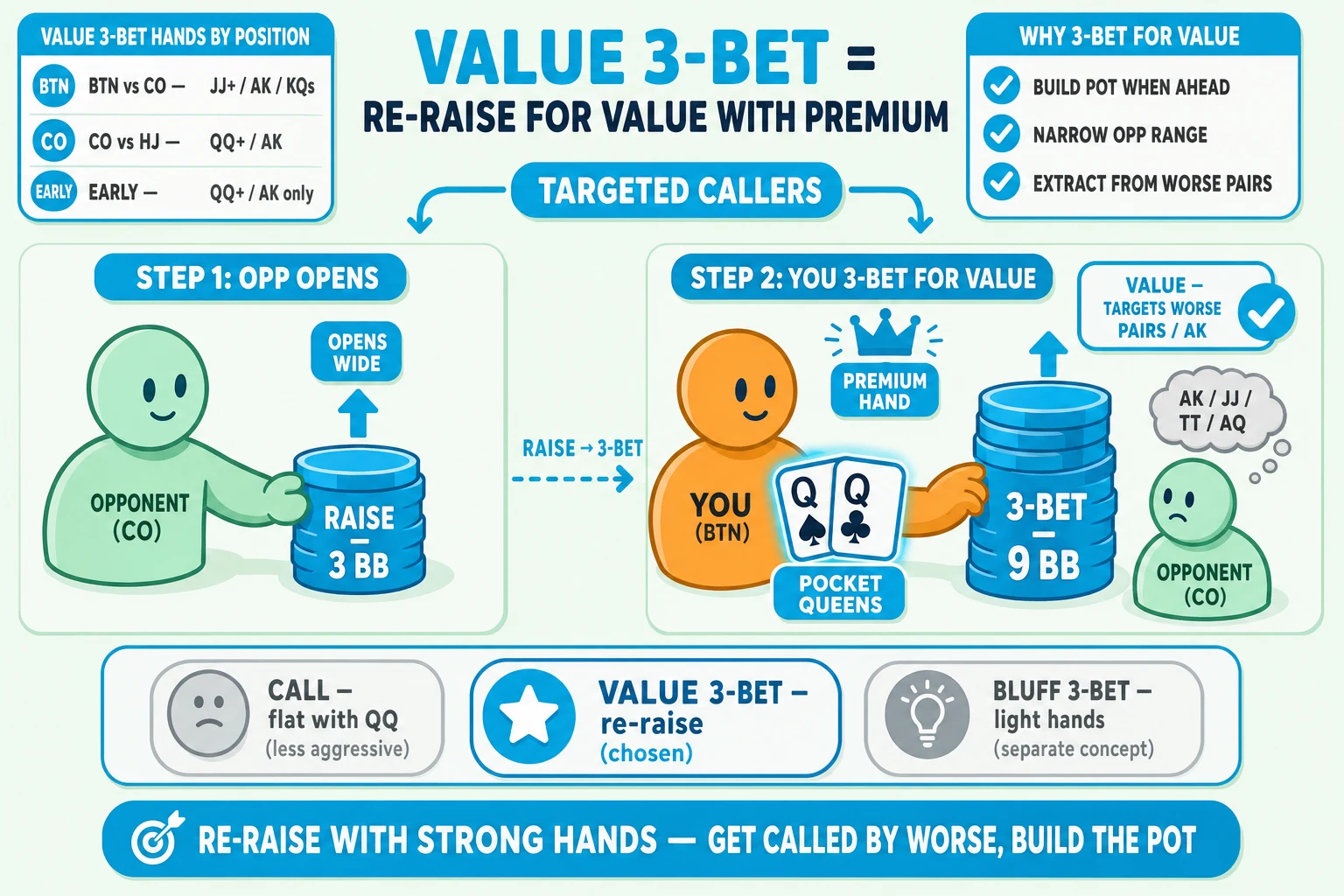
A “3-bet” is a re-raise of an initial raiser; a value 3-bet uses that re-raise with a strong hand. You make it to get called by worse hands and extract maximum chips. The goal is simple: build a bigger pot when you are likely ahead. A good value 3-bet grows the pot and narrows the opponent’s continuing range. That simplifies later decisions and increases your expected value. Used correctly, value 3-betting punishes weaker players and balances your strategy against stronger opponents.
Hand selection for value 3-bets
Pick hands that are clearly ahead of the opener’s calling range in the spot.
- Late-position battles (Button vs Cutoff open): core value hands are JJ+, AK, and strong suited aces. Add suited broadways like KQs and KJs when the opener opens wide. Example: Cutoff opens and you’re on the Button - 3-betting JJ or AK targets calls from AQ, KQ, or mid pocket pairs.
- Suited connectors and lower holdings: these serve more as speculative or balancing hands, not primary value 3-bets. Include them sparingly and only when the opponent folds too often to aggression.
- Early position opens: tighten your value range. Versus an early opener, restrict value 3-bets to top hands like QQ+ and AK. Example: Under the Gun opens - avoid 3-betting KQs as value; prefer QQ+ and AK.
Position and range construction
Position matters because acting last postflop gives you more information and control.
- In later positions you can 3-bet for value more widely since openers usually have wider, weaker ranges. Example: Button vs Cutoff - JJ+/AK plus suited aces and KQs/KJs make reasonable value 3-bets.
- Against earlier opens, narrow your value 3-bet range to top hands to avoid big pots out of position. Example: Cutoff vs Hijack - lean to QQ+/AK; add suited aces only if the opener is loose.
- Early position 3-bets for value should be reserved for the strongest holdings (AA/KK/QQ/AK), because you may face multiple callers or 4-bets.
Bet sizing principles for extracting value
Sizing affects who calls and how strong your range must be.
- Larger 3-bets increase pressure and extract more value when called, but they force you to have a stronger range. Opponents fold weaker hands more often to bigger sizes.
- Smaller 3-bets invite more callers by offering better pot odds; use smaller sizes when you have position and plan to play postflop.
- Rule of thumb: size up out of position since you need stronger hands to compensate. Consider slightly smaller sizes in position to attract worse hands.
Opponent adjustments and balancing with bluffs
Adapt your value 3-bet plan to player tendencies.
- Versus loose, calling-station opponents, widen your value 3-bet range to include hands that will get called by worse holdings.
- Versus aggressive players who 4-bet frequently, tighten your value 3-bet range to top hands to avoid costly confrontations.
- Mix in a controlled number of bluffs. Prefer blockers or hands with good postflop playability so observant opponents can’t exploit you by folding to every 3-bet.
Quick checklist
- Identify core value hands by position (Button, Cutoff, Early).
- Size larger out of position; slightly smaller in position.
- Widen vs calling players; tighten vs frequent 4-betters.
- Include a small, well-chosen bluff package to balance your range.