


Value 4-Bet
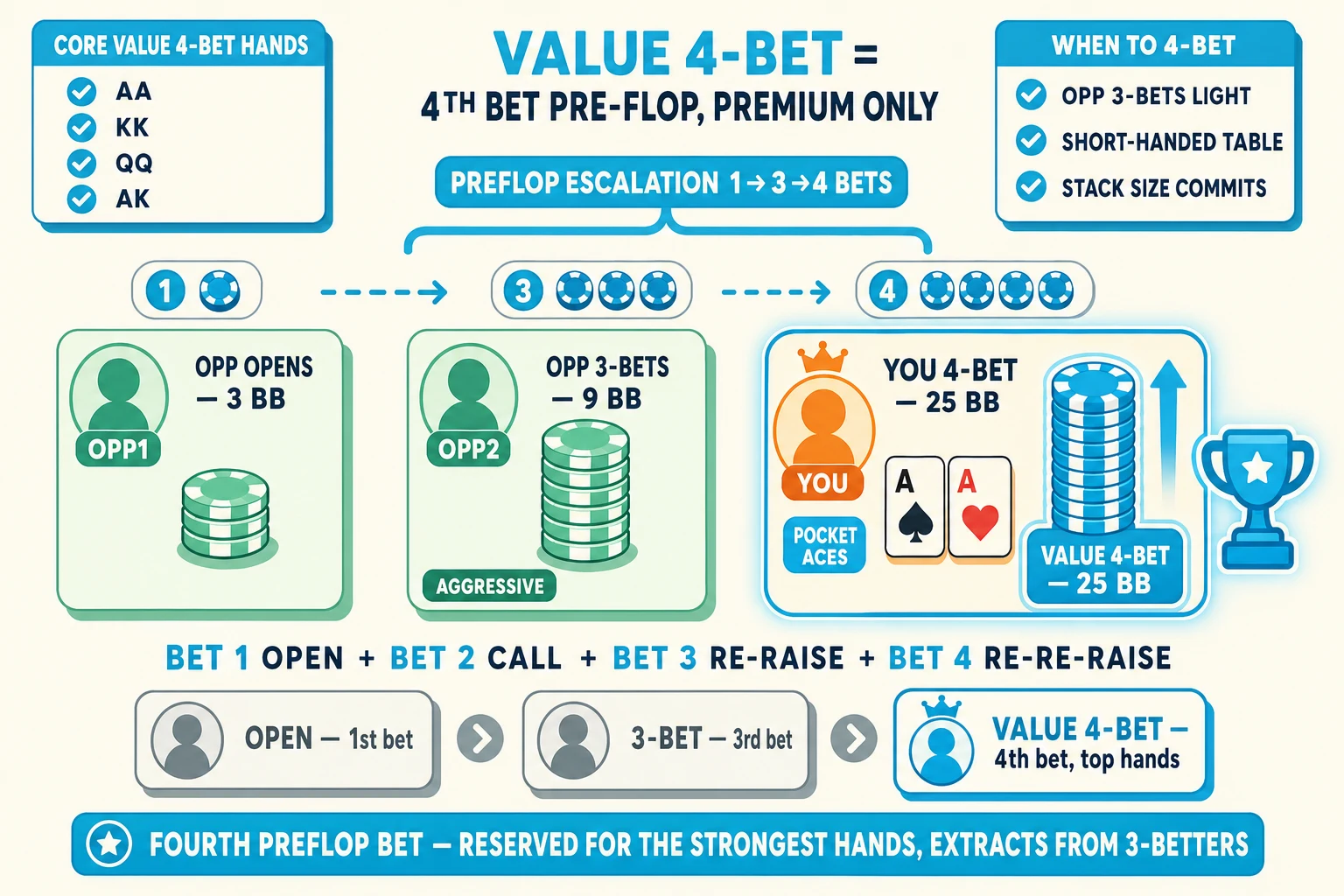
A 4-bet is the fourth bet in a preflop sequence: an open-raise, a 3-bet, then a 4-bet. A value 4-bet aims to be called by worse hands rather than primarily to fold opponents. Example: holding AA, an opponent opens, a second player 3-bets, and you 4-bet expecting calls. You expect calls from hands like KK, QQ, and AK to extract value. Typical value 4-bet holdings are the strongest premiums: AA, KK, QQ, and AK. These hands usually sit ahead of the caller's range and form the core of a value 4-bet strategy.

Practice this in Poker Skill. When a 3-bet comes back at a premium hand in Practice vs AI, the heads-up and three-player games against AI opponents, Coach Max can ask whether calling is all that hand is worth, the question behind a value 4-bet.
Get the free appValue 4-Bet: Preflop Value Extraction in No-Limit Hold’em
Definition: What a value 4-bet is
A 4-bet is the fourth bet in a preflop sequence: an open-raise, a 3-bet, then a 4-bet. A value 4-bet aims to be called by worse hands rather than primarily to fold opponents. Example: holding AA, an opponent opens, a second player 3-bets, and you 4-bet expecting calls. You expect calls from hands like KK, QQ, and AK to extract value. Typical value 4-bet holdings are the strongest premiums: AA, KK, QQ, and AK. These hands usually sit ahead of the caller’s range and form the core of a value 4-bet strategy.
When to use a value 4-bet
Deciding to value 4-bet depends on opponent type, table dynamics, and stack depths.
- Opponent tendencies: Target players who will call 4-bets with worse hands rather than folding frequently. If an opponent plays calling-light or shows aggression with their 3-bets, expect more calls. Against very tight callers who fold most 4-bets, tighten and reserve 4-bets for your absolute top hands.
- Table format and dynamics: In short-handed or highly aggressive games, 4-bet ranges can widen because players 3-bet and call more. Short-handed means fewer players at the table. In full-ring or passive games, keep your value 4-bets narrower.
- Effective stack sizes: Effective stacks are the chips both players have behind. With deeper stacks you gain postflop maneuvering room and can sometimes 4-bet lighter. Short stacks demand a tighter, commit-focused approach. Commit-sized 4-bets push toward all-in decisions and avoid awkward postflop spots.
Example: against an aggressive 3-bettor on a short-handed table you might include AK as a value 4-bet. Versus a tight player at a full-ring table, stick to AA and KK.
Choosing 4-bet size and managing pot control
Size your 4-bet to extract calls from weaker hands while matching stack dynamics.
- With deeper stacks, vary sizes and include more hands selectively because postflop playability matters.
- With short stacks, use commit-sized 4-bets that clearly intend to get all-in or near it.
- Larger 4-bets increase opponent commitment and reduce their postflop maneuvering.
Use sizing deliberately. Make weaker holdings comfortable calling, but avoid bloating the pot when stacks make commitment costly.
Typical hands and how ranges change
Core value 4-bet range: top pairs and strong Broadway hands - primarily AA, KK, QQ, and AK. These hands are usually ahead of the caller’s likely range. Against aggressive 3-bettors, slightly widen the range to include hands often ahead of their calling range, such as AK or QQ. Versus tight opponents, keep the range narrow and reserve 4-bets for the very top holdings.
Common mistakes and how to avoid them
- Mistake: 4-betting for thin value versus opponents who fold most worse hands. Fix: tighten your range and re-evaluate opponent tendencies.
- Mistake: Using inappropriate sizing for stack depth. Fix: scale your 4-bet sizes to effective stacks - deeper allows flexibility, short stacks demand commit-sized value bets.
- Mistake: Treating every 4-bet as a bluff or overbalancing. Fix: reserve 4-bets primarily for clear value hands and include only occasional, planned bluffs.
Quick checklist
- Confirm the opponent is likely to call 4-bets with worse hands before value 4-betting.
- Prioritize AA, KK, QQ, AK as core value 4-bet candidates.
- Adjust range width for loose/aggressive versus tight opponents.
- Set 4-bet sizes according to effective stack depth and desired commitment.
- Balance predictability by keeping value 4-bets dominant and using only occasional, planned bluffs.