
Out of Position: How to Play and Adjust in No-Limit Hold’em
Why position matters in No-Limit Hold’em
Out of position (OOP) means you act before opponents on betting rounds, with less information. Acting first increases the chance of being outplayed because you can’t see opponents’ reactions. Position changes the betting dynamic: you’ll struggle to control pot size and extract thin value. Opponents can bluff more effectively when they act after you. Tighten starting hands and raise commitment thresholds-avoid marginal hands you can’t comfortably play first.
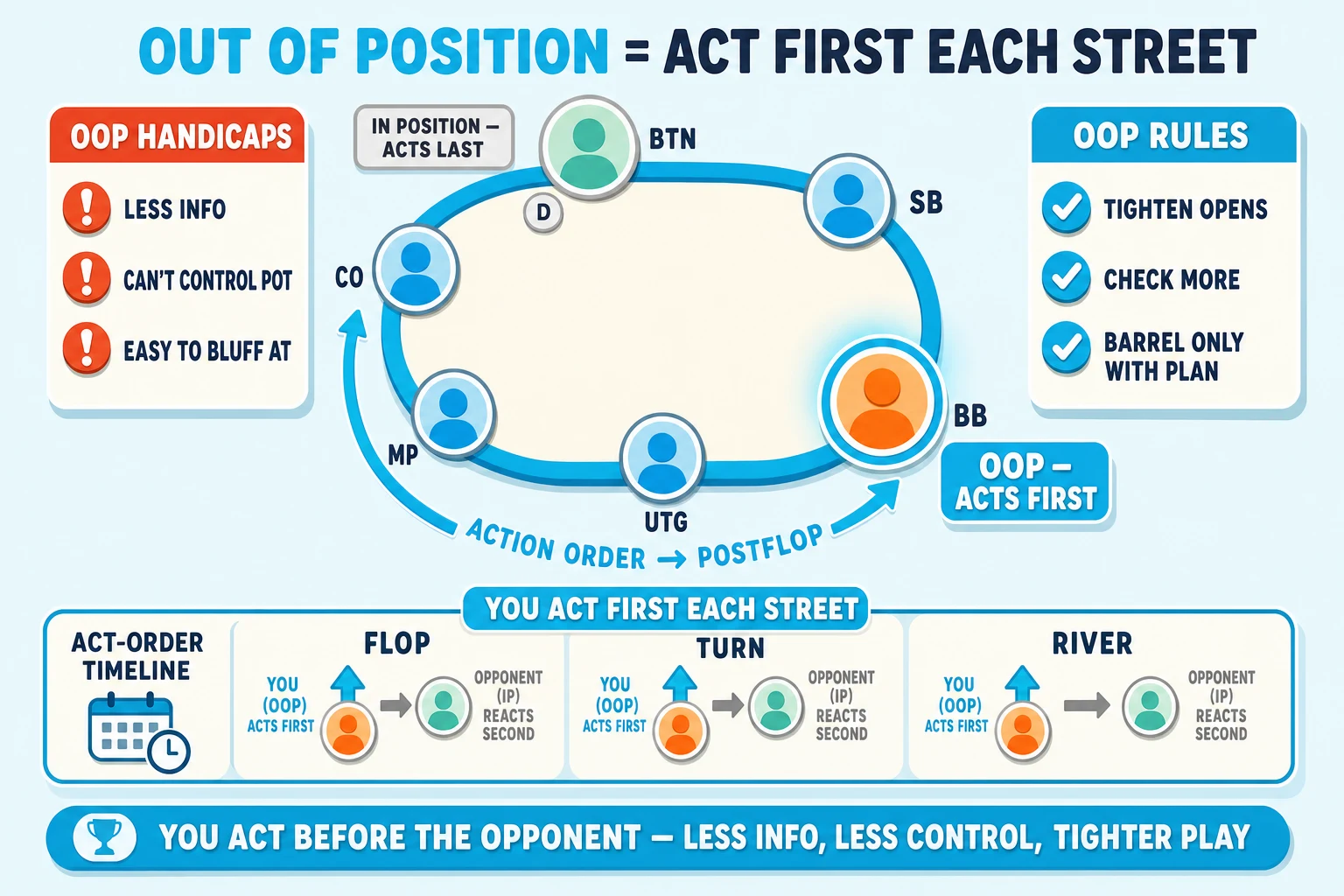
Typical out-of-position spots (blinds and facing raises)
The most common OOP seats are the Small Blind (SB) and Big Blind (BB) when later seats raise. Facing a late-position raise from the blinds often leaves you OOP for the entire hand. On early streets-preflop, flop, turn-OOP players generally avoid aggression unless holding strong hands. The river differs: acting first is often your last chance to bet for value or attempt a bluff.
Preflop adjustments: tighten ranges and prefer 3-bet-or-fold from the small blind
Simple preflop rules reduce costly postflop problems when OOP:
- Tighten your opening range. Enter pots with stronger starting hands since you’ll rarely realize equity comfortably after the flop.
- From the small blind, favor a 3-bet-or-fold mindset rather than flat-calling. Flat-calling from the SB often leads to multiway or heads-up OOP, both unfavorable.
- Avoid speculative and marginal hands that create awkward multiway pots. Speculative hands lose value when you can’t use position to realize equity.
Example: facing a button raise from the SB, 3-bet with hands you can play aggressively postflop or fold to avoid being OOP with marginal holdings.
Postflop play: value betting, bluff catching, and reading board texture
Apply these concise postflop rules when OOP:
- Bet strong hands and strong draws. When you have clear equity or the best hand, take the initiative to build the pot.
- Avoid overextending with medium-strength holdings. Medium hands are difficult to play OOP; check to control the pot rather than thin value-bet.
- Use continuation bets (c-bets) more on dry flops-boards that don’t connect much with a caller’s range. Exercise caution on coordinated boards that favor opponents’ raising ranges; those often deserve checks or more cautious lines.
- Be conservative with bluffs and river bets. OOP bluffs are easier to call, and extracting river value is harder because opponents act last.
Example: on a dry flop you can c-bet more frequently; on a two-tone, connected flop, check more hands OOP.
Stack depth and how it changes OOP strategy
Stack depth alters the cost of being OOP. Deeper stacks amplify the disadvantage since postflop maneuvering and implied odds matter more. With shallow stacks, shove/push equity can neutralize some positional harm and justify looser preflop calls or shoves. As stacks grow, tighten ranges further and avoid marginal spots where acting first will cost significant equity.
Quick checklist
- Tighten preflop ranges when you’ll be out of position.
- From the small blind, adopt a 3-bet-or-fold mindset rather than flat-calling.
- Bet strong hands and draws; avoid overcommitting with medium hands OOP.
- Use continuation bets on dry boards; check or proceed cautiously on coordinated boards.
- Respect stack depth: shove more with shallow stacks, tighten up with deep stacks.
- Save river bluffs and value bets for clear edges-OOP river decisions are high risk.