
Kicker - No-Limit Texas Hold’em
What a kicker is and how it decides ties
A kicker is the highest unpaired side card that accompanies your main combination. When two players share the same made hand, the kicker breaks the tie. For example, if both players have a pair of aces, the player with the higher side card wins. Kickers also decide high-card showdowns: A K beats A 9 because the king is the higher kicker. Read kickers to avoid surprise losses and make sharper calls and bets.
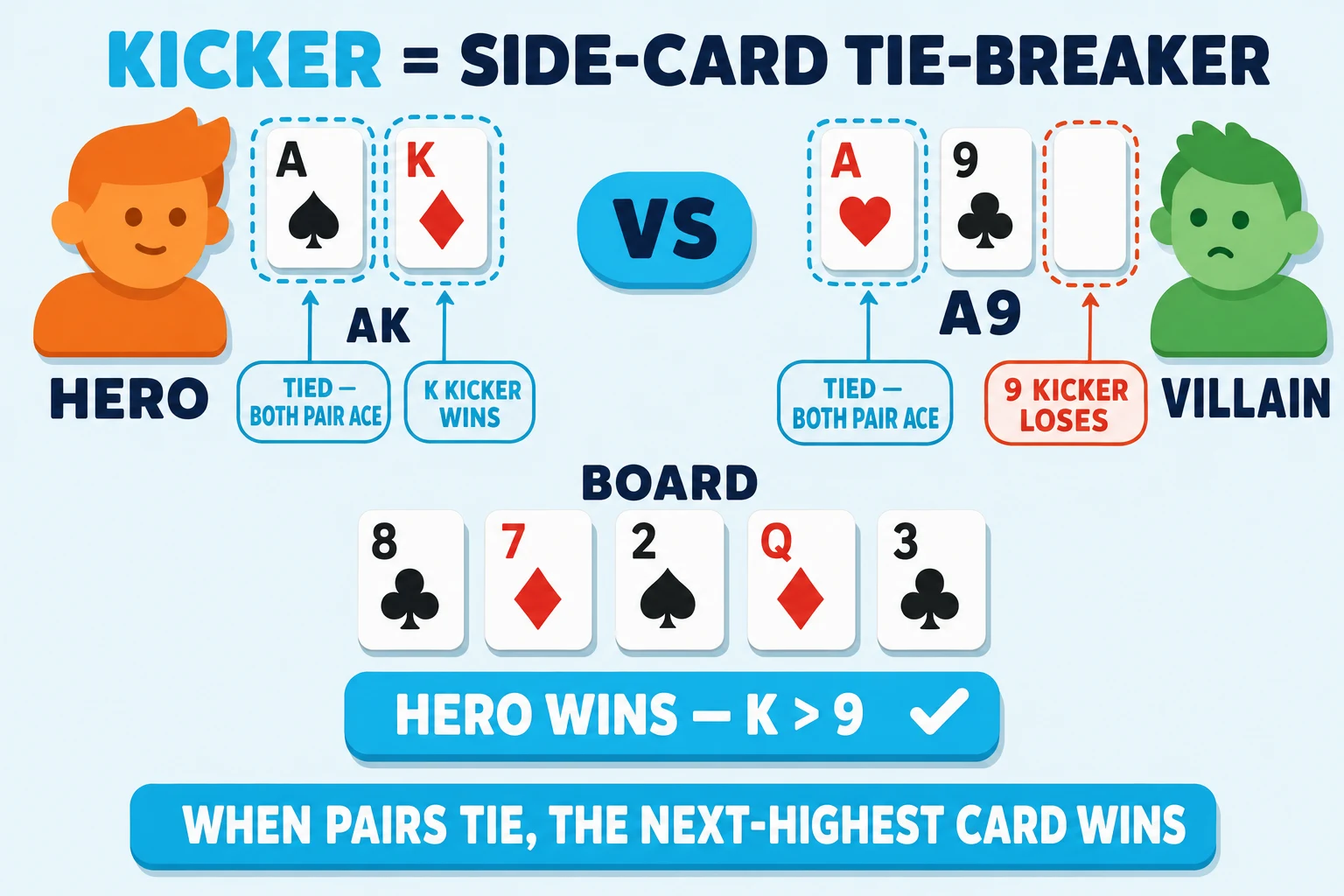
Simple example: AK vs A9 on an unhelpful board
Hero A♠K♦ versus Villain A♥9♣ on 8♣ 7♦ 2♠ Q♦ 3♣. No ace, king, or nine hits the board, so both have ace-high. Hero’s king kicker beats Villain’s nine, so Hero wins. This is being outkicked: you have a strong top card but lose because your second card is weaker.
Choosing starting hands with kicker awareness
- Favor high-kicker Ax hands (Ace plus another card). Hands like A K and A Q dominate weaker aces and reduce being outkicked.
- Pocket pairs rely less on kickers preflop because the pair is already made. Still watch for overcards on the board that can pair opponents and give them better kickers.
- Consider playability: suited or connected kickers add flush and straight potential. Low isolated kickers (for example A2 offsuit) offer limited post-flop options and mainly rely on showdown value.
Post-flop decisions: betting, calling, and folding based on kickers
Top pair with the top kicker is a pure value situation: bet to extract calls from worse kickers. For example, K♠Q♣ on K♦ 8♣ 2♠ should get value from K-J and K-9. Top pair with a weak kicker needs more caution: check-call or small bets are common because big bets often mean a better kicker or a stronger hand. Against heavy action, evaluate if your kicker is likely dominated; fold marginal kicker hands versus aggressive, tight opponents. Weak kickers often work only as bluff-catchers; avoid bloated pots without improvement.
Range analysis and avoiding kicker trouble
Think in ranges: tight players who play aces tend to have stronger kicker distributions than loose callers. Use that to judge whether your kicker will hold up. Balance your range by including some strong-kicker hands and some weaker ones to stay unpredictable. Use blockers and bet sizing to charge hands that depend on weak kickers and to protect yourself when opponents can dominate you.
For when the kicker decides a pot and when the hand never gets that far, see what beats what in poker.
Quick checklist
- Before calling big bets ask: “If we both have the same pair, does my second card beat theirs?”
- Favor high-kicker Ax hands preflop; treat low kickers as bluff-catchers post-flop.
- On heavy action, fold marginal kicker hands unless board texture and reads justify a call.