


Royal Flush
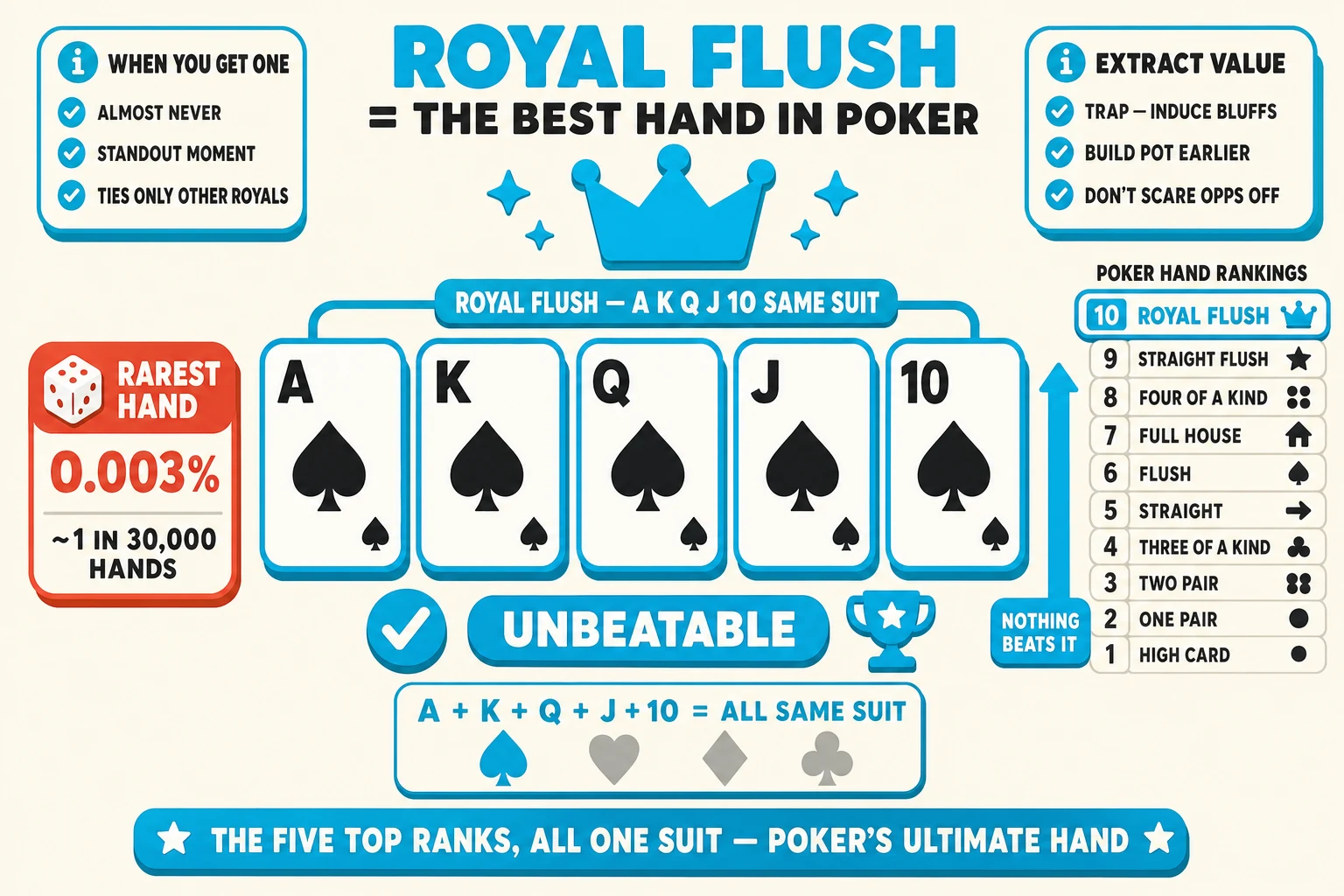
The five-card combination A-K-Q-J-10, all of one suit. The highest-ranking hand in standard poker. It cannot be beaten at showdown; when the board holds a royal flush, everyone still in chops.

Practice this in Poker Skill. A royal in hearts dealt entirely to the board closes the Winners in Context capstone, and every hand ties by playing it.
Get the free appTwo Hold’em players can only share a royal flush when all five of its cards are on the board.
Royal flush
What a royal flush is
A royal flush is A-K-Q-J-10, all of one suit (for example A♠ K♠ Q♠ J♠ 10♠). It is the highest possible flush in poker and the top of the hand-rankings chart in Texas Hold’em and the other common variants. Nothing beats it at showdown. Poker Skill teaches it as the highest straight flush in its Straight Flush & Royal lesson, right after K♠ Q♠ J♠ 10♠ 9♠, the straight flush one rank below.
For the full odds math and how royals actually arrive, see royal flush odds. For the full order of hands and tie-break examples, see the poker hand rankings chart.
How rare a royal flush is
A royal flush shows up roughly once in 30,940 seven-card Hold’em deals, or about 0.0032% of the time. Most recreational players go years between sightings. When one lands, it usually becomes the table’s story for the night.
What a royal flush actually does to a pot
Because it cannot be beaten, the question stops being “do I win?” and becomes “how much do I get paid?” Strong second-best hands still lose to it: an opponent whose pocket Queens fill up to a full house on a Q♠ J♠ 10♠ board pays off your A♠ K♠ for stacks if the betting goes that way. In No-Limit Hold’em the payoff is whatever you can pry out of villain’s range, which is usually a lot when the board makes other big hands.
How to play it for value
Two competing instincts to balance: don’t scare opponents into folding, and don’t slow-play so passively that you miss bets villain would have called. Some practical points:
- Read the table first. Aggressive opponents often bet for you if you check; calling stations want a clear price. Don’t apply the same line to both.
- On the river, a check often induces a bluff from a missed draw or a thin value bet from a decent made hand. A small lead can do the same against a passive opponent who folds to anything bigger.
- If the royal completes on the turn and stacks are deep, start building the pot then. River-only value is often capped by the size you can realistically bet without telegraphing strength.
- With short stacks, the right play is usually to keep firing and get all-in. With deep stacks, slowing down for one street to let villain bet often pays better than three-streeting yourself out of action.
If the royal completes on the river and villain bets, a smooth call or a smaller raise often converts their confidence into a bigger pot than a snap shove would.
Cultural and strategic significance
The royal flush is the picture-on-the-poster hand. It headlines highlight reels and gets pinned to the casino wall. Strategically, the lesson it carries is the same one that applies to every nut hand: rarity does not extract chips on its own. Reads, sizing, and patience do.
Compare all ten poker hand rankings, best to worst to see where a royal flush sits.
For the royal against quad aces and the rest of the matchups, see what beats what in poker.
Quick checklist
- Five-card composition: A K Q J 10, all the same suit.
- Unbeatable. If the board is a royal flush, everyone still in chops.
- Frequency: about 1 in 30,940 seven-card hands.
- When you make one, the question is sizing, not whether you’re ahead.