


Rule of 2 and 4
Use the Rule of 2 and 4 to estimate draw equity from outs on the flop and turn. Includes a cheat sheet plus worked examples.

Practice this in Poker Skill. The Outs II lesson has you turn outs into chances: A♠ Q♠ on 10♠ 6♣ 2♠ holds nine clean spades, about 35% to hit by the river and about 19% on the turn card alone.
Get the free appRule of 2 and 4 (poker): quick definition
The Rule of 2 and 4 is a fast way to estimate your chance of improving a draw using outs:
- On the flop (two cards to come):
outs × 4 ≈ %to improve by the river - On the turn (one card to come):
outs × 2 ≈ %to improve on the river
It’s not exact math, but it’s close enough for most in‑game decisions.
Caveat: the flop version estimates your chance by the river — it doesn’t guarantee you’ll get to see both cards for the price of one call.
For the longer cheat sheet with worked hands and the spots where the shortcut lies, read The Rule of 2 and 4: estimate poker equity in your head. The printable poker odds chart puts the exact numbers next to the shortcut, out to twenty outs, if you want to see where the two drift apart.
First step is always the same: count your outs correctly.
Step 1: Count your outs (the right way)
Outs are the unseen cards that make the hand you’re drawing to.
Two common mistakes:
- Double-counting (a card that completes two things still counts as one out)
- Counting dirty outs (cards that “improve you” but can still leave you losing)
If you want a refresher, see: Outs.
Step 2: Use the Rule (flop vs turn)
On the flop (Rule of 4)
Two cards left (turn + river):
- Approx % to hit by river ≈
outs × 4
Example: a flush draw is usually 9 outs → 9 × 4 = 36% by the river.
On the turn (Rule of 2)
One card left (river):
- Approx % to hit on river ≈
outs × 2
Example: an open‑ended straight draw is usually 8 outs → 8 × 2 = 16% to hit on the river.
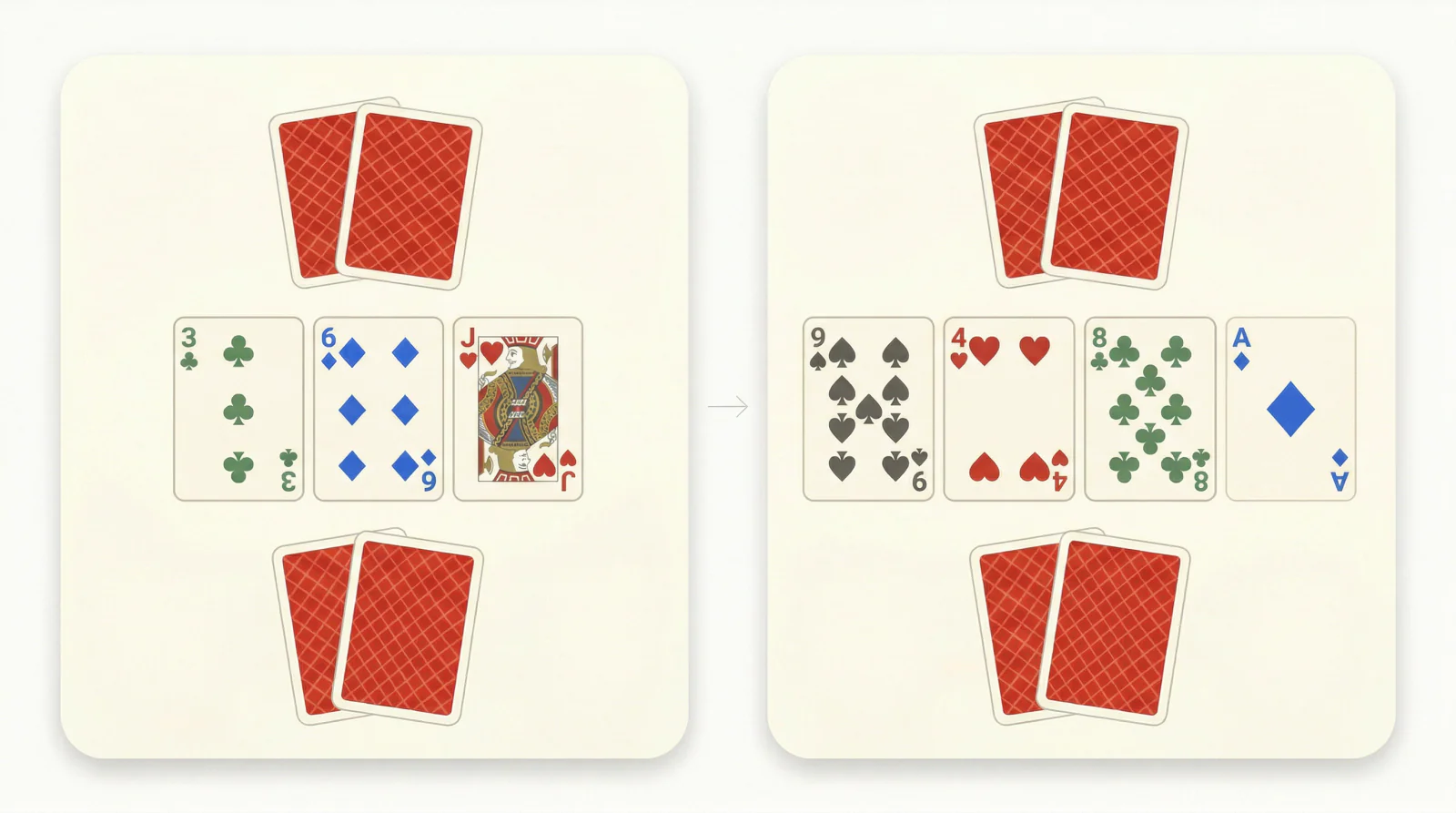
Outs → % cheat sheet (Rule of 4 / Rule of 2)
Use this table as an estimate.
| Outs | Flop: % by river (×4) | Turn: % on river (×2) |
|---|---|---|
| 1 | 4% | 2% |
| 2 | 8% | 4% |
| 3 | 12% | 6% |
| 4 | 16% | 8% |
| 5 | 20% | 10% |
| 6 | 24% | 12% |
| 7 | 28% | 14% |
| 8 | 32% | 16% |
| 9 | 36% | 18% |
| 10 | 40% | 20% |
| 11 | 44% | 22% |
| 12 | 48% | 24% |
| 13 | 52% | 26% |
| 14 | 56% | 28% |
| 15 | 60% | 30% |
| 16 | 64% | 32% |
| 17 | 68% | 34% |
| 18 | 72% | 36% |
| 19 | 76% | 38% |
| 20 | 80% | 40% |
How accurate is the Rule of 2 and 4?
It’s a shortcut, so it’s not perfect.
Quick accuracy table (exact vs shortcut)
These “exact” numbers are the true probabilities from the deck math (not the shortcut):
| Outs | Exact % by river | Rule of 4 | Exact % on river (turn) | Rule of 2 |
|---|---|---|---|---|
| 4 | 16.5% | 16% | 8.7% | 8% |
| 8 | 31.5% | 32% | 17.4% | 16% |
| 9 | 35.0% | 36% | 19.6% | 18% |
| 15 | 54.1% | 60% | 32.6% | 30% |
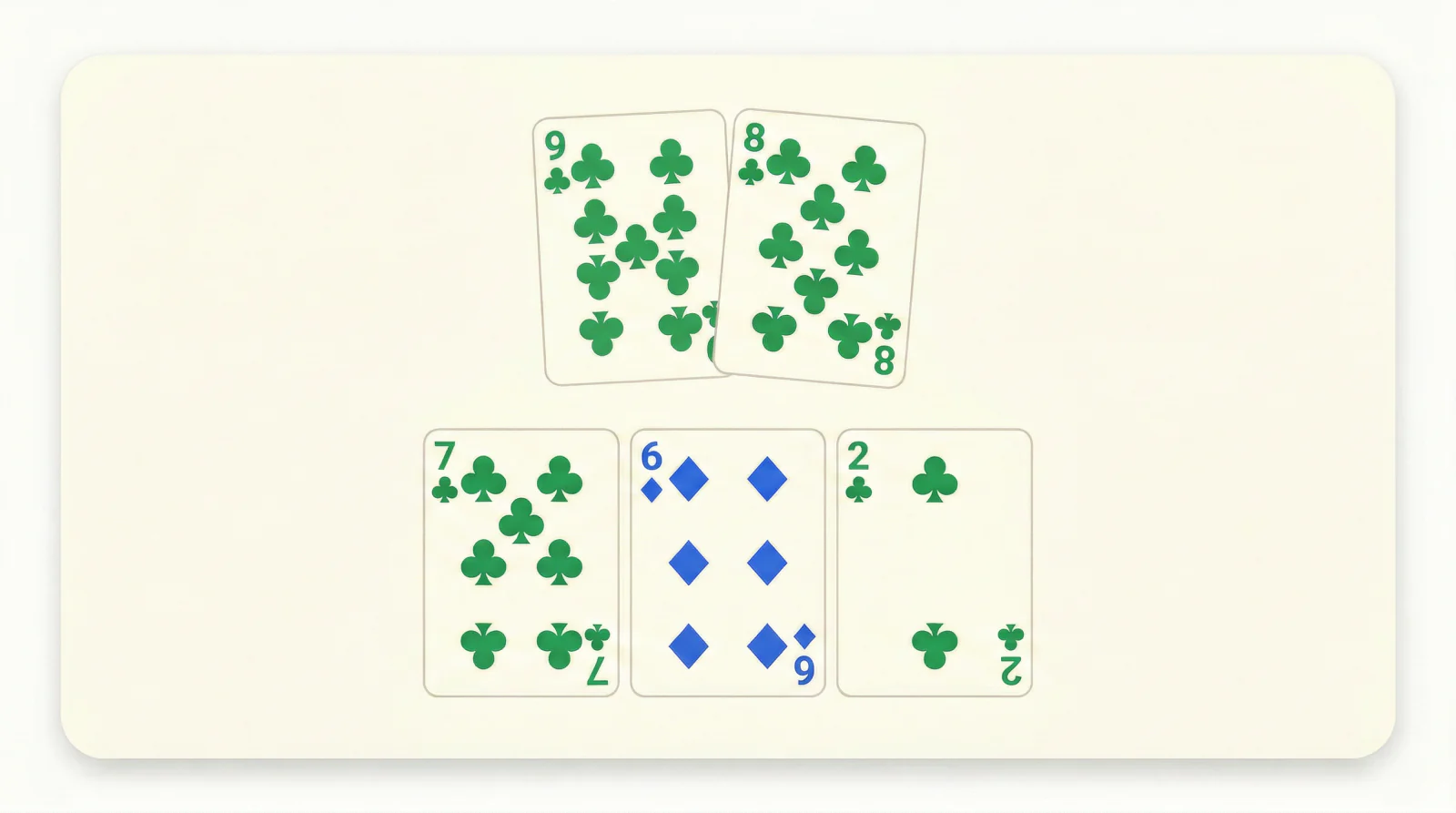
Takeaway: for “normal” draws (8–12 outs), the shortcut is usually close. For big combo draws (10+ outs), the Rule of 4 can start to overestimate. 7♣ 6♣ on 9♣ 8♦ 4♣, a combo draw from Poker Skill’s draw lessons, has nine clubs plus six more fives and tens for 15 outs, where the Rule of 4 says 60% against an exact 54.1%.
Two simple “modified” versions (optional)
If you want a slightly better estimate:
-
Modified Rule of 2 (turn):
outs × 2then add ~10% of that number- Example (9 outs):
18% + 1.8% ≈ 19.8%
- Example (9 outs):
-
Modified Rule of 4 (flop, for 10+ outs):
outs × 3 + 9- Example (15 outs):
15×3 + 9 = 54%(very close to exact 54.1%)
- Example (15 outs):
Worked examples (with decisions)
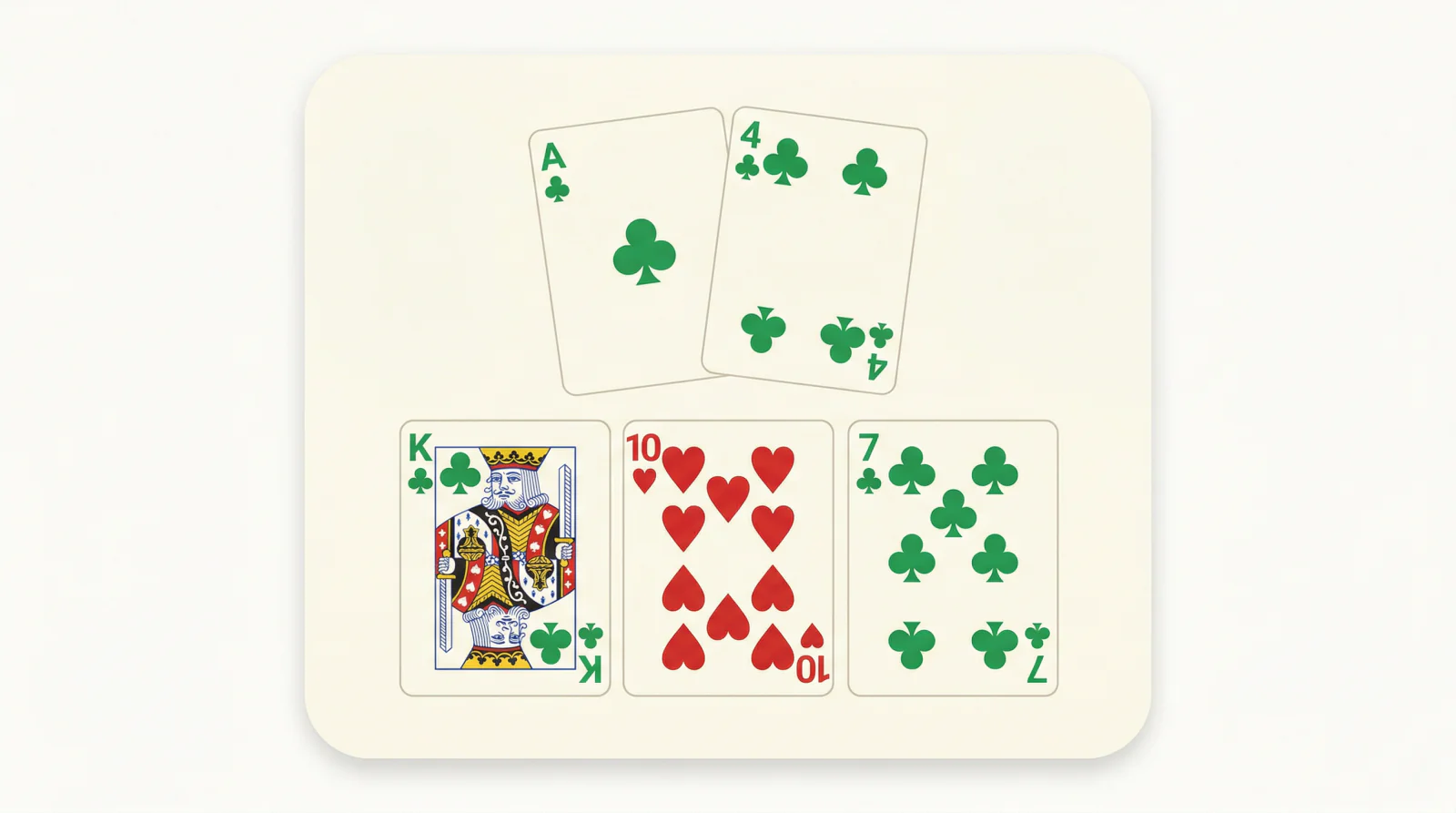
Example 1: Flush draw (9 outs)
Hand: A♣ Q♣
Flop: K♣ 7♣ 2♦
You have a flush draw. Typically:
- Outs = 9 clubs
- Rule of 4:
9 × 4 = 36%to make your flush by the river
So what?
- If the pot is laying you a price that’s clearly better than your odds (and you can win more when you hit), calling can be fine.
- If you can also win by making your opponent fold, betting or raising can be even better.
Related: Pot odds.
Example 2: Open‑ended straight draw (8 outs)
Hand: 8♠ 9♠
Flop: 6♦ 7♥ K♣
You have an open‑ended straight draw (OESD):
- Outs = 8 (any 5 or 10)
- Rule of 4:
8 × 4 = 32%by the river
Related: Open‑ended straight draw.
Example 3: Combo draw (don’t double‑count)
Hand: A♠ J♠
Flop: Q♠ 10♠ 2♦
You have:
- Flush draw = 9 outs (spades)
- Gutshot to Broadway (any K) = 4 outs
But K♠ is already counted in your flush outs.
So your outs are:
- 9 flush outs + 3 non‑spade kings = 12 outs
- Rule of 4:
12 × 4 = 48%by the river
Common mistakes (and how to fix them)
1) Counting dirty outs as clean outs
If you hit your card but still lose (or lose big), that out was dirty.
Dirty outs are common when:
- You’re drawing to a non‑nut flush
- Your straight completes while the board also completes a flush
- You’re up against a set, and the board can pair into a full house
See: Dirty outs.
2) Forgetting pot odds (or implied odds)
The Rule of 2 and 4 tells you “how often you hit,” not whether calling is profitable. To judge the call, compare your estimate to the break-even equity the price implies: clear it and the call profits, miss it and the call loses.
Your decision still depends on:
- Pot odds (what you’re risking vs what you can win now)
- Implied odds (what you can win later when you hit)
- Reverse implied odds (how much you can lose when you hit but are still beat)
Related terms
FAQ
How many outs is a flush draw?
Usually 9 outs (there are 13 cards of a suit; you see 4 of them between your hand and the board).
How many outs is an open‑ended straight draw?
Usually 8 outs (four cards on each end rank).
Is the Rule of 2 and 4 exact?
No. It’s a quick estimate. It’s most reliable for common draws (8–12 outs) and less reliable for very large draws.
What if some outs are “dirty”?
Then you should discount them before you multiply.